Tutor Intelligence, a Watertown, Massachusetts, robotics company that rents out robot workers by the hour, has raised a $75 million Series B led by Andreessen Horowitz (a16z). The Tutor Intelligence Series B, announced November 2, 2026, brings the company’s total funding to $117 million. Union Square Ventures, which led its $34 million Series A in December 2025, and Neo, which led its seed round, also took part.
The pitch is unusual. Tutor doesn’t wait for its robots to be fully autonomous before putting them to work. Remote human operators, which the company calls “tutors,” take over when a robot gets stuck or meets a new task, and every correction becomes training data for Tutor’s own AI models. The company says the money will go into that model training and into building and deploying more of its two robots, Cassie and Sonny.
- The round: $75 million Series B led by a16z, announced November 2, 2026; $117 million raised in total. No valuation was disclosed.
- Price: $14 to $18 per robot-hour for palletizing, or per pick at 10% to 50% below a customer’s current cost per pick, with no long-term contract.
- Status: Cassie robots are in paid production use; Tutor says it is on track for more than 1,000 robots under contract by the end of 2027.
- The catch: remote humans still step in when the robots can’t cope, and Tutor hasn’t said how much of the work is done autonomously.
What Tutor Intelligence sells
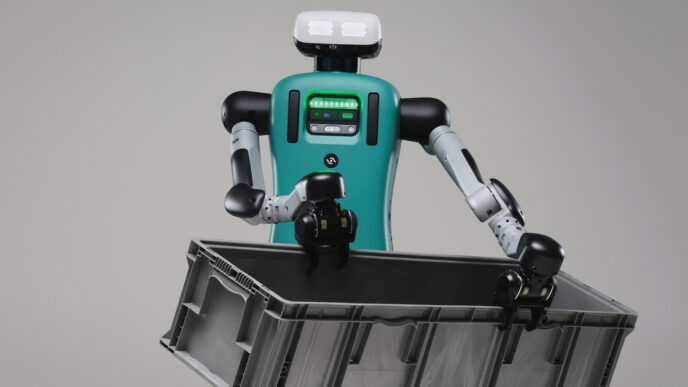
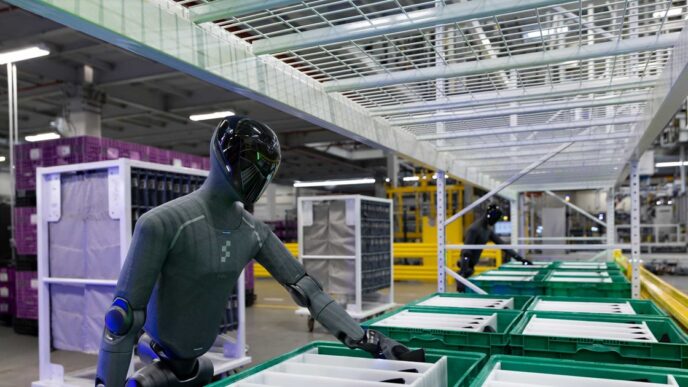
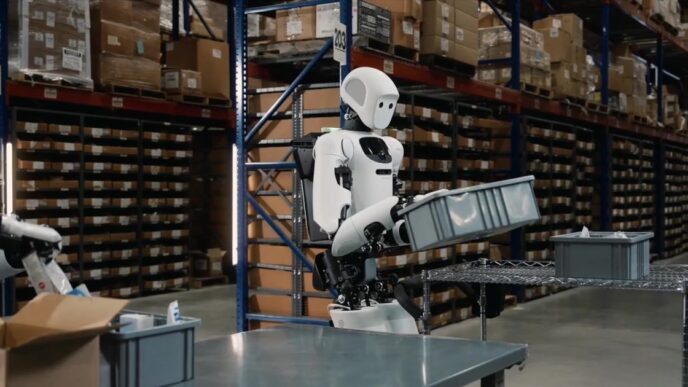
Tutor makes two robots. Cassie is a single-arm mobile robot for heavy, bulky work: stacking cases on pallets, unloading them and picking cases for wholesale orders. Tutor says Cassie has made millions of picks in production and runs its Turing model series, which has 200 million parameters. A second-generation Cassie launched in September 2026 drives itself between workstations on four wheels.
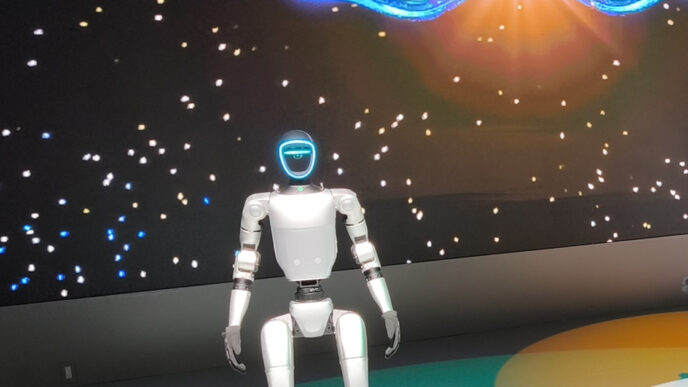
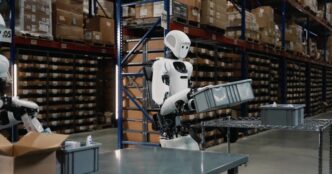
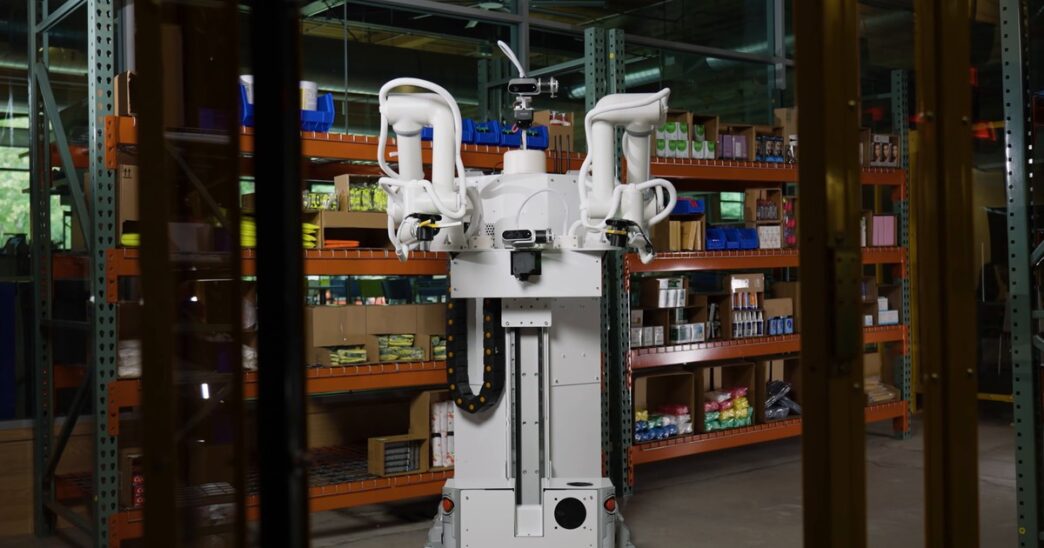
Sonny is what Tutor calls a “semi-humanoid”: two 6-degree-of-freedom arms on a vertical lift, on a wheeled base. Tutor’s spec page lists up to 100 picks an hour, 10 lb per arm, a reach of up to 7 feet, a 12-hour battery and a safety design built around ISO/TS 15066, the technical specification for robots that work near people, plus a LiDAR-enforced safety zone. Sonny runs Ti0, a 4.5-billion-parameter vision-language-action model, and its first job is e-commerce order picking. Tutor hasn’t said how many Sonny robots are working for customers.
Robots by the hour, not by the purchase order
Tutor’s business model is the part customers are most likely to notice. Instead of selling a robot cell for a large upfront sum, it charges like a staffing agency. Its pricing page lists $14 to $18 per robot-hour for palletizing and depalletizing, all-in for support, maintenance and model updates, with a minimum of 80 hours a month. On top of that come a flat $10,000 implementation fee, a refundable $8,000 deposit and $1,000 to $3,500 in freight. Case picking and each picking are priced per pick, which Tutor says will be 10% to 50% below what a pick costs the customer today.
Terms are month to month, and Tutor says customers can also buy Cassie outright with an annual service plan. The company quotes a median of about 40 days from signing to robots in production, and a16z cites implementations as short as 8 hours. If you’re weighing the general trade-off between paying per hour and owning a robot, our guide to robots-as-a-service versus buying sets out the questions to ask.
How the human “tutors” fit in
This is where the claims need the most care. Tutor describes itself as deploying “ahead of autonomy.” Its remote tutors demonstrate tasks and correct mistakes, and that data trains the models that run the fleet. A Tutor blog post from April 2026 says its 100-robot Sonny data factory is “remotely supervised by our international Tutor team” using virtual reality teleoperation. The pricing page says a remote operations team watches every robot around the clock.
In its investment post, a16z says tutors were skillful enough that customers couldn’t tell the difference between work done by employees and work done by tutors. That makes the robots useful from day one. It also means a customer is paying partly for remote human labor routed through a robot, at least at first. Gruenstein writes that the number of tutors should grow more slowly than the fleet as the models improve, but it hasn’t published autonomy rates, intervention counts or how many tutors it employs. Our explainer on teleoperation versus autonomy covers why that disclosure matters, and our guide to robot training data explains why companies want this kind of real-world data.
Tutor Intelligence’s Series B growth claims, and what’s missing
According to the company, twice as many Tutor robots are working in almost four times as many facilities as a year ago, and it is “on track” to have more than 1,000 robots under contract by the end of 2027, all built in and deployed from the US. a16z adds that nearly a third of customers who received Tutor robots in the past 12 months were existing customers adding more. In September, Tutor said its fleet was growing 20% month over month.
Co-founder and CEO Josh Gruenstein went further in a post published with the round. He wrote that in the coming year Tutor “will manufacture a plurality of all industrial robots in the United States, most of which will be Cassies,” and cited 38,000 robots deployed into US businesses in 2025. A plurality means more than any other single maker, not a majority. It’s a forecast, and Tutor didn’t give production figures to back it. The same post estimates that Tutor today performs 0.02 basis points of the economically valuable labor in the US, a frank reminder of how early this is.
The company hasn’t disclosed its current fleet size, revenue or valuation, or named customers in the release. “We can hardly build robots fast enough,” Gruenstein said in the announcement. For a16z, general partner Raghu Raghuram said, “Tutor’s insight is that deployment isn’t just the destination for robotics research. It’s how you overcome its limitations.” Tutor joins a busy year for robotics funding, which we track in our 2026 robotics funding tracker.
What to watch next
Three things will show whether the model scales. First, whether Tutor publishes how much of its robots’ work is autonomous and how that share changes as Ti0 and Turing improve. Second, Sonny’s move from the data factory into paying e-commerce sites, which Tutor hasn’t yet quantified. Third, progress toward the 1,000-robot target and the manufacturing claim, which should become visible in contract announcements over the next year.
Frequently asked questions
How much did Tutor Intelligence raise in its Series B?
Tutor Intelligence raised $75 million in a Series B round led by Andreessen Horowitz, announced November 2, 2026. Union Square Ventures and Neo also participated. The round brings Tutor’s total funding to $117 million. The company did not disclose its valuation.
What robots does Tutor Intelligence make?
Tutor makes Cassie, a single-arm mobile robot for palletizing, depalletizing and case picking, and Sonny, a two-arm “semi-humanoid” on a vertical lift built for picking individual items in e-commerce. Cassie runs Tutor’s Turing models and Sonny runs Ti0, a 4.5-billion-parameter vision-language-action model.
How much does a Tutor robot cost?
Tutor’s pricing page lists $14 to $18 per robot-hour for palletizing and depalletizing, with an 80-hour monthly minimum, a $10,000 implementation fee and a refundable $8,000 deposit. Picking is priced per pick, at 10% to 50% below a customer’s current cost per pick. Terms are month to month, and Cassie can also be bought outright.
Are Tutor’s robots autonomous?
Partly. Tutor deploys robots before they are fully autonomous, and remote human operators called tutors step in to demonstrate tasks and correct errors. That data trains Tutor’s AI models. The company has not published what share of its robots’ work is done autonomously.
Is Sonny a humanoid robot?
Tutor calls Sonny a semi-humanoid. It has two arms with 6 degrees of freedom each and a head with cameras and 3D LiDAR, mounted on a vertical lift and a wheeled base rather than legs. Tutor lists up to 100 picks an hour and a 12-hour battery.
Sources
- Business Wire: “Tutor Intelligence Raises $75 Million Series B Led by Andreessen Horowitz to Scale Frontier Robotics Model Training, Manufacturing and Deployment,” November 2, 2026
- Andreessen Horowitz: “Investing in Tutor Intelligence,” Raghu Raghuram, Martin Casado and Jamie Sullivan, November 2, 2026
- Tutor Intelligence: “Tutor Intelligence and the Next Age of Machines,” Josh Gruenstein
- Tutor Intelligence: usage-based pricing page
- Tutor Intelligence: Sonny product page and specifications
- Tutor Intelligence: “Announcing the next generation of robot workers Cassie and Sonny,” September 16, 2026
- Tutor Intelligence: “Building a 100-Robot Data Factory Toward Factory-Ready AI,” April 30, 2026
- The Robot Report: “Tutor Intelligence raises Series B to scale model training, robot deployments,” November 2, 2026
All sources accessed November 3, 2026.
Last updated: November 3, 2026. To report an error, see our corrections page. Articles are drafted with AI assistance and reviewed and edited by an editor; see our editorial policy.