
One of the robots drawing the biggest crowds at the Hong Kong Trade Development Council’s electronics show last week spent the event sitting on a sofa in a skirt suit and glittery heels. The robot was UBTech’s companion humanoid, and its global sales director told Nikkei Asia that buyers in China are spending about $20,000 on one for emotional support, while a flagship version with autonomous navigation and more computing power costs $130,000. Those two numbers spread fast. Channelnews ran them on October 19.
The robot is the UWORLD U1, which UBTech launched in Shenzhen on June 30. Its official price list is more precise than the show-floor figures, and it tops out well above $130,000. But the most useful number for anyone weighing a U1 isn’t the price. It’s the gap between the 13,361 orders UBTech announced at launch and the 1,500 to 2,000 units its finance chief now expects to deliver this year.
What each U1 version costs
UBTech sells the U1 in three tiers, and the top tier comes in male and female versions. These are the yuan prices UBTech set at launch, as reported by Southern Finance and 36Kr, converted at the People’s Bank of China’s October 19 reference rate of 6.7208 yuan per dollar.
| Version | What UBTech says it is | Price (yuan) | About (US$) |
|---|---|---|---|
| U1 Lite | Semi-torso (upper body) edition | 119,800 | $17,800 |
| U1 Pro | Full-body standard edition | 169,800 | $25,300 |
| U1 Ultra, female | High-dynamic full-body edition | 880,000 | $130,900 |
| U1 Ultra, male | High-dynamic full-body edition | 990,000 | $147,300 |
The $130,000 flagship the sales director described lines up almost exactly with the female Ultra. The $20,000 figure falls between the Lite and the Pro, so it is best read as a ballpark for the entry models rather than a list price. The male robot stands 183 cm and the female 168 cm, according to the South China Morning Post. Pre-sales opened on Chinese e-commerce platforms on June 2. UBTech has published prices only in yuan, for China.
What UBTech says the robot can do
The pitch is a face and a personality, not a pair of hands. In its launch release, UBTech claims the U1 has 88 degrees of freedom and a “dual-pivot biomimetic cervical spine” that lets it replicate “up to 90% of fundamental human movements.” It says the robot runs an emotion-aware large language model that recognizes more than 20 emotional states with better than 90% accuracy, answers in about 500 milliseconds and keeps lip movement within 20 milliseconds of its speech. A memory system called Agent Memory OS is meant to let it remember a user over time. These are company claims, and UBTech hasn’t published independent tests of any of them.
Southern Finance’s reporter, who visited UBTech’s Shenzhen showroom on October 13, saw the robots blink, smile and follow visitors with their eyes. A staff member said the expressions are generated by a model in real time and drive small servo motors in the face, rather than playing back a few fixed expressions. UBTech vice president Jiao Jichao said interaction data stays on the user’s device, and that only updated model parameters are sent back for training.
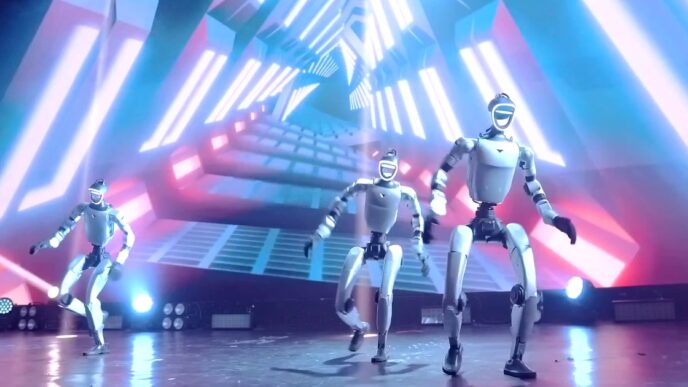
Nikkei’s reporter was less impressed. Up close, the reporter wrote, the silicone skin on the arms and legs gave the robot away, and called it “a doll with a chatbot” because it couldn’t dance like other robots on the floor.
What the price leaves out
The biggest omission is household work. The U1 is sold for companionship and conversation, and Chinese financial outlet Dama Caijing, in a report republished by 36Kr, says it currently can’t do housework. Jiao himself told Southern Finance that becoming a true household helper still “faces many challenges.”
Then there is the wait. At launch, CEO James Zhou said omnichannel orders had passed 13,361 units, and UBTech said first deliveries would start on September 16, with the aim of filling all domestic orders within the year, according to the 36Kr report. On UBTech’s August earnings call, CFO Zhang Ju cut the 2026 delivery target to 1,500 to 2,000 units, as eefocus and China AI Dispatch reported. If that guidance holds, at most about 15% of the announced orders get filled this year.
The timing has been messy too. In late September, Chinese media reported that UWORLD’s cross-border e-commerce store had told customers the first deliveries had moved to November 30. UBTech called those reports inaccurate and said U1 deliveries had started and were going out in batches in reservation order. On October 13, Jiao said small batches reached end customers in September and that factory capacity is ramping up. The 36Kr report also notes that, according to UBTech’s Douyin account, some of the first U1 units went on display at business customers, including two large car dealer groups and a robot park in South Korea.
The head is the hard part. Southern Finance reported that packing dozens of miniature servos into the face, with tight demands on heat and skin stretch, is the core engineering challenge, and that UBTech still needs to lower the price and improve how well the robot generalizes before more people will buy one.
Japan is not imminent either. The sales director told Nikkei that Japan could become UBTech’s biggest market but that certification is still pending. On October 16, Tokyo-listed Bitcoin Japan disclosed an exclusive deal to sell UBTech robots in Japan. The six models it lists are the Walker S2, Walker Tienkung, Tienkung Dex, Sky Walker, Walker C1 and Cruzr S2. The U1 isn’t among them.
One more detail deserves attention. UBTech says it will donate 100 customized U1 robots this year that use 3D facial reconstruction and voiceprint replication “to recreate designated individuals” for people who need emotional support. The release does not say how consent from the person being recreated is handled. Four days after the launch, two Chinese industry groups issued an initiative calling for safety and ethics rules across the design, advertising and use of emotional companion humanoids, according to the 36Kr report.
Why UBTech is betting on companionship
UBTech’s money still comes from factories. Its full-size humanoids for industrial use brought in about 590 million yuan in the first half of 2026, or 46.5% of total revenue of 1.27 billion yuan, which was up 104.2% from a year earlier. The company lost 339 million yuan over the same period, and its Hong Kong shares closed at HK$73.70 on September 28, about half their February high of HK$156.40. UBTech’s chief brand officer, Michael Tam, who runs UWORLD, has called companion robots a potential new consumer category, citing projections that China’s market for lifelike humanoids could grow to the trillion-yuan level by 2036. That is a projection the company chose to quote, not a forecast it has backed with sales.
The next test is the cheaper U1 “youth edition” Jiao says will arrive in the fourth quarter. UBTech hasn’t given its price or specs. If it lands close to the $20,000 the sales director quoted in Hong Kong and ships on time, the order book starts to look real. If deliveries stay near 2,000 a year, most of those 13,361 buyers are still waiting in 2027.
Frequently asked questions
How much does the UBTech U1 cost?
UBTech’s launch prices in China are 119,800 yuan for the U1 Lite (about $17,800), 169,800 yuan for the U1 Pro (about $25,300), and 880,000 or 990,000 yuan for the female or male U1 Ultra (about $130,900 or $147,300), at the October 19 central bank rate.
Is the UBTech U1 shipping yet?
UBTech says small batches reached end customers in September and that production is ramping. Its CFO expects 1,500 to 2,000 deliveries in 2026, against more than 13,361 orders announced at launch.
Can the UBTech U1 do housework?
No. It is sold as an emotional companion that talks, makes facial expressions and remembers users. Reports say it currently can’t do household chores, and UBTech’s own vice president says becoming a household helper still faces many challenges.
Can you buy a UBTech U1 outside China?
Not yet through any announced channel. UBTech has published prices only in yuan. Its sales director told Nikkei Asia that Japan could become its biggest market but that certification is still needed, and Bitcoin Japan’s October 16 distribution deal does not include the U1.
What is the U1 youth edition?
It is a lower-cost U1 model that UBTech vice president Jiao Jichao says is planned for the fourth quarter of 2026, designed to cut cost without affecting core functions. UBTech has not announced its price or specifications.
Sources
- UBTech, “UBTECH Launches UWORLD U1, the World’s First Full-Size Mass-Produced Ultra-Bionic Humanoid Robot,” PR Newswire, July 1, 2026 (launch, tiers, 13,361 orders, company technical claims, donation plan; source of the featured image): prnewswire.com
- Nikkei Asia, “Robot dolls, chip shortages and Apple’s soft sales,” October 16, 2026 (Hong Kong fair visit, $20,000 and $130,000 figures, buyer mix, Japan certification): asia.nikkei.com
- Channelnews, “UBTech’s $20,000 Humanoid Companion Robot Showcases Push Into Emotional Support Market,” October 19, 2026: channelnews.com.au
- Southern Finance (21jingji), Zheng Kangxi, “优必选U1机器人已小批量交付,四季度拟推’青春版’,” October 14, 2026 (September deliveries, youth edition, prices, face engineering, local data, H1 revenue): 21jingji.com
- Dama Caijing via 36Kr, “UBTECH U1 Caught in Delivery ‘Rashomon’ Controversy,” September 29, 2026 (delivery dispute, CFO guidance, housework, early business displays, H1 industrial revenue and loss, share price, industry initiative): 36kr.com
- eefocus, “From 10,000 Units to 1,500–2,000 Units: What Does UBTECH’s Revised U1 Guidance Mean,” 2026: global.eefocus.com
- China AI Dispatch, “UBTech Took 13,000 Robot Orders and Now Expects to Fill 2,000 of Them,” September 2026: chinaaidispatch.substack.com
- South China Morning Post, “UBTech’s lifelike humanoid robots built for companionship arriving in homes across China,” July 1, 2026 (heights, price range): scmp.com
- Bitcoin Japan, timely disclosure on the UBTech exclusive distribution agreement (product list, Walker C1 certification start), October 16, 2026: bitcoin.co.jp (PDF)
- China News Service, People’s Bank of China central parity rate of 6.7208 yuan per dollar, October 19, 2026: chinanews.com.cn
All sources accessed October 19, 2026.
Related: Humanoid robot prices in 2026 · Humanoid robots for home use · What humanoid production numbers really count · Demo, pilot or commercial? How to read humanoid claims · Robot companies directory
Last updated: October 19, 2026. To report an error, see our corrections page. Articles are drafted with AI assistance and reviewed and edited by an editor; see our editorial policy.