On October 1, 2026, Boston Dynamics published a blog post showing a new hand for its electric Atlas humanoid: four fingers, 13 degrees of freedom, tactile sensing on the fingertips and palm, and no pinky. The company framed it as a hand built for manipulation, not just grasping, and positioned tool use as the top application. This article lays out what Boston Dynamics actually said, which statements are company claims, what the company did not disclose, and how the hand fits into Atlas’s current status at Hyundai. It does not include any price, because none is public.
What Boston Dynamics announced
According to the company’s post, the new Atlas hand:
- has four fingers, including an opposable thumb, for 13 degrees of freedom (DOF): four in the thumb and three in each of the other three fingers, which allows fingers to splay;
- is directly actuated using a single type of actuator, with encapsulated actuators and no fragile cables running across joints;
- is about the size of a large human hand;
- has dense pressure-based tactile sensors on the fingertips and palm;
- uses backdrivable (transparent) actuation, so the hand can sense forces through its joints; and
- was designed with simulation-to-real reinforcement learning in mind. The company says initial results show promising sim-to-real transfer in dynamic tasks.
The post says the previous Atlas hand had seven DOF and was “designed to grasp,” while the new generation is “designed to manipulate.” The company describes the new hand as having similar strength to the old one, “capable of carrying a 100lb+ loaded minifridge.”
Old hand versus new hand
| Feature | Previous Atlas hand | New Atlas hand (Oct 1, 2026) |
|---|---|---|
| Degrees of freedom | 7 (company figure) | 13: thumb 4, three fingers at 3 each |
| Fingers | Not detailed in the post | Four, including an opposable thumb |
| Design aim | Grasping | Manipulation, especially tool use |
| Tactile sensing | Not detailed in the post | Pressure sensors on fingertips and palm |
| Strength | Baseline | “Similar” to previous; loaded-minifridge claim of 100 lb+ |
| Actuators | Not detailed in the post | One actuator type, encapsulated, directly driven |
| Weight, fingertip force, cycle life, cost | Not publicly confirmed | |
The design argument: why no pinky
The most notable choice is the missing fifth finger. Boston Dynamics says a pinky would need three more actuators, adding cost, volume and failure probability, and that the benefit was not worth it. It describes CTO Zack Jackowski’s experiment of taping a pinky down during tasks to see how much it mattered. The Robot Report, which covered the announcement the same day, quotes Boston Dynamics’ Alberto Rodriguez on the engineering trade-offs. IEEE Spectrum quotes him as saying that hands are “a ruthless design trade-off,” and reports that the company is working out what would need to change if it wants to make 100,000 of these hands a year. Spectrum’s Evan Ackerman also notes the design looks less humanlike than other humanoid hands and says each actuator pack is a single replaceable unit. Those are reporter observations and company explanations, not independent test results.
The logic is consistent with the company’s emphasis on industrial work. A hand that is robust, simple and cheap to repair may be more useful in a factory than a hand with more joints that breaks more often. Whether that is true for Atlas is a testable claim; the company has not yet published reliability data.
What the hand is meant to do
The post lists capabilities the new hand supports: sliding the thumb along the fingers, precise pinch grasps, tripod grasps, and grasping triggered tools such as drills, power torque drivers, grinders, nail guns and welding torches. These are described as design capabilities. The post does not provide a tool-use benchmark, success rates or video evidence of continuous autonomous operation with the new hand. Where the post shows results, treat them as company-selected demonstrations.
The post also says tactile sensing and backdrivable joints help with proprioception, meaning the hand can feel contact and forces. That matters because dexterous manipulation is often a perception and control problem as much as a mechanical one. For how models turn camera input into hand actions, see What is a vision-language-action model? For how to judge control claims in a demo, see our guide to teleoperation versus autonomy.
What Boston Dynamics has not disclosed
| Question | Status |
|---|---|
| Which Atlas units will ship with the new hand, and when | Not publicly confirmed |
| Whether Atlas units at Hyundai’s training center use it | Not publicly confirmed |
| Hand mass and grip-force specification | Not publicly disclosed; only the “100lb+ minifridge” claim |
| Fingertip force and tactile sensor specs | Not publicly disclosed |
| Durability, cycle life, mean time between failures | Not publicly disclosed |
| Cost per hand | Not publicly disclosed; the company calls the hand a long-term bet toward low-cost mass manufacturing |
| Whether Atlas’s published 56 degrees of freedom includes the new hand | Not publicly confirmed |
| Independent test of tool use | None found |
Where Atlas stands today
Hand news is easier to judge once you separate the company’s claims from deployment evidence.
| Evidence tier | What is published | Source type |
|---|---|---|
| Product specifications | Height 1.9 m (6.2 ft), mass 90 kg (198 lb), 56 degrees of freedom; payload 50 kg instantaneous, 30 kg sustained, 20 kg one-handed; reach 2.3 m; battery runtime about 4 hours (2 hours for heavy lifting), swappable in about 3 minutes; IP67; tactile fingers and palm; modes: autonomous, VR teleoperated, tablet | Boston Dynamics spec sheet (company) |
| First customer and plans | Hyundai named as first customer; the company said in January 2026 that a fleet was scheduled to ship to Hyundai’s Robotics Metaplant Application Center (RMAC) in 2026, and that it was starting to work with select customers to evaluate Atlas | Boston Dynamics blog (company) |
| Training in progress | On Sept 21, 2026, Boston Dynamics said Atlas is “now in training” at RMAC near Savannah, Georgia, on parts logistics and sequencing tasks, and that the center moves to a building about ten times larger next year | Company press release |
| Future production tasks | Component assembly applications targeted by 2030; Hyundai Group has plans for 25,000 units over the next few years and for a US facility producing 30,000 robots a year | Company release; these are plans |
| Commercial deployment | No confirmed revenue deployment doing production work reported by the company or customer | Not publicly confirmed |
Even the company’s own boilerplate in the September release calls Atlas its “electric humanoid platform currently in development.” That is useful context when reading the hand announcement: the hand is a hardware milestone, not a deployment milestone. For a broader comparison, see our ranking of the best humanoid robots in 2026, which uses the same evidence tiers.
How it compares with other published hand specs
Degrees of freedom are a rough measure. Vendors count differently, and some figures include wrist or palm joints. Treat this as a published-specs snapshot, not a ranking.
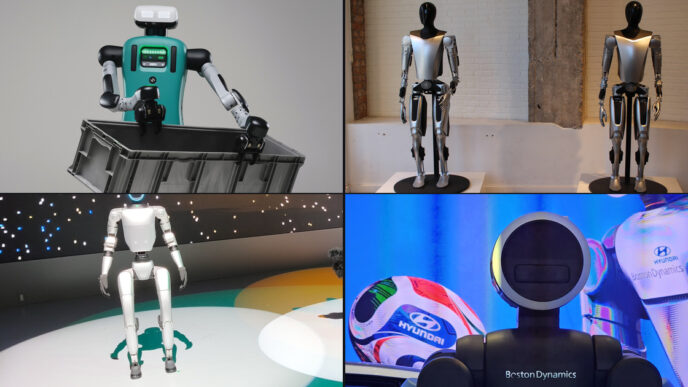
| Robot | Hand information published by the maker |
|---|---|
| Boston Dynamics Atlas (new hand) | Four fingers, 13 DOF, tactile fingertips and palm |
| Figure 03 | Hands with fingertip tactile sensors that Figure says detect about 3 g, and a camera in each palm; DOF count not found on Figure’s pages |
| 1X NEO | 22 DOF per hand; hands rated IP68 on the product page |
| Unitree G1 EDU (optional) | Dex3-1 three-fingered force-controlled hand, 7 DOF |
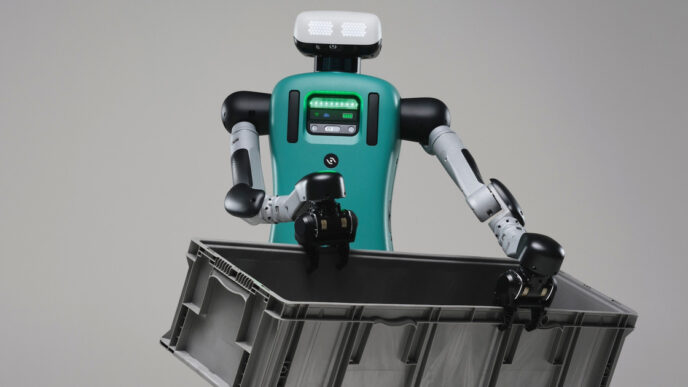
| Agility Digit 5 | Uses end-of-arm tooling interfaces (ISO flanges) rather than a general dexterous hand, per our Digit 5 article |
| Tesla Optimus | Current hand specifications not publicly disclosed; see Optimus status |
What to watch next
- Whether Boston Dynamics publishes a spec sheet update with hand mass, force and sensor details.
- Whether RMAC or Hyundai plant footage shows Atlas using the hand on real parts.
- Whether Boston Dynamics releases reliability data, such as cycles to failure or hours between repairs.
- Whether the company offers the hand to research customers.
Frequently asked questions
How many fingers and degrees of freedom does the new Atlas hand have?
Boston Dynamics says the new hand has four fingers, including an opposable thumb, and 13 degrees of freedom. The thumb has four and each of the other three fingers has three. The company says the previous Atlas hand had seven degrees of freedom.
Why does the new Atlas hand have no pinky?
Boston Dynamics says a pinky would add three more actuators, which means more cost, volume and chances to fail, and that its team judged the finger not worth that trade for the tasks it targets.
Can the new hand carry heavy loads?
The company says the hand has similar strength to the previous one and is capable of carrying a loaded minifridge of more than 100 lb. That is a company claim; Boston Dynamics did not publish grip-force or cycle-life test data.
Will Atlas robots at Hyundai’s plant use the new hand?
Not publicly confirmed. Boston Dynamics has not said which hand the Atlas units in training at Hyundai’s Robotics Metaplant Application Center use, or when production units will ship with the new hand.
How much does Atlas cost?
Not publicly disclosed. Boston Dynamics has published specifications for the Atlas product but no price.
Related reading
- Best humanoid robots in 2026
- What is a humanoid robot?
- What is a vision-language-action model?
- Teleoperation vs autonomy: how to read humanoid robot demos
Sources
All accessed October 4, 2026.
- Boston Dynamics, “Robot Hands for Modern AI and Real Work” (Oct 1, 2026): bostondynamics.com
- Boston Dynamics, Atlas spec sheet (Jan 2026): bostondynamics.com (PDF)
- Boston Dynamics, “Enterprise Robotics Redefined” (Jan 5, 2026): bostondynamics.com
- Boston Dynamics, “Boston Dynamics Opens Robotics Metaplant Application Center to Train Humanoid Robots for Manufacturing Tasks” (Sep 21, 2026): bostondynamics.com
- Figure AI, “Introducing Figure 03” (Oct 9, 2025): figure.ai
- 1X, NEO product page: 1x.tech/neo
- Unitree, G1 product page: unitree.com/g1
- The Robot Report, “Boston Dynamics drops pinkie on new humanoid hand” (Oct 1, 2026) (secondary): therobotreport.com
- IEEE Spectrum, Evan Ackerman, “A Robust Robot Hand Engineered for Mass Production” (Oct 1, 2026) (secondary): spectrum.ieee.org
Last updated: October 4, 2026. To report an error, see our corrections page. Articles are drafted with AI assistance and reviewed and edited by an editor; see our editorial policy.