On July 28, 2026, the Federal Communications Commission added “foreign-produced advanced robotic devices” to its Covered List, a national-security list of equipment that cannot receive new FCC equipment authorization. The category is defined to include humanoid robots, quadrupeds and autonomous mobile robots. In plain terms: new foreign-produced robot models generally cannot get the FCC authorization they need to be imported, marketed or sold in the United States, unless the Department of War grants a Conditional Approval. Robots people already own, and models the FCC already authorized, are not affected in the way many headlines suggested.
This guide separates what the FCC has published, what companies say, and what nobody has confirmed. It is a plain-English explainer, not legal advice. If you are importing robots commercially, talk to a trade or FCC compliance lawyer.
The short version
- Confirmed by the FCC: the listing took effect July 28, 2026; it applies to new models; previously authorized models may still be imported and sold; owners may keep using what they bought; federal government purchases are exempt.
- Confirmed by the FCC: “foreign-produced” is a product test, not a nationality test. The maker’s country does not matter.
- Company statement, not independently verified: Unitree says its main current humanoids and quadrupeds were authorized before the rule.
- Not publicly confirmed: the FCC status or domestic-content level of most other humanoids, including those from US companies.
Timeline
| Date (2026 unless noted) | Event |
|---|---|
| Dec 22, 2025 | FCC adds foreign-produced drones (UAS) and critical components to the Covered List (earlier category-wide listing) |
| Mar 23 | FCC adds foreign-produced consumer routers |
| Jul 27 | A White House-convened interagency body sends the FCC two National Security Determinations, one on robots and one on power inverters |
| Jul 28 | FCC Public Safety and Homeland Security Bureau adds foreign-produced advanced robotic devices and power inverters (DA 26-786); the same day, the Office of Engineering and Technology waives a rule so authorized robots can keep getting software updates (DA 26-789) |
| Aug 20 | The inverter entry is revised. The robot entry is unchanged by this update |
| Sep 9 | First robot Conditional Approvals appear: four Husqvarna “IQ” robotic platforms |
| Sep 18 | Conditional Approval for ANSCER Robotics AR250, AR650 and AR1250 platforms |
| Oct 2 | Conditional Approval for a Matic robotic floor cleaner and dock; FCC FAQ page updated |
What counts as an “advanced robotic device”
The FCC follows the definition in the national security determination. A device is covered if it is a mechanical mobile device (the text names autonomous mobile robots, humanoid robots and quadrupeds) that:
- is capable of locomotion, obstacle avoidance, navigation or movement on the ground;
- operates at a distance from a human operator or supervisor, on commands or in response to sensor data;
- weighs more than 4.4 lb (the weight of the device plus any dock or ground station); and
- contains a sensor that can perceive its environment, a component with network connectivity of at least 200 kbps, and software (including firmware and AI model weights) that controls navigation, movement perception, data collection or remote command and control.
Excluded categories include connected vehicles, rail vehicles, drones, underwater vehicles, medical devices regulated under section 513 of the Food, Drug, and Cosmetic Act (including wheelchairs and surgical instruments), and fixed, stationary robots such as industrial arms. The FCC FAQ adds that automated guided vehicles may be covered even if they follow set paths, and that a bare mechanical platform with no compute, sensors or radios is not covered until such parts are added.
What counts as “foreign-produced”
The FCC ties the term to the US “domestic end product” definition in procurement rules (48 CFR 25.101(a)). A product is not foreign-produced only if it is manufactured in the United States and the cost of its domestic components exceeds 65 percent for items delivered in 2024 through 2028 (75 percent from 2029). Off-the-shelf components still count toward the calculation. The FAQ states that the nationality of the producing company is not relevant. A robot designed in the US but assembled abroad can be covered, and a US-brand robot assembled in the US with too little domestic content could be too.
Law firm Sidley Austin, in a client analysis, notes this is the first time a Covered List entry has been defined with a trade-law standard, and that the burden shifts to manufacturers to perform and document a component-cost calculation. That is a legal interpretation, not an FCC statement.
What changes for buyers
| Situation | What the FCC says |
|---|---|
| You already own a robot | The Covered List does not restrict continued use of devices lawfully purchased |
| A retailer sells a model the FCC authorized before July 28 | Importing, marketing and selling existing authorized models can continue |
| A maker launches a new foreign-produced model | It cannot receive FCC authorization, so it cannot be imported or sold in the US, unless it gets a Conditional Approval |
| You buy a covered robot abroad and bring it into the US | If it has no FCC authorization, the FAQ’s general answer on operating it in the US is “no” |
| A developer imports a small batch for testing | Allowed under 47 CFR 2.1204(a)(3) if the units are not marketed or sold |
| US federal agencies buy robots | Exempt from the Covered List restrictions |
| Software and firmware updates | An OET waiver lets authorized robots keep receiving updates that mitigate harm to US consumers at least until Jan 1, 2029 |
Which robots are affected? What we can and cannot say
We checked the FCC’s Covered List page, updated October 2, 2026. Its Robotic Devices Conditional Approvals table lists three entries: Husqvarna AB’s 305v IQ, 310v IQ, 420v IQ and 440v IQ platforms (Sep 9), ANSCER Robotics’ AR250, AR650 and AR1250 (Sep 18), and Matic Robots’ floor cleaner Model 4MA0001 with dock 4DK0008 (Oct 2). No humanoid or quadruped is on that list.
| Robot or group | What the sources show | Our label |
|---|---|---|
| Unitree G1, H2, R1 (humanoids); Go2, B2, A2 (quadrupeds) | Unitree’s IPO prospectus, as reported by Global Times on Jul 31, says all six hold FCC authorization and fall inside the category, so continued US sales are unaffected; it warns future models could be barred and that the FCC could revoke or extend restrictions. A third-party FCC ID mirror (fccid.io) shows filings under Unitree’s grantee code 2A5PE, including a G1 user manual under 2A5PE-YUSHU008 and R1 and H2 entries with June 2026 filing dates | Company claim, partly consistent with third-party records. We did not confirm grant dates in the FCC’s own system |
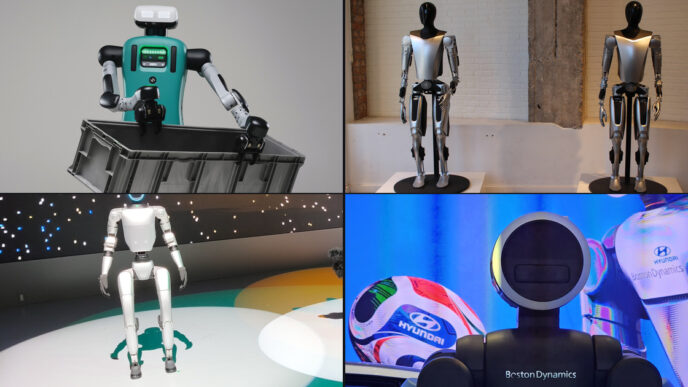
| Atlas, Digit 5, Figure 03, Optimus, NEO, Apollo 2 | We found no maker statement on FCC authorization or domestic-content level | Not publicly confirmed |
For specs and evidence tiers for these robots, see our guide to the best humanoid robots in 2026. Background on what counts as a humanoid is in What is a humanoid robot?
Open questions and risks
- Grandfathering is model-level. Sidley notes a product that was developed or in inventory before July 28 but had not yet received authorization is not grandfathered.
- Existing authorizations could be narrowed. The FCC has a process (47 CFR 2.939(e)) to limit importation and marketing of previously authorized covered equipment after a public notice and at least 30 days of comment. The proposal the FCC published in August under that process concerned drones and certain communications and video-surveillance equipment named in the FY2025 defense authorization act, per the Federal Register notice. We found no such proposal for robots as of October 4, but Unitree’s own prospectus lists the possibility as a risk.
- Conditional Approvals carry conditions. Reporting on the ANSCER approval says it depends on an onshoring plan and can be terminated for non-compliance or false statements. Sidley reports that applications for the robot pathway must be filed by January 1, 2028.
- Hardware changes. The OET waiver covers software and firmware updates, not hardware modifications, according to Sidley’s reading.
- Nobody has published a list of covered humanoids. The FCC identifies the category and exceptions, not individual products.
Buyer checklist
- Ask the seller for the robot’s FCC ID (or Supplier’s Declaration of Conformity details) and the model number it applies to.
- Search the FCC ID in the FCC equipment authorization database and compare the model and the grant date with July 28, 2026.
- If the model launched after July 28, ask whether it has a Conditional Approval or qualifies as a domestic end product, and ask for that in writing.
- Ask how long the maker commits to security and firmware updates, and who handles warranty service if import conditions change.
- Keep invoices and the FCC ID record. Buyers who import for resale or demonstration have different obligations from private owners.
- Do not treat a brand’s origin as a proxy. Check the product.
Frequently asked questions
Is it illegal to own a foreign-made humanoid robot in the United States?
No. The FCC says the Covered List does not restrict the continued use of devices consumers have already bought, and it does not stop the import or sale of models the FCC previously authorized. The restriction applies to new models that need FCC equipment authorization.
Does the rule only target Chinese robots?
The FCC describes the action as country-neutral. ‘Foreign-produced’ means a product that is not a ‘domestic end product’ under US procurement rules, regardless of the maker’s nationality. A US-branded robot can be covered if it is not made in the US with enough domestic components.
Can I still buy a Unitree humanoid in the US?
Unitree has said its G1, H2 and R1 humanoids and three quadrupeds were FCC-authorized before the rule took effect, and the FCC says authorized models may still be imported and sold. That is a company statement; confirm the FCC ID and authorization with the seller before you pay.
What is a Conditional Approval?
It is an exemption route. The Department of War can determine that a specific foreign-produced robot or class of robots does not pose the unacceptable risk, after which the FCC updates the Covered List. As of the FCC page updated Oct 2, 2026, three approvals were listed, none for a humanoid.
Will covered robots still receive software updates?
Yes. An FCC Office of Engineering and Technology waiver (DA 26-789) lets already-authorized covered robots keep receiving software and firmware updates that mitigate harm to US consumers at least until January 1, 2029.
How can I check whether a robot has FCC authorization?
Look for an FCC ID on the label or in the manual and search it in the FCC’s equipment authorization database. Devices authorized through Supplier’s Declaration of Conformity have no FCC ID and are not listed centrally, so ask the importer for the compliance information.
Related reading
- Best humanoid robots in 2026: specs, prices and evidence tiers
- What is a humanoid robot? Definition, types and 2026 examples
- Agility Digit 5: specs, safety design and availability
- Tesla Optimus status, October 2026
Sources
All accessed October 4, 2026 unless noted.
- FCC, “FAQs on Recent Updates to FCC Covered List Regarding Foreign-Produced Advanced Robotic Devices and Power Inverters” (updated Oct 2, 2026): fcc.gov
- FCC Public Safety and Homeland Security Bureau, Public Notice DA 26-786 (Jul 28, 2026): docs.fcc.gov
- FCC, Fact Sheet DOC-423682A1 (Jul 28, 2026): docs.fcc.gov
- FCC Office of Engineering and Technology, DA 26-789, waiver for software and firmware updates (Jul 28, 2026): docs.fcc.gov
- FCC, Covered List and Conditional Approvals tables (updated Oct 2, 2026): fcc.gov/supplychain/coveredlist
- Federal Register, “Comment Sought on Prohibiting the Importation and Marketing of Certain Covered UAS and UAS Critical Components and Equipment Listed in Section 1709 of FY2025 NDAA” (Aug 24, 2026): federalregister.gov
- Sidley Austin LLP, “FCC Adds All Foreign-Produced Advanced Robotic Devices to the Covered List” (Aug 7, 2026), law firm analysis (secondary): sidley.com
- Global Times, “China’s Unitree Robotics flags risks to future US sales under FCC restrictions; barriers can’t erase firm’s competitiveness: expert” (Jul 31, 2026), reporting Unitree’s prospectus (secondary): globaltimes.cn
- Digital Watch Observatory, “FCC exempts ANSCER robots from FCC Covered List” (Sep 18, 2026) (secondary): dig.watch
- FCCID.io, grantee 2A5PE (YuShu Technology Co., Ltd.), third-party mirror of FCC filings (not an FCC site): fccid.io/2A5PE
Last updated: October 4, 2026. To report an error, see our corrections page. Articles are drafted with AI assistance and reviewed and edited by an editor; see our editorial policy. This article is general information, not legal advice.