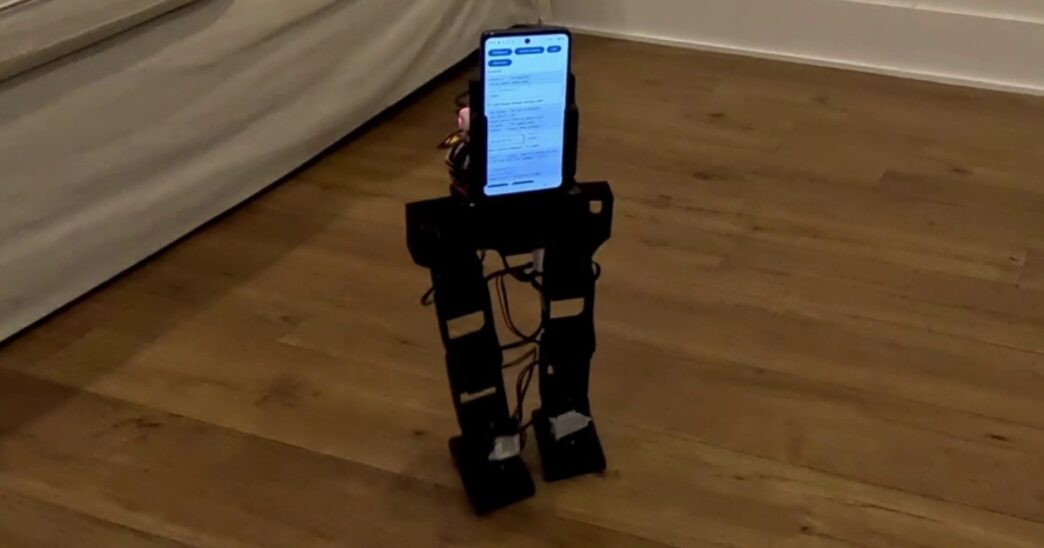
The phone sitting in your drawer could be a robot’s brain. That’s the pitch behind PhoneBot, a small two-legged humanoid from the Robotics and Mechanisms Laboratory (RoMeLa) at UCLA, the lab run by roboticist Dennis Hong. The robot uses an ordinary Android phone as its camera, balance sensor, computer and screen, and the team says everything else costs about $400.
The preprint, by Ruochen Hou, Quanyou Wang, Daniel Koh and Hong, went up on arXiv on October 6, and the idea has been travelling since, with coverage from New Atlas, TechRadar and Digital Trends. Small research humanoids listed in the paper cost $3,500 to $13,800. We went through the paper, the parts list and the project site to see what the $400 actually buys, what it leaves out, and what “open source” means here.
How a phone runs a walking robot
PhoneBot stands 48.3 cm (19 inches) tall and weighs 1.8 kg with the phone mounted. It has 13 joints: six in each leg plus one that twists the torso, so the phone’s camera can turn toward a person without the whole robot turning. All 13 are driven by ROBOTIS DYNAMIXEL XL430-W250-T servos, which the authors call the system’s primary expense at $23.90 each.
The phone does the thinking. An Android app reads the phone’s motion sensor and runs the trained walking policy as a TensorFlow Lite model on the phone’s processor, 50 times a second. It sends joint targets over Wi-Fi to a small onboard computer, a Radxa ZERO 3W in the parts list, which passes them to the servos through a ROBOTIS U2D2 adapter. The phone has no electrical connection to the robot at all. The authors say that choice is what lets different phone models drop in without rewiring.
The walking policy was trained in simulation with reinforcement learning (PPO in MuJoCo’s MJX), using a model of the cheap servos’ limited torque, speed and gear play so the moves would transfer to the real robot. A training trick that mirrors left and right leg motions cut the gait’s joint-angle symmetry error from 0.254 to 0.003 radians across five training runs. On the real robot, the team shows walking, standing up from lying face down, and turning the torso to aim the camera.
The phone also handles perception. Its rear camera runs Google’s ML Kit and MediaPipe for object detection and human pose estimation, which the robot uses to follow a person, and ARCore for visual mapping and localization (SLAM). Conversation is the exception. Speech recognition (whisper.cpp) and the language model run on a nearby laptop, and the reply is spoken through the phone with Piper text-to-speech. The authors keep the API key on the laptop rather than in the app.
Four cheap phones, including one from 2017
The team tested a 2017 Honor 9 and three prepaid phones bought for roughly $50 to $90: a moto g 2025, a Galaxy A16 5G and a moto g 2024. All four ran motion sensing, motor communication, the walking policy, on-device vision and interaction. The Honor 9 couldn’t run ARCore SLAM, which the authors put down to Google services being unavailable on that Huawei-made phone in the US.
The load is modest. On the moto g 2024, the paper reports the walking policy used 6.3% of the CPU, vision detection 16.7% and SLAM 25.2%. The paper tests four phones, though, and does not claim every Android phone will work.
What the $400 buys
The project’s bill of materials, posted on phonebot.dev, adds up to about $443. Servos account for roughly 70% of it.
| Part | Qty | Cost in the BOM |
|---|---|---|
| DYNAMIXEL XL430-W250-T servos | 13 | $310.70 |
| ROBOTIS U2D2 USB-to-TTL interface | 1 | $32.10 |
| U2D2 power hub | 1 | $19.00 |
| Radxa ZERO 3W single-board computer | 1 | $19.00 |
| PLA filament for all printed parts (one roll) | 1 | $18.99 |
| 3S 2200 mAh LiPo battery | 1 | $17.06 |
| Screws, inserts, standoffs, bearing, DC converter | various | about $26 |
That total leaves out the phone, the wireless gamepad the robot accepts commands from, a battery charger, the laptop that runs conversation and, unless you already own one, a 3D printer. The fastener lines are priced per screw from bulk packs, so your checkout total for those will run higher. None of this undercuts the headline. A walking humanoid you can build for under $500 plus a $50 phone is a big drop from what this class of robot has cost.
How it compares with other small research humanoids
The paper lists five other platforms. The prices are the ones the authors cite, and PhoneBot’s excludes the phone.
| Robot | Height | Weight | Active joints | Price |
|---|---|---|---|---|
| ROBOTIS OP3 | 0.51 m | 3.5 kg | 20 | $13,800 |
| BRUCE | 0.70 m | 4.8 kg | 16 | $9,000 |
| ToddlerBot | 0.56 m | 3.4 kg | 30 | $6,000 |
| Berkeley Humanoid Lite | 0.80 m | 16.0 kg | 22 | $5,000 |
| HighTorque Mini Pi | 0.52 m | 7.0 kg | 12 | $3,500 |
| PhoneBot | 0.48 m | 1.8 kg | 13 | about $400 |
This isn’t a like-for-like ranking. ToddlerBot has arms and is built for manipulation, and the larger robots carry far stronger motors. PhoneBot’s XL430 servos are rated at 1.4 newton-meters of stall torque, which the authors say limits payload and dynamic motion. What PhoneBot keeps despite the savings is perception: in the paper’s table, only PhoneBot, ToddlerBot and the $13,800 OP3 are marked as having it. Joint counts alone don’t settle much either, as our degrees-of-freedom explainer shows.
What “open source” means for PhoneBot, and what’s missing
The paper calls PhoneBot fully open source and says the hardware and software are released. On October 19, the project site offered the bill of materials and a STEP file of the full assembly, both under a Creative Commons Attribution-NonCommercial 4.0 license. That means anyone can copy and adapt the designs for noncommercial use, but selling kits or robots based on them needs permission from the rights holders. The site’s Paper, Video and Code buttons weren’t linked to anything when we checked, and we couldn’t find the app or training code. The site still lists “anonymous authors,” the usual sign of a paper under peer review.
The robot’s own limits are spelled out in the paper. It has no arms, its walking was trained only on flat ground, and conversation depends on that laptop. The team says future work covers uneven terrain, lightweight arms, language-model planning that turns spoken instructions into robot skills, and running language models on the phone itself.
The cheap hardware is the easy part to copy. Whether PhoneBot becomes a classroom staple depends on when the code lands, and on whether the noncommercial license leaves room for someone to sell a ready-made kit.
Frequently asked questions
What is PhoneBot?
PhoneBot is a 48.3 cm, 13-joint bipedal humanoid from UCLA’s RoMeLa lab that uses an Android smartphone as its camera, motion sensor, computer and screen. It was described in an arXiv preprint posted October 6, 2026.
How much does it cost to build PhoneBot?
The team puts the cost at about $400 excluding the phone. The project’s bill of materials adds up to about $443, with 13 servos making up $310.70. A phone, gamepad, charger and a 3D printer are extra.
Which phones work with PhoneBot?
The team tested a 2017 Honor 9, a moto g 2025, a Galaxy A16 5G and a moto g 2024. All four ran the core functions. The Honor 9 couldn’t run ARCore mapping because Google services aren’t available on it in the US.
Is PhoneBot open source?
The paper says the hardware and software are released. As of October 19, 2026, the project site offered the parts list and CAD assembly under a noncommercial CC BY-NC 4.0 license, but we couldn’t find the code.
Can PhoneBot talk or pick things up?
It can hold a conversation, but speech recognition and the language model run on a nearby laptop, with replies spoken through the phone. It can’t pick things up, because the current design has no arms.
Sources
- Ruochen Hou, Quanyou Wang, Daniel Koh and Dennis W. Hong (RoMeLa, UCLA), “PhoneBot: A Low-Cost Open Humanoid Robot Platform Reusing Smartphones,” arXiv:2610.08737, submitted October 6, 2026 (design, training, phone tests, CPU table, comparison table, limitations): arxiv.org
- PhoneBot project site (specs, system description, CC BY-NC 4.0 license, downloads, demo videos; source of the featured image): phonebot.dev
- PhoneBot bill of materials (spreadsheet): phonebot.dev
- New Atlas, Omar Kardoudi, “Biped bot uses your old, dusty phone for brains,” October 12, 2026: newatlas.com
- TechRadar, “An old Honor 9 can help power a humanoid robot,” October 2026: techradar.com
- Digital Trends, “A tiny humanoid robot uses an Android phone as its brain, and costs just $400,” October 2026: digitaltrends.com
All sources accessed October 19, 2026.
Related: RoboParty’s RP1 open-source humanoid · Humanoid robot degrees of freedom, explained · Electric vs hydraulic humanoid actuators · Humanoid robot prices in 2026 · More Research coverage
Last updated: October 19, 2026. To report an error, see our corrections page. Articles are drafted with AI assistance and reviewed and edited by an editor; see our editorial policy.