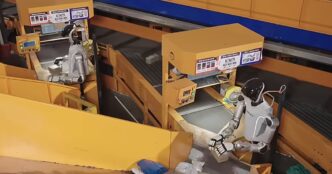
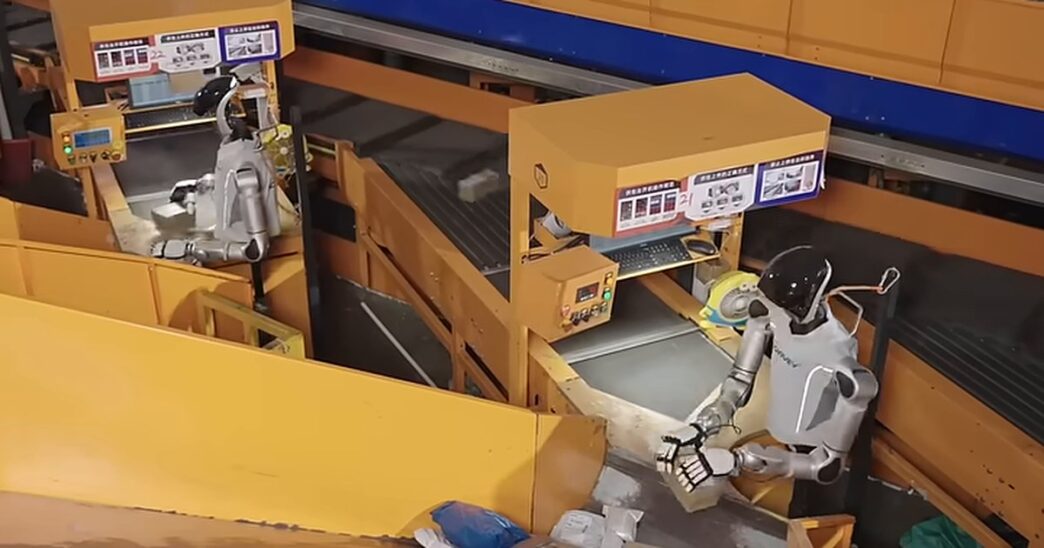
ROBOTERA China Post robots are now feeding parcels into sorting lines at 11 postal hubs in eight cities across Guangdong, the Beijing humanoid maker announced on November 17, 2026. The rollout with China Post Group’s Guangdong branch grew from a single pilot at the Guangzhou Postal District Center that began in March. ROBOTERA calls it the largest and most geographically extensive deployment of embodied-intelligence robots in logistics to date.
It’s a real multi-site rollout with a named customer, which is still rare for humanoid makers. But the announcement counts hubs, not robots. We checked every source we could find, in English and Chinese, for a Guangdong robot count and didn’t find one. We also lined up ROBOTERA’s own throughput figures from May and November, which don’t sit easily together, and compared the rollout with the other logistics humanoid programs we track.
- What: ROBOTERA’s M7 logistics robots do parcel induction, placing parcels label-up onto sorting lines, at 11 China Post hubs in Guangzhou, Shenzhen, Dongguan, Jiangmen, Shantou, Shanwei, Jieyang and Heyuan. The Guangzhou pilot started in March 2026.
- How fast: an average of more than 1,500 parcels an hour per ROBOTERA, which it calls comparable to an experienced worker. In May the company gave a maximum of 1,200 an hour.
- How many robots: not disclosed for Guangdong. ROBOTERA told Chinese media it has 45 robots at China Post’s Hangzhou center and has delivered “hundreds” to logistics companies overall.
- The catch: every figure comes from ROBOTERA. China Post hasn’t published its own numbers for the Guangdong rollout, and there’s no uptime, intervention or price data.
What ROBOTERA says it has deployed at China Post
The release describes a project “jointly implemented” by China Post Group Guangdong Branch and Beijing Xingdongjiyuan Technology Co., Ltd., ROBOTERA’s legal name. Guangdong is China’s largest province by express parcel volume, the company notes, and the deployment covers high-volume sorting and cross-regional logistics. ROBOTERA pitches the robots as extra capacity for peak shopping seasons, when parcel volumes “can surge to several times their normal levels,” with people moving into robot maintenance, operations coordination and quality control.
Chinese coverage adds details the English release leaves out. The Paper names the robot as the ROBOTERA M7, an “embodied intelligence logistics robot,” and says it handles small parcels of different materials, sizes and weights, rejects odd-shaped items, adjusts its speed and flips parcels so the label faces up, without changes to the existing line. Huanqiu, also citing the company, adds a claim of “24-hour stable operation.” Both outlets report that ROBOTERA has deployed 45 robots at China Post’s Hangzhou Postal District Center and delivered “hundreds” in total to logistics companies in China and abroad.
That’s the closest thing to a fleet size in the record, and it isn’t a Guangdong number. ROBOTERA’s own November 11 video on its parcel-induction product says the same thing in English: “partnerships established with China Post and SF Express and hundreds of units delivered.” The release also says the system runs in postal operations in East China, where Hangzhou is, without giving sites or counts.
ROBOTERA’s video for the announcement, posted to its official YouTube channel the same day, shows the robots working induction stations on orange and yellow sorting lines.
What the robot actually does on a sorting line
Induction is the step where a person, or now a robot, takes parcels from a pile after a truck is unloaded and places them one at a time, label up, onto the sorter’s feed. The sorter then reads the label and routes the parcel. It’s repetitive, fast and physically hard, and it’s one stage of a hub’s work, not the whole operation. A robot that inducts 1,500 parcels an hour is not a hub that sorts 1,500 parcels an hour.
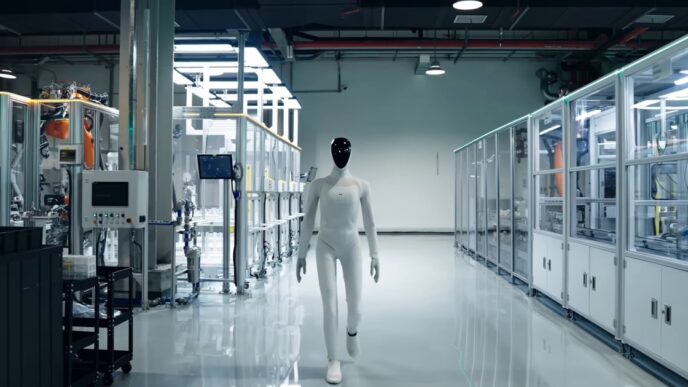
The M7 seen in ROBOTERA’s footage is a humanoid upper body, with a helmet-style head and two arms ending in five-finger hands, working at a fixed station. When ROBOTERA first showed the Guangzhou robot in May, it said the M7 used its own XHAND1 direct-drive hand and its ERA-42 robot model, according to IT Home. Mixed parcels are hard for older automation: a soft bag, a rigid box and a document envelope each need a different grip, and round items can roll off a sorter. That’s the job ROBOTERA says the hand and model handle, along with pulling out items that shouldn’t go on the line.
How ROBOTERA’s throughput claim changed between May and November
ROBOTERA has given three versions of its headline number this year. All three are company figures.
| When | Where | Throughput claim | Compared with a person | Source |
|---|---|---|---|---|
| May 15, 2026 | Guangzhou pilot (one site) | Maximum of 1,200 parcels an hour | “85% or more” of a human worker | ROBOTERA via IT Home |
| Nov 11, 2026 | Induction product overall | “Over 1,500 parcels per hour” | Not stated | ROBOTERA YouTube |
| Nov 17, 2026 | 11 Guangdong hubs | Average of more than 1,500 an hour “since the pilot began” in March | “Comparable to the performance of experienced human workers” | ROBOTERA release; The Paper |
The numbers moved fast. If 1,200 parcels an hour was 85% of a person in May, the human benchmark was about 1,410 an hour, by our arithmetic. A November average above 1,500 would beat that benchmark rather than match it. And an average “since the pilot began” in March that tops 1,500 is hard to square with a May maximum of 1,200. Robots can get faster with more data and tuning, and the May and November figures may measure different things, such as one robot’s peak versus a station’s output. ROBOTERA hasn’t explained how it measures the rate, over what hours, or whether people step in to help. Until it does, treat 1,500 as a company target that the robots reach in routine work, not an audited average.
The only robot count on camera: three robots in Shenzhen
The one outside look at a China Post induction line came from CCTV, China’s state broadcaster. In a November 15 report filmed overnight at China Post’s Shenzhen land mail processing center, which handles 1 million to 1.2 million parcels a night, three embodied robots worked a row of induction stations. Staff told CCTV each robot handles about 1,000 to 1,200 parcels an hour, and center manager Zeng Guodong said induction accuracy is above 95%. A data collector explained that people wearing VR headsets remotely operate the robots for about a week to collect demonstrations that train the robots’ base model, then add data for the hardest moves.
There’s a gap we couldn’t close. The company executive CCTV interviewed is from Woneng Embodied (Shenzhen), not ROBOTERA, and the report doesn’t name ROBOTERA or the M7. Shenzhen is one of ROBOTERA’s eight cities, but we found no primary source tying the two companies together, so we don’t count these three robots as ROBOTERA’s. The report still shows what a China Post induction line with robots looks like: a few robots alongside people, covering the extra load at peak. By our arithmetic, three robots at ROBOTERA’s 1,500-an-hour rate over a 10-hour night would induct about 45,000 parcels, under 5% of what that center handles in a night.
How it compares with other logistics humanoid deployments
Here’s how the China Post rollout stacks up against the other warehouse and parcel humanoid programs we track. “Robots” means a count the companies published, not an estimate.
| Program | Sites | Robots | Status | Evidence |
|---|---|---|---|---|
| ROBOTERA M7 at China Post Guangdong | 11 hubs in 8 cities | Not disclosed | Routine operation since a March 2026 pilot (company) | ROBOTERA release and video, Nov 17; The Paper |
| ROBOTERA M7 at China Post Hangzhou | 1 hub | 45 (company) | Batch deployment (company) | ROBOTERA, as reported by The Paper and Huanqiu |
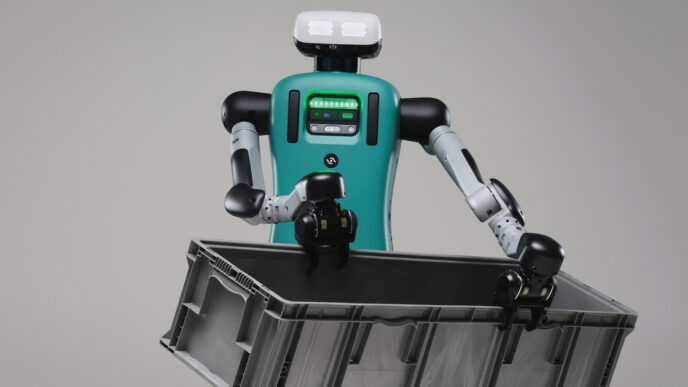
| Agility Digit at GXO, Flowery Branch, Georgia | 1 warehouse | 3 (Agility investor presentation) | Multi-year robots-as-a-service deal since June 2024; more than 100,000 totes moved (companies) | GXO and Agility releases; SPAC presentation |
| Agility Digit at GXO, Statesville and Lebanon | 2 warehouses | Not disclosed | Expected to begin in early 2027, Digit 4 first | GXO and Agility, Oct 26, 2026 |
| Agility Digit, all customers | 9 customer facilities, deployed or committed | Not disclosed | More than 65,000 hours of operation (company) | Agility SEC filings |
| Apptronik Apollo at GXO | Not named; first North American deployment late 2027 | Up to 1,000 over four years (a ceiling) | Letter of intent; trials from 2027 after an earlier U.S. picking pilot | GXO release, Nov 12, 2026 |
| Woneng Embodied (Shenzhen) robots at China Post Shenzhen | 1 center | 3 (on camera) | Working the night shift; accuracy above 95% (China Post manager) | CCTV, Nov 15, 2026 |
Two things stand out. ROBOTERA has the widest live footprint in the table: 11 hubs for one customer, plus Hangzhou. But the Western programs disclose more of the numbers that matter for judging them: Agility has put a robot count, a tote count and operating hours on the record, and GXO spelled out the conditions on its Apptronik deal. ROBOTERA gives a site count and a rate. Our guide to humanoids in warehouse logistics lists the numbers a buyer should ask for, and most of them aren’t public here.
Our take: a real rollout, measured in hubs instead of robots
This is more than a demo. A named national operator, 11 sites, eight months from pilot to province-wide use, and a second China Post center with 45 robots add up to stronger evidence than most humanoid announcements this year. On our readiness scale it sits between a pilot and a commercial deployment: a named customer, several sites and routine work, but no contract terms, price or customer statement of its own. Induction is also a smart first job. It happens at a fixed station, the parcels arrive in front of the robot, and a mistake costs a re-scan, not an injury.
The way it’s counted matters, though. “Eleven hubs” could mean 11 robots or 200. ROBOTERA was willing to give 45 for Hangzhou, so it’s notable that it gave no number for its biggest project. The headline rate rose by a quarter between May and November with no word on how it’s measured, and the only on-camera look at a China Post line, in Shenzhen, can’t be tied to ROBOTERA. China is also writing its own rules for these robots, with national humanoid standards that list ROBOTERA among the drafters.
We’d judge the rollout on three things. First, a Guangdong robot count, or one from China Post. Second, how the 1,500 figure is measured, including hours and human help. Third, whether China Post extends the program beyond Guangdong and Zhejiang, or SF Express names its own sites. Any one of those would turn a strong claim into a checkable one.
Company claim or verified: where each piece stands
- Confirmed by the company, with the customer named: 11 China Post hubs in eight Guangdong cities, the March 2026 Guangzhou pilot and the induction job (ROBOTERA release, November 17).
- Company figures, not independently checked: more than 1,500 parcels an hour on average, “comparable to experienced human workers,” 24-hour operation, 45 robots in Hangzhou and “hundreds” delivered overall.
- Outside reporting: CCTV filmed three induction robots at China Post’s Shenzhen center, with a China Post manager citing accuracy above 95%. The vendor named there is Woneng Embodied (Shenzhen), not ROBOTERA.
- Not disclosed: robots per hub or in Guangdong overall, uptime, interventions or teleoperation share, contract value, price and any statement from China Post on the Guangdong rollout.
Frequently asked questions
What is ROBOTERA?
ROBOTERA is a Beijing humanoid robot company whose legal name is Beijing Xingdongjiyuan Technology Co., Ltd. It builds humanoid robots, including the M7 logistics robot, its own XHAND dexterous hands and the ERA-42 robot model, and says it develops its hardware and AI in-house.
How many robots has ROBOTERA deployed at China Post?
ROBOTERA hasn’t said how many robots work at the 11 Guangdong hubs. It told Chinese media it has 45 robots at China Post’s Hangzhou Postal District Center and has delivered “hundreds” in total to logistics companies in China and abroad.
What does a parcel induction robot do?
It picks parcels from a pile and places them one at a time, label up, onto a sorting machine’s feed, setting aside odd-shaped or damaged items. The sorter then routes each parcel. ROBOTERA says its M7 averages more than 1,500 parcels an hour at this task.
Which cities does the China Post rollout cover?
Guangzhou, Shenzhen, Dongguan, Jiangmen, Shantou, Shanwei, Jieyang and Heyuan, all in Guangdong Province. The project started with a pilot at the Guangzhou Postal District Center in March 2026. ROBOTERA also reports postal deployments in East China, including Hangzhou.
Sources
- ROBOTERA: “ROBOTERA Expands Humanoid Robot Deployment Across China Post’s Guangdong Network, Reaching Eight Cities Province-Wide,” November 17, 2026 (PR Newswire)
- ROBOTERA (YouTube): “ROBOTERA Expands Humanoid Robot Deployment Across China Post’s Guangdong Network,” November 17, 2026
- ROBOTERA (YouTube): “ROBOTERA in Logistics | Small Parcel Induction,” November 11, 2026
- The Paper: ROBOTERA robots at China Post’s Guangdong network, November 17, 2026 (in Chinese)
- Huanqiu via Sina Finance: ROBOTERA robots in eight Guangdong cities, November 18, 2026 (in Chinese)
- IT Home via Sina Tech: ROBOTERA and China Post’s parcel-sorting robot, May 15, 2026 (in Chinese)
- CCTV News via Tencent News: robots on the night shift at China Post’s Shenzhen land mail processing center, November 15, 2026 (in Chinese)
- GXO: GXO and Apptronik expand humanoid robotics partnership, November 12, 2026
- GXO: GXO and Agility Robotics expand partnership, October 26, 2026
- Agility Robotics: commercial update, October 26, 2026
All sources accessed November 19, 2026.
Last updated: November 19, 2026. To report an error, see our corrections page. See our editorial policy.