Google has turned its new fast model into a robot-arm workbench. On November 17, 2026, the Gemini Robotics team launched a Robotics plugin for Google Antigravity, its agent coding app, built around Gemini 4 Hydrogen robotics skills: plug in a supported arm, let the model install drivers and calibrate it, practice a task in the MuJoCo simulator, then run the same code on the real robot. Google says a developer can go “from a robot in a box to one that can perform a working application in an afternoon.”
We read the plugin’s code repository to see which robots it actually supports, lined Hydrogen’s robot-arm score up against the other frontier models on the same independent test, and compared its price with the robotics model it is meant to replace. The tools are real and open source. The robot list is short, and the speed claims come from Google’s own demos.
- What launched: a free, Apache 2.0 Robotics plugin for Google Antigravity (November 17, 2026) that uses Gemini 4 Hydrogen to bring up a robot arm, build a MuJoCo simulation and control the arm in a closed loop.
- Robots supported out of the box: three arm families have their own setup skills: I2RT’s YAM arms, the open-source SO-101 and Franka’s FR3 Duo. An I2RT YAM with gripper lists at $2,999.
- How good is Hydrogen at robot control: 58 on the independent AA-Robotics v0.1 test, fourth behind Claude Fable 5.2 (75), GPT-6 Astra (69) and GPT-6.1 Sol (65), and ahead of Gemini 4 Argon (55).
- Cost: Antigravity needs a paid Google AI Pro or Ultra plan. Through the Gemini API, Hydrogen costs $1.50 per million input tokens and $7.50 per million output tokens.
What Google launched on November 17
Gemini 4 Hydrogen itself is not new. Google introduced it on November 12 as the fast, cheaper member of the Gemini 4 family, pitched at coding and agent work, with a 1-million-token context window and a flat price across it. That launch post said nothing about robots, which is why we didn’t cover it then. The November 17 post is the robotics half of the story.
Google makes two claims about the model. First, Hydrogen keeps the robot-control ability of the larger Gemini 4 Argon: given a goal in plain language and a camera view, it plans the task, writes and runs control code, and keeps adjusting until the job is done. Second, it folds the skills of Gemini Robotics ER 2, Google’s dedicated embodied-reasoning model, into the main Gemini line, and Google now tells ER 2 users to try Hydrogen instead.
The plugin is the new product. Google describes four groups of skills:
- Robot bring-up: installs drivers, finds cameras, calibrates the arm and checks for safe motion, starting from a USB cable.
- MuJoCo inside Antigravity: builds and previews simulated scenes and objects next to the code, so a task can be tried in simulation first. Google calls adjusting a scene through chat “vibe sim.”
- Perception and control: uses Gemini’s spatial understanding to find objects, plan grasps and drive the arm in a closed loop.
- Application building: generates the controller and the app around it, from simulation to the real robot.
To install it, open Antigravity, go to Customizations and search for Robotics on the Build With Google shelf. Antigravity is limited to paid Google AI Pro and Ultra subscribers, according to Google. The model is also available as gemini-4-hydrogen in the Gemini API and in Google AI Studio.
What is actually in the plugin
Google published the plugin as google-deepmind/robotics-antigravity-plugin on GitHub. We checked it on November 18. The repository was created on November 16, carries the Apache 2.0 license, had 56 stars, and its plugin manifest lists version 0.1.11. It holds 18 skill folders. The Antigravity marketplace version also bundles seven MuJoCo skills that live in Google DeepMind’s main MuJoCo repository.
The useful finding is how the skills split. Most are general and work in simulation with no hardware at all. Only five are tied to specific robots, and they cover three arm families.
| Skill group | Skills in the repository | Needs a robot? |
|---|---|---|
| Robot-specific setup and control | i2rt-yam-bringup, i2rt-yam-ik, so101-bringup, so101-calibration, fr3-duo-control | Yes: an I2RT YAM, SO-101 or Franka FR3 Duo |
| Perception and motion | rgb-object-localization, motion-planning, visual-servoing | Works in simulation or on a real arm |
| Simulation and assets | mujoco-playground, mujoco-playground-rl, mujoco-audit, mujoco-studio-sidecar, mujoco-showcase-shot, blender-creation | No |
| Sim-to-real and iteration | sim2real-gauntlet, sim2real-iteration, iteration | For the real-robot step |
| Community | share-example | No |
So “robotics skills for any robot,” as the manifest puts it, is true for simulation and for the general perception and planning skills. Plug-and-go bring-up, the part behind Google’s 10-minute claim, exists today for three arm families. Anyone with a different arm would be writing that part with the model’s help, not running a ready-made skill. The README says perception skills need a GEMINI_API_KEY, documents an install path with npx alongside the Antigravity marketplace, and carries a plain safety warning: stay next to the robot and keep a way to cut power within reach.
The arms it supports, and what they cost
The three arm families span a wide price range, which is the point Google is making about access.
| Arm | What Google showed | Price we could verify |
|---|---|---|
| I2RT YAM / YAM Pro (6-axis) | Bring-up from USB to a calibrated arm in about 10 minutes; snack sorting off a moving conveyor; two YAM Pro arms packing soap orders | YAM with gripper $2,999; YAM Pro with gripper $3,499 (I2RT store, November 18) |
| SO-101 (SO-ARM101) | Bring-up “from scratch to live waving” | Open-source design documented by Hugging Face’s LeRobot project; built from parts, no single list price |
| Franka Research 3 Duo | Bring-up to waving; a simulated chess board, then playing chess | Quote only. Franka lists the FR3 at 7 degrees of freedom, 3 kg payload and 855 mm reach |
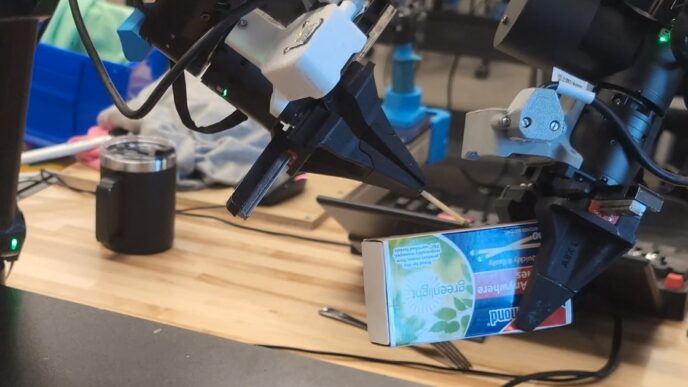
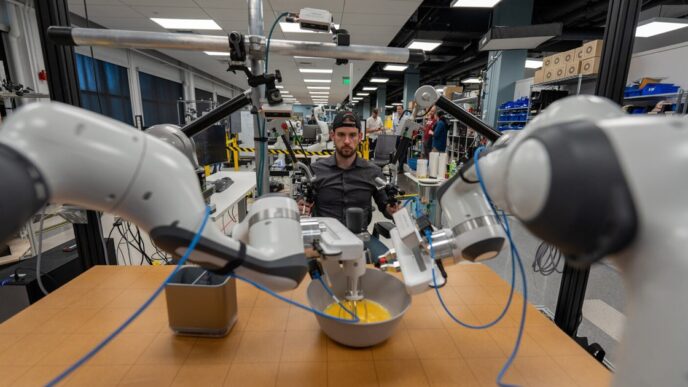
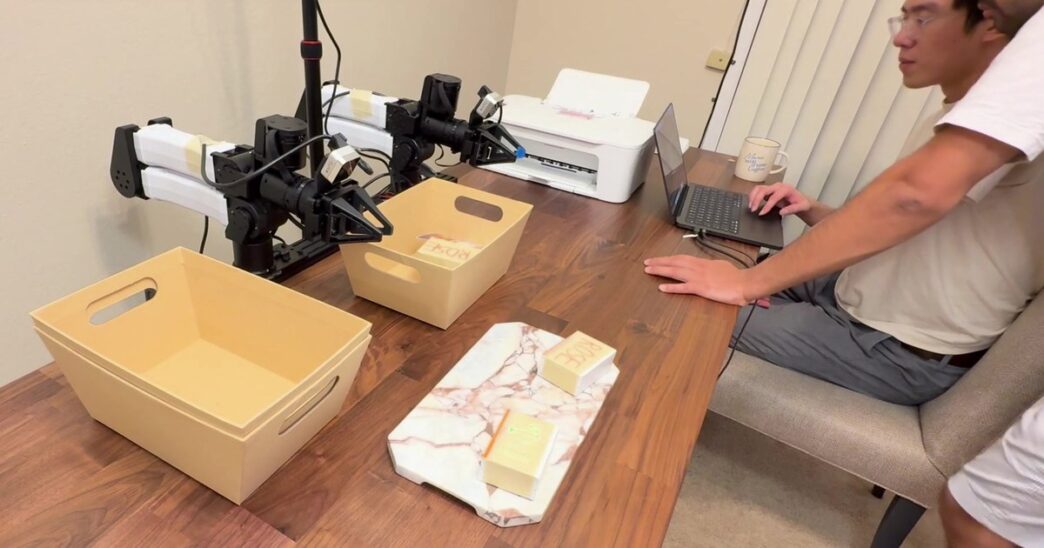
The snack sorter is Google’s showcase. From one prompt with photos of a real scene, Hydrogen built a MuJoCo copy of the cell, tested the grasping in simulation over several runs, and the developer then ran the policy on the real arm and tuned grip force and sorting rules in plain language. Google says it took “about an hour end-to-end.” The soap store demo goes further: Hydrogen builds a small web shop, and when an order arrives two YAM Pro arms set out a bin, pick the bars and pull a printed thank-you note from a printer.
How Hydrogen compares on an independent robot-arm test
Google’s only outside number for robot control is Artificial Analysis’s AA-Robotics v0.1, launched October 14. Each model, running in a coding-agent harness, controls a real Hiwonder 6-axis arm through an HTTP API, sees the table through four cameras, and attempts eight tabletop tasks, from pressing a button and pouring a drink to building a tower and measuring a box. A full pass scores 100; partial progress earns partial credit. Artificial Analysis posted Hydrogen’s result on November 12.
| Model | AA-Robotics v0.1 score | API list price per million tokens (input / output) |
|---|---|---|
| Claude Fable 5.2 (Anthropic) | 75 | $8 / $40 |
| GPT-6 Astra (OpenAI) | 69 | Replaced by GPT-6.2 Astra at $8 / $40 (not yet scored) |
| GPT-6.1 Sol (OpenAI) | 65 | $2 / $10 |
| Gemini 4 Hydrogen (Google) | 58 | $1.50 / $7.50 |
| Gemini 4 Argon (Google) | 55 | $2 / $10 through November 30, then $4 / $20 |
| Claude Opus 5.5 (Anthropic) | 49 | Not compared here |
| Claude Fable 5.1 (Anthropic) | 46 | Replaced by Fable 5.2 |
Two things follow. Hydrogen is now Google’s best model on this test and the cheapest per token in the top five, so Google’s “similar to Argon at a lower cost per token” holds up: 58 against Argon’s 55, at three-quarters of Argon’s current price and less than half of its December price. But it is not the best robot-arm model. Claude Fable 5.2 leads by 17 points, and GPT-6.1 Sol scores 7 points higher at a similar price.
Keep the test’s own warning in mind. Artificial Analysis says frontier models took about half an hour per task against a human average of 20 seconds, and calls them “far too slow and expensive for any kind of production usage.” Argon was the slowest model in its first round, at 52 minutes per task. Artificial Analysis hasn’t published Hydrogen’s time or cost per task in the material we found, so Google’s claim that Hydrogen makes robot apps practical “all day” is not yet backed by an outside measurement. It is the same gap we found when NVIDIA tested GPT-6 Astra on robot tasks with its thinking time left in.
Hydrogen against Gemini Robotics ER 2: better scores, different price curve
Google’s developer post includes a chart of 16 embodied-reasoning tests, from ERQA and gauge reading to error detection and task breakdown. On Google’s numbers, Hydrogen at its default high thinking setting averages 84.8 against 75.5 for Gemini Robotics ER 2. ER 2 still comes out ahead on one test, steerable pointing, and the two are about level on multi-point pointing. These are Google’s own results. ERQA is a public benchmark; Google’s post doesn’t say where the other 15 tests come from.
Price is where the switch gets interesting. On Google’s Gemini API pricing page, the ER 2 preview costs $1 per million input tokens and $5 per million output tokens through December 31, then $2 and $10 from January 1, 2027. Hydrogen costs $1.50 and $7.50, with no scheduled change. So for the next six weeks Hydrogen costs 50% more per token than ER 2. From January it costs 25% less. Both have a free tier in the Gemini API; Argon and Carbon don’t. A team running ER 2 for robot perception today can test Hydrogen now and plan the move for the new year, when the numbers favor it on both score and price.
Our take: a real on-ramp for hobby and lab arms, not a shortcut for factory robots
This is the most practical thing Google has shipped for robot builders in the Gemini 4 cycle. Argon’s robotics debut was a lab demo with Apptronik’s Apollo that outsiders couldn’t try. The Hydrogen plugin is an Apache-licensed repository, a model with a free API tier and a list of arms that a university lab, or a well-funded hobbyist, can buy for about $3,000. That lowers the bar for the dull part of robotics, drivers, calibration and simulation setup, which is where many first projects stall.
It doesn’t change what a language model can do on a production line. On the one outside test, the best models still fail some tasks outright and take minutes where a person takes seconds, and Hydrogen sits fourth. Fast bring-up on a $3,000 arm is not the same as reliable picking at line speed, and the work Google showed is tabletop: snacks, soap bars, pens and chess pieces. Robots in factories, like the Apollo units in Google’s Mercedes-Benz kitting trial, run dedicated robot models, not a coding agent writing control scripts.
We’d judge the plugin on three things in the coming months: whether developers outside Google post working builds on the repository’s Discussions page, whether skills for more arms appear (community or Google), and whether Artificial Analysis publishes Hydrogen’s time and cost per task. If the first two happen, Antigravity could become the default starting point for LLM-driven arm projects, a role Hugging Face’s open LeRobot tools already fill for many hobby arms, the SO-101 among them. Safety deserves a note too: our report on RoboSpoof showed how easily camera tricks pushed AI models into unsafe robot actions, and Google’s own README tells users to keep a hand near the power switch.
Demo, claim or independent result: where each claim stands
- Verified by us: the repository, its Apache 2.0 license, version 0.1.11, the 18 skill folders and the five robot-specific skills (GitHub, November 18); Hydrogen’s API prices and ER 2’s scheduled price rise (Google’s pricing page); I2RT’s list prices.
- Independent result: Hydrogen’s 58 on AA-Robotics v0.1, published by Artificial Analysis, behind Fable 5.2, GPT-6 Astra and GPT-6.1 Sol.
- Google’s own results: the 16-test embodied-reasoning chart against ER 2 (average 84.8 against 75.5).
- Google demos: 10-minute YAM bring-up, the hour-long snack sorter, the soap store and the chess-playing FR3 Duo. Not independently reproduced.
- Not disclosed: Hydrogen’s time and cost per task on AA-Robotics, success rates for the demos over repeated runs, and any customer using the plugin in production.
Frequently asked questions
What is Gemini 4 Hydrogen?
Gemini 4 Hydrogen is Google’s fast, lower-cost Gemini 4 model, introduced November 12, 2026. It has a 1-million-token context window and costs $1.50 per million input tokens and $7.50 per million output tokens in the Gemini API, with a free tier. On November 17 Google added robotics skills around it through a plugin for Google Antigravity.
Which robots work with the Antigravity Robotics plugin?
The plugin has dedicated setup and control skills for I2RT YAM arms, the open-source SO-101 arm and the Franka Research 3 Duo. Its simulation, perception and planning skills are general, and the plugin can be used in MuJoCo simulation with no robot at all.
Is the Antigravity Robotics plugin free?
The plugin is open source under the Apache 2.0 license. Google Antigravity itself requires a paid Google AI Pro or Ultra subscription, and skills that call Gemini perception models need a Gemini API key, which has a free tier for Hydrogen.
Is Gemini 4 Hydrogen the best AI model for controlling robot arms?
No. On Artificial Analysis’s AA-Robotics v0.1 test, Hydrogen scores 58, fourth behind Claude Fable 5.2 (75), GPT-6 Astra (69) and GPT-6.1 Sol (65). It is Google’s top model on that test and ahead of Gemini 4 Argon (55).
Sources
- Google Developers Blog: “Gemini 4 Hydrogen: a faster model for general purpose robotics,” November 17, 2026
- Google: “Introducing Gemini 4 Hydrogen,” November 12, 2026
- google-deepmind/robotics-antigravity-plugin on GitHub (license, skills, version 0.1.11, checked November 18, 2026)
- Google: Gemini API pricing (Hydrogen, Argon, Carbon, Gemini Robotics ER 2 Preview)
- Google DeepMind: Gemini Robotics ER
- Artificial Analysis: “Welcome to the era of embodied AI: Introducing AA-Robotics v0.1,” October 14, 2026
- Artificial Analysis on X: Gemini 4 Hydrogen AA-Robotics result, November 12, 2026
- ERQA benchmark on GitHub
- I2RT Robotics store (YAM and YAM Pro prices, checked November 18, 2026)
- Hugging Face LeRobot: SO-101 documentation
- Franka Robotics: Franka Research 3
- OpenAI: “Introducing GPT-6.2 Astra and Sol,” November 17, 2026 (API prices)
All sources accessed November 18, 2026.
Last updated: November 18, 2026. To report an error, see our corrections page. See our editorial policy.