Japan’s AI Robot Association (AIRoA) has released AIRoA-0, a robot foundation model for two-armed manipulation that learned entirely from people. Its training data is 16,151 hours of demonstrations recorded with YUBI, a handheld gripper, with no robot involved: no teleoperation, no reinforcement learning and no corrections on a real robot. AIRoA-0, or A-0, was announced on November 6 with a technical report, downloadable weights and post-training code. The work was commissioned under a project of Japan’s Ministry of Economy, Trade and Industry (METI) and NEDO.
The headline result is AIRoA’s: a 78% average success rate on ten tasks at a site where none of the training data was recorded, against 27% for the best of four other vision-language-action models post-trained on the same demonstrations. We opened the Hugging Face and GitHub repositories on November 14 to see what “released” covers. The weights are real and downloadable after a click-through license. The full training dataset isn’t out yet.
- What: AIRoA-0 (A-0), a vision-language-action model built from Physical Intelligence’s π0.5 base weights and pre-trained on 16,151 hours of handheld-gripper demonstrations. Released November 6, 2026.
- What you can download: one pre-trained checkpoint and three post-trained task examples, about 12.4 GB each and 49.8 GB in total, on Hugging Face under the Gemma Terms of Use. The code is Apache 2.0.
- Results (AIRoA’s tests): 78% average on ten tasks on a Franka setup, against 27% for π0.5, 23% for XR-1, 16% for GR00T N1.7 and 14% for MolmoAct2. Scores give partial credit.
- The catch: the 16,151-hour dataset is listed as “coming soon,” post-training a new task takes eight H200 GPUs, and the robot has to carry the YUBI gripper and its wrist cameras.
What AIRoA-0 is
A-0 is a vision-language-action model: it takes camera images and a text instruction and outputs robot actions. AIRoA started from the π0.5 base weights that Physical Intelligence released, and the post-training code on GitHub says it derives from Physical Intelligence’s OpenPI implementation. What’s new is the data and the recipe around it.
All of the manipulation data comes from YUBI, short for Yielding Universal Bidigital Interface. A person holds a gripper in each hand and does the task. Each gripper carries a camera, and VR-based tracking records its position. The hardware design comes from Toyota Motor Corporation’s Frontier Research Center and the collection software from AIRoA, and both are open source. According to the project page, the corpus holds 10.65 million subtask segments, averaging 5.5 seconds, and 1.74 billion time steps at 30 Hz, each with a task instruction and a subtask instruction.
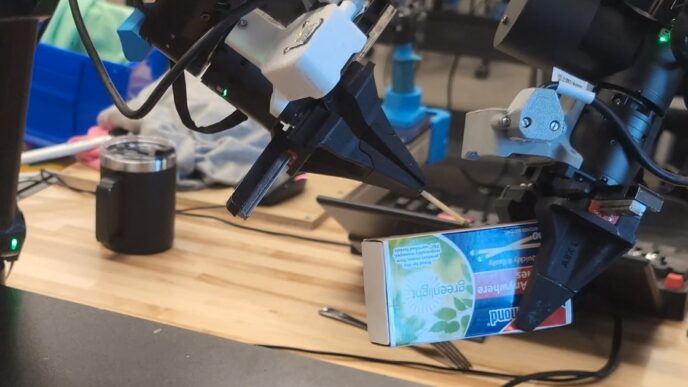
The trick that makes the data usable is that the same gripper mounts on a robot arm. The robot sees through the same cameras in the same place that the person’s demonstration did, and A-0 outputs gripper poses rather than joint angles. Each robot’s controller turns those poses into arm motion. AIRoA says that’s why one model runs on four dual-arm platforms: a bimanual Franka, TX-G2 (which the project page calls a semi-humanoid), OpenArm and UR. The robot uses only the two wrist cameras, with no head or scene camera.
What the release includes, checked on November 14
“Open” covers different things in different robot releases, so we checked each piece against the repositories themselves.
| Piece | What AIRoA says | What we found on November 14 |
|---|---|---|
| Pre-trained weights | Released on Hugging Face | Yes: a pretrained/ checkpoint of 12.44 GB in the JAX checkpoint format OpenPI uses, not a single safetensors file |
| Post-trained weights | “Post-trained models for the evaluation tasks” | Three examples (towel folding, letter blocks, orange pyramid) of about 12.45 GB each, not all ten tasks; 49.8 GB for the whole repository |
| Weights license | “Available for use in research and development” | The model card sets the Gemma license. Access needs a logged-in Hugging Face account and a click-through acceptance of the Gemma Terms of Use and Prohibited Use Policy, which the card says is “processed immediately” |
| Code | Data collection, post-training and inference code | Three GitHub repositories (AIRoA-0, yubi-go, openarm-pipeline), all Apache 2.0, created November 3 to 5 |
| Training dataset | The arXiv abstract says “We are releasing the dataset” | Not yet. The project page lists it as “Coming soon,” the release says timing will be announced, and no 16,151-hour dataset appears among AIRoA’s Hugging Face datasets |
| Hardware to post-train | “Under four hours on a single node of eight GPUs” | The report and project page specify eight H200 GPUs. The README asks for Linux, Python 3.11 and CUDA 12, with at least 32 CPU cores; the default recipe runs 20,000 updates at a global batch of 64 |
One practical detail from the README: the released post-trained checkpoints use an 11-number robot state and a 20-number action, and their normalization files only fit that layout. To use your own robot data, you set your own state and action sizes (up to 32 each) and run the post-training recipe.
The results, and how they were scored
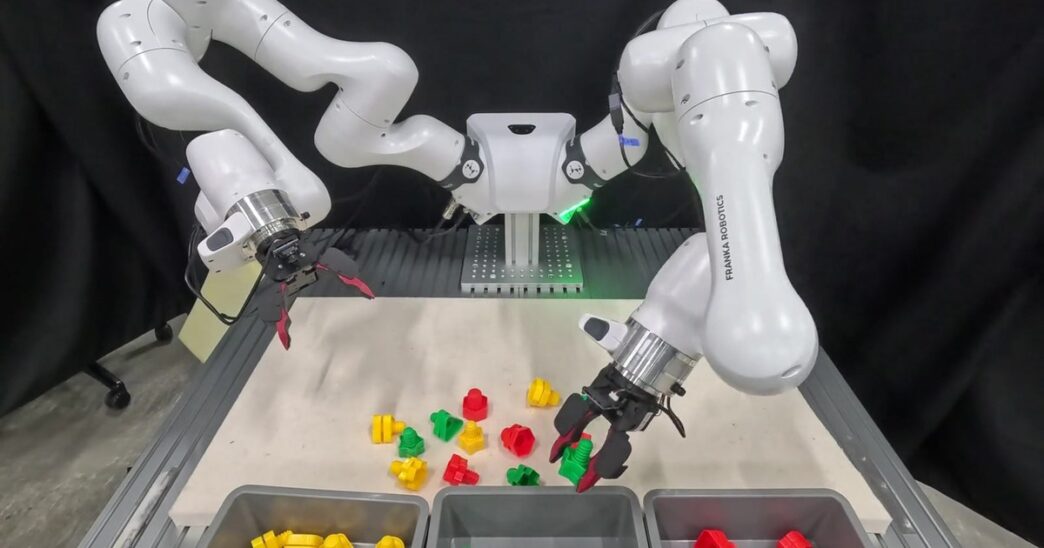
AIRoA tested ten tasks 15 times each on a bimanual Franka, at a site where none of the training data was recorded. Scores range from 30% on putting earbuds into their case to 97% on sorting toy bolts and nuts by colour, and A-0 has the highest score on every task in the project page’s table. Other tasks include folding a towel, swapping the mop pads and brush of a robot vacuum, and spelling YUBI with letter blocks. The four comparison models started from their public pre-trained checkpoints, and each entry is that model’s best result across the post-training settings AIRoA tried, which is a fairer setup than a single default run.
Three limits apply. The scores give partial credit for partly completed tasks, the same caveat we noted for Robbyant’s LingBot-Touch. AIRoA ran every trial. And the scored results are all from the Franka: the other three robots appear in demonstration clips, not in the benchmark. Every robot clip on the project page is labeled autonomous, and the clips are sped up, by three times on the Franka and OpenArm, two times on the UR and five times on TX-G2.
How AIRoA-0 compares with other open robot models
We compared A-0 with three other robot models released or announced in the past two weeks, from each maker’s own pages and our earlier checks.
| Model | Released | Weights you can download | License | Training data | Hardware to adapt it |
|---|---|---|---|---|---|
| AIRoA-0 (AIRoA) | Nov 6 | Pre-trained + 3 task checkpoints (click-through) | Gemma terms (weights); Apache 2.0 (code) | 16,151 hours of handheld-gripper demonstrations | Eight H200 GPUs, under four hours per task |
| Praxis-1 (Runway) | Nov 11 | Base, single-arm and two-arm checkpoints | Apache 2.0 (weights and code) | Large-scale video pretraining, per Runway | A single 80 GB GPU for inference and LoRA |
| LingBot-Touch (Robbyant) | Nov 9 | Frozen touch encoders only | Apache 2.0 | 4,983 hours of touch recordings | Training code not released |
| GR00T 2 (NVIDIA) | Announced Nov 9 | None yet; project page still says “Code Available in December” | Not published | 402,730 hours of egocentric video, 10,184 hours of handheld UMI demonstrations, 23,500 hours of teleoperation | Not published |
Sources: AIRoA’s release and repositories; our checks of Runway’s Praxis-1, LingBot-Touch and NVIDIA’s GR00T 2. We rechecked the GR00T 2 project page and NVIDIA’s Hugging Face models on November 14.
The data column is the interesting one. NVIDIA used about 10,000 hours of handheld-gripper data as one ingredient among several. AIRoA used about 60% more and nothing else, and the project page reports that the model’s loss after post-training follows a power law in the hours of pre-training data. That’s AIRoA’s analysis of its own runs, but it is the argument for handheld collection in one line: the data grows with the number of people recording, not the number of robots. Our explainer on humanoid robot training data covers why that bottleneck matters.
Our take: the gripper may matter more than the checkpoint
A-0 is a solid open release with honest limits. The weights download, the code is Apache 2.0, the baselines were given a fair shot, and AIRoA is clear that the robot appears only at test time. For a lab that already has Franka or UR arms, it’s a working recipe: build the open gripper, record a task by hand and post-train.
It’s less open than Runway’s Praxis-1, though. The weights carry Gemma’s use terms rather than Apache 2.0, they sit behind a login and acceptance step, and they come in OpenPI’s JAX format. Post-training on eight H200s puts it at lab or cloud scale, not a desktop GPU. The biggest gap is the dataset. The arXiv abstract describes it as released, while the project page and the release say it’s still coming. Until the 16,151 hours are public, nobody outside AIRoA can reproduce the pre-training or test the scaling claim.
Our view is that the lasting contribution may be the method more than this checkpoint. If robot-free handheld data really does scale the way AIRoA’s curve suggests, the cheapest way to build a robot dataset is to hand people grippers, and Japan now has an open, government-funded version of that pipeline. The things to check next are the dataset release and the first independent results from labs that post-train A-0 on their own tasks.
Frequently asked questions
What is AIRoA-0?
AIRoA-0 (A-0) is a vision-language-action robot model from Japan’s AI Robot Association, released November 6, 2026. It was built from Physical Intelligence’s π0.5 base weights and pre-trained on 16,151 hours of demonstrations that people recorded with the YUBI handheld gripper, with no robot data.
Is AIRoA-0 open source?
Partly. The post-training, inference and data-collection code is Apache 2.0 on GitHub. The model weights are on Hugging Face under the Gemma Terms of Use and require a logged-in account and a click-through acceptance. The training dataset hasn’t been released yet.
What hardware do you need for AIRoA-0?
AIRoA says post-training on a new task takes under four hours on a single node of eight NVIDIA H200 GPUs. The code needs Linux, Python 3.11 and a CUDA 12 NVIDIA GPU. On the robot side, the arm has to carry the YUBI gripper and its wrist cameras.
Which robots does AIRoA-0 work with?
AIRoA has run it on four dual-arm platforms fitted with the YUBI gripper: a bimanual Franka, TX-G2, OpenArm and UR. Because the model outputs gripper poses rather than joint angles, each robot’s own controller converts them into arm motion.
Is the AIRoA-0 dataset available?
Not yet. AIRoA’s project page lists the 16,151-hour dataset as coming soon, and its release says details and timing will be announced on its website. The YUBI hardware design and collection software are already public.
Sources
- AIRoA: “AIRoA Releases AIRoA-0 Robot Foundation Model,” November 6, 2026
- arXiv: “AIRoA-0: Long-Horizon, Precise, Cross-Embodiment Manipulation from Handheld Data,” submitted November 2, 2026
- AIRoA-0 project page (results table, release status and videos)
- Hugging Face: airoa-org/AIRoA-0 model repository
- GitHub: airoa-org/AIRoA-0 post-training code (README)
- NVIDIA GEAR: GR00T 2 project page
- Runway: “Praxis-1 Is Now Available,” November 11, 2026
All sources accessed November 14, 2026.
Last updated: November 14, 2026. To report an error, see our corrections page. See our editorial policy.