
Anthropic’s Claude Opus 5.5 is the top model on the GDPx benchmark, a new test of AI agents doing long, expert-level work that the research firm SemiAnalysis released on Sunday night. Its score is 12.0%. Google’s Gemini 4 Carbon came second at 10.9% while costing less than a third as much per task, and OpenAI’s GPT-6 Astra was third at 9.6%, according to the public leaderboard.
The low numbers are the point. GDPx has 206 tasks across 11 fields, built with 14 specialist data companies, and agents get up to eight hours on each one inside working copies of real professional software. SemiAnalysis is pitching it as the replacement for OpenAI’s GDPval, which labs still quote on model cards, and it ran all 20 models itself instead of relying on launch charts. Every model scored zero on the legal tasks. Only one scored anything on finance.
- Who leads: Claude Opus 5.5 at 12.0%, then Gemini 4 Carbon at 10.9% and GPT-6 Astra at 9.6%, out of 20 models tested.
- Price per task: SemiAnalysis measured an average of $51.41 per task for Opus 5.5, $16.29 for Gemini 4 Carbon and $53.99 for GPT-6 Astra. The cheapest models, GPT-6 Luna and DeepSeek V4.1 Flash 1017, cost under a dollar a task and scored about 5%.
- Availability: the leaderboard, per-field scores and one sample transcript per partner are free on the GDPx site. The other tasks stay private, and most of SemiAnalysis’s write-up sits behind its paywall.
- The catch: safety filters cost Claude and GPT points in cyber and biology. Drop those fields and alignment, and GPT-6 Astra edges past Opus. Gemini 4 Carbon is also not generally available yet.
GDPx benchmark results for all 20 models
The headline score is the average of 11 fields weighted equally: alignment research, biology, chip design, cybersecurity, finance, hardware design, legal, materials science, quant trading, recursive self-improvement (AI research on AI) and software engineering. Within each field, every partner company counts equally. Each model gets three attempts per task, and the score is the average of those attempts, so luck on one run doesn’t carry a model. Some tasks are pass or fail, while others give partial credit for how far the agent got.
Cost is SemiAnalysis’s measured average API spend per task, so it reflects both a model’s token price and how much it writes. Opus 5.5 produced about 548,000 output tokens per task on average. GPT-6 Astra used about half that, but its higher price made it the most expensive of the top three.
| Rank | Model (maker) | GDPx score | Avg. cost per task |
|---|---|---|---|
| 1 | Claude Opus 5.5 (Anthropic) | 12.0% | $51.41 |
| 2 | Gemini 4 Carbon (Google) | 10.9% | $16.29 |
| 3 | GPT-6 Astra (OpenAI) | 9.6% | $53.99 |
| 4 | Muse Wonder Full (Meta) | 9.0% | No public price |
| 5 | Claude Fable 5.1 (Anthropic) | 8.5% | $67.16 |
| 6 | GPT-6.1 Terra (OpenAI) | 8.5% | $15.02 |
| 7 | GPT-6.1 Sol (OpenAI) | 8.4% | $9.80 |
| 8 | Claude Sonnet 5.5 (Anthropic) | 8.2% | $45.27 |
| 9 | Gemini 4 Argon (Google) | 7.3% | $12.79 |
| 10 | Muse Wonder (Meta) | 6.8% | $15.63 |
| 11 | DeepSeek V4.1 Flash 1017 (DeepSeek, open weights) | 5.4% | $0.94 |
| 12 | GPT-6 Luna (OpenAI) | 5.1% | $0.92 |
| 13 | Claude Haiku 5.5 (Anthropic) | 4.9% | $3.98 |
| 14 | MiniMax M3.1 Flash (MiniMax, open weights) | 4.0% | $1.61 |
| 15 | Grok 4.7 (SpaceXSI) | 3.9% | $16.34 |
| 16 | Kimi K3 (Moonshot AI, open weights) | 3.7% | $28.38 |
| 17 | Qwen 3.8 Max (Alibaba) | 3.5% | $11.53 |
| 18 | GLM 5.3 (Z.ai, open weights) | 2.7% | $11.79 |
| 19 | Inkling (Thinking Machines, open weights) | 2.3% | $6.70 |
| 20 | Muse Spark Open (Meta, open weights) | 1.7% | $4.35 |
The site’s default view shows 13 of these models. We pulled all 20 from the leaderboard data, rounded to one decimal. Fable 5.1 (8.53) edges Terra (8.48) before rounding. Each lab’s model ran in its own coding harness where one exists: Claude Code for Anthropic, Codex for OpenAI, Antigravity for Google, Muse Code for Meta and Grok Build for Grok 4.7. Open models ran in OpenCode on inference from Fireworks.
The cheap end is where the value is. GPT-6 Luna and DeepSeek V4.1 Flash 1017 deliver almost half of Opus’s score for under 2% of its cost, and SemiAnalysis puts them with Opus on the curve of best score for the money, with OpenAI’s models filling the middle. For a closer look at the mid-priced OpenAI option, see our GPT-6.1 Terra price guide.
Opus 5.5 wins on breadth, not in every field
SemiAnalysis calls Opus 5.5 the best all-around model, and the field scores back that up. Among the top three, Opus leads quant trading (27.4%) and hardware design (18.7%), and it is the only one of them that scores reasonably everywhere outside law and finance. Gemini 4 Carbon leads biology (25.6%) and software engineering (11.1%, in a three-way tie with GPT-6.1 Terra and Claude Sonnet 5.5). GPT-6 Astra leads recursive self-improvement (24.9%) and materials science (21.6%).
Other models win single fields. Across all 20, Claude Fable 5.1 has the best quant trading score (28.6%), GPT-6.1 Sol has the best chip design score (5.6%), and Meta’s Muse Wonder Full posts 35.2% in cybersecurity, well ahead of the regular Muse Wonder at 24.1% and everyone else. SemiAnalysis says Muse Wonder Full is “the best available cyber model today by a meaningful margin.”
The result also supports Anthropic’s launch pitch for Opus 5.5. When it shipped on September 22, Anthropic said the model costs $4 per million input tokens and $20 per million output tokens, down from $5 and $25 for Opus 5, and claimed it is about 40% cheaper to run than Opus 5 on typical workloads. On GDPx it beat Anthropic’s pricier Fable 5.1 by 3.5 points while costing about $16 less per task.
Safety filters cost Claude and GPT points
Three of the 11 fields, cybersecurity, biology and alignment research, involve work that safety systems are built to refuse. SemiAnalysis says those classifiers sometimes kick in and hold back Opus 5.5 and GPT-6 Astra. The clearest sign is in cyber, where GPT-6 Astra scored 0%. Anthropic says on its Opus 5.5 page that it ships the model with bio and cyber safeguards similar to Fable 5.1’s, and that vetted organizations can apply to its verification programs for fewer restrictions.
Take those three fields out and the order changes. On the leaderboard’s no-safety view, GPT-6 Astra scores 11.8% to Opus 5.5’s 11.7%, followed by GPT-6.1 Sol (10.6%), GPT-6.1 Terra (9.9%) and Claude Sonnet 5.5 (9.7%). Gemini 4 Carbon drops to 9.2%. SemiAnalysis credits Carbon’s biology lead to “weaker safety classifiers,” which is its reading, not something Google has said.
For a team building a coding or research agent, the no-safety ranking is the more useful one, and three OpenAI models land in its top four.
Why every model failed the legal tasks
The finance and legal fields are where GDPx is hardest on today’s agents. In legal, built with partner Chakra, every model scored exactly zero. In finance, only Gemini 4 Carbon scored at all, with 2.8%. SemiAnalysis’s sample finance task, from partner Living Context, drops the agent into a private equity deal with roughly 4,000 files, including a deal room of about 2,000 documents, and asks it to produce the kind of work an associate would hand a partner.
This is SemiAnalysis’s main complaint about GDPval, which OpenAI released on September 25, 2025. GDPval hands the model everything it needs in one prompt and grades a single response, and SemiAnalysis notes its human expert graders agreed with each other only 71% of the time. GDPx makes the agent find the context itself, inside software, over hours. SemiAnalysis also says its quality checks flagged nearly half of the tasks in Terminal Bench 4.0, another popular agent test, as broken, and that it rejected partner tasks that failed its own checks.
Where robots come in
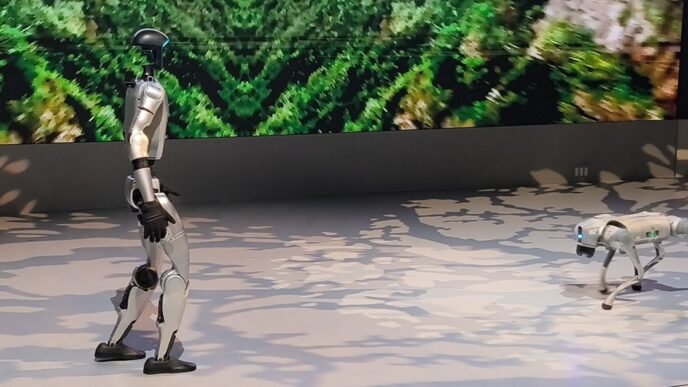
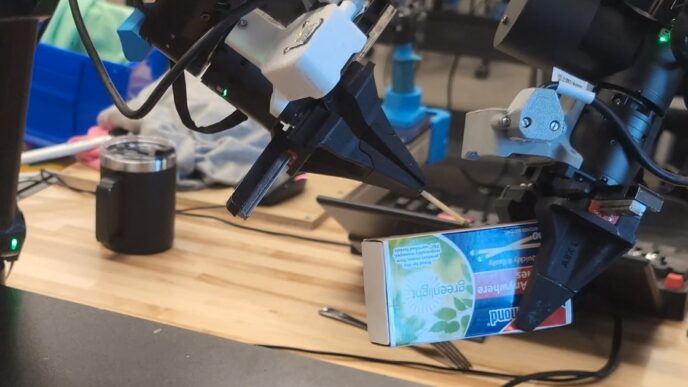
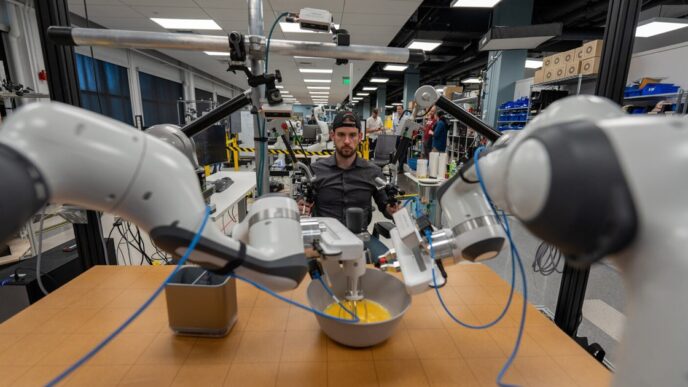
Two GDPx fields sit close to robotics. The hardware design tasks, from partner Beautiful Machines, are based on real engineering projects, including a robotic patient-transfer system with about 7,000 components, and run in professional CAD and electronics tools. Opus 5.5 led that field at 18.7%, with GPT-6 Astra at 16.5% and Gemini 4 Carbon far back at 5.8%. The materials science tasks put agents in simulated labs with equipment such as battery testers and electron microscopes, where Astra and Carbon both scored above 20%.
Chip design was harder. The best score was 5.6%. In one task from partner Aria, the agent gets eight hours to take a chip that runs small neural networks from a fixed pin list to a finished layout. For now, agents are much better at designing the machine than the chip that runs it.
How much to trust GDPx
GDPx is more open than most lab charts: SemiAnalysis published every run of one task per partner, 168 transcripts in all. But the field sizes are small. Recursive self-improvement and quant trading have 10 tasks each, so a single solved task can move a model’s field score by several points. The 14 partners are companies that build training environments and sell them to AI labs, and the remaining tasks stay private, so outsiders can’t rerun them. SemiAnalysis says that is to stop labs training on the test.
The fields were also picked by SemiAnalysis, which deliberately left out areas such as government, real estate and insurance. A different mix would produce a different order, and the no-safety view already shows how close the top three are.
There is also an availability problem with the second-place model. Gemini 4 Carbon is open only to selected cyber defenders in Google’s Fairwind program, and SemiAnalysis itself frames its cost advantage as something that matters “once Carbon becomes generally available.” We found no public response to the rankings from Anthropic, Google or OpenAI as of Monday morning.
What to watch next
The real test is whether the next model card from Anthropic, Google or OpenAI quotes GDPx alongside GDPval. A benchmark where the best model scores 12% leaves plenty of room to show progress, and labs that don’t like their score can simply leave it out. The other date to watch is Gemini 4 Carbon’s general release. If Google keeps its $2 and $10 per million token launch price, it would be the cheapest way to get near the top of this leaderboard.
Frequently asked questions
What is the GDPx benchmark?
GDPx is an AI agent benchmark from the research firm SemiAnalysis, released November 1 to 2, 2026. It has 206 long tasks in 11 professional fields, from chip design and quant trading to biology and law, built with 14 partner companies. Agents get up to eight hours per task inside real professional software.
Which AI model is best on GDPx?
Anthropic’s Claude Opus 5.5 leads with 12.0%, ahead of Gemini 4 Carbon at 10.9% and GPT-6 Astra at 9.6%. If you leave out cybersecurity, biology and alignment, where safety filters affect results, GPT-6 Astra edges ahead, 11.8% to 11.7%.
Is Gemini 4 Carbon cheaper than Claude Opus 5.5?
Yes, by a wide margin on GDPx. SemiAnalysis measured an average of $16.29 per task for Gemini 4 Carbon and $51.41 for Opus 5.5, for scores of 10.9% and 12.0%. Carbon is not generally available yet, though, so most developers can’t buy it today.
How is GDPx different from GDPval?
OpenAI’s GDPval gives a model everything it needs in one prompt and grades a single answer. GDPx makes the agent work for hours in real software, find the relevant files itself and produce finished work. SemiAnalysis also runs every model three times and averages the results.
Sources
- SemiAnalysis, GDPx leaderboard, domains and rollouts (data updated November 1, 2026): gdpx.semianalysis.com
- SemiAnalysis, “GDPx: Measuring Frontier Model Capabilities” (Max Kan, Andrew Megalaa and Dylan Patel, November 2, 2026; partly paywalled): newsletter.semianalysis.com
- SemiAnalysis, GDPx launch thread on X (November 1, 2026, 9:06 PM ET): x.com
- Anthropic, Claude Opus 5.5 model page and pricing: anthropic.com
- Aria, GDPx chip design partner page (November 1, 2026): ariadata.ai
- Anthropic, “Introducing Claude Opus 5.5” (official Claude YouTube channel, September 2026): youtube.com
All sources accessed November 2, 2026.
Last updated: November 2, 2026. To report an error, see our corrections page. Articles are drafted with AI assistance and reviewed and edited by an editor; see our editorial policy.