OpenAI released GPT-6.1 Terra on Monday, October 26, at 2:06 PM ET, and the GPT-6.1 Terra price is the part that matters most: $1 per million input tokens and $5 per million output tokens in the API. That’s half of what OpenAI charges for GPT-6.1 Sol and a tenth of GPT-6 Astra. OpenAI pitches Terra as its fast model for computer use, meaning it reads what’s on a screen and clicks, types and drags through apps for you.
It’s now OpenAI’s cheapest route into agents that operate software, and OpenAI is aiming it straight at Anthropic: the company claims that on its own computer-use benchmark, Terra finishes a task for about a ninth of what Claude Opus 5.5 costs. There’s a catch for ChatGPT subscribers, though. Terra isn’t in the regular chat window.
- Price: $1 per million input tokens, $0.05 cached, $5 output (standard API). Prompts over 272,000 input tokens cost 2x input and 1.5x output for the whole request.
- Where: the API as
gpt-6.1-terra, Amazon Bedrock, and ChatGPT Work and Codex on Plus, Pro, Business, Enterprise and Edu. - Free? No. Free isn’t on the plan list, and OpenAI’s help center says Terra is “not Chat.”
- The catch: every benchmark is OpenAI’s own run, and OpenAI still recommends Sol or Astra for the hardest coding.
GPT-6.1 Terra price vs. Sol, Astra and the old Terra
OpenAI’s Terra model page lists the standard rates. Cached input is 5% of the input price, and cache writes cost $1.25 per million tokens with 30-minute retention or $2.50 with 12-hour retention. Batch and Flex processing are half price, Fast mode is double, and regional processing adds 10%. Here’s how it sits in the lineup, from OpenAI’s own model pages:
| Model (standard, per 1M tokens) | Input | Cached input | Output |
|---|---|---|---|
| GPT-6.1 Terra | $1 | $0.05 | $5 |
| GPT-5.6 Terra | $2 | $0.20 | $12 |
| GPT-6.1 Sol | $2 | $0.10 | $10 |
| GPT-6 Astra | $10 | $1 | $50 |
| GPT-6 Luna | $0.10 | $0.01 | $0.50 |
OpenAI’s “50% lower” line, measured against GPT-5.6 Terra, holds for input and undersells the output cut: $12 down to $5 is 58%. Cached input falls from $0.20 to $0.05. Terra is still ten times the price of Luna, which stays OpenAI’s budget model.
The specs match the rest of the GPT-6 family. The context window is 1,050,000 tokens, but the maximum input is 922,000 tokens, with up to 128,000 output tokens. (Amazon’s Bedrock announcement rounds that to “up to 1 million input tokens.”) Terra takes text and images and returns text only, with no audio or video input. The knowledge cutoff is June 1, 2026. Tool calling requires the Responses API, and fine-tuning isn’t supported.
Where you can use Terra in ChatGPT, and where you can’t
OpenAI’s launch post lists Plus, Pro, Enterprise and Edu. The ChatGPT release notes add Business. Both put Terra in ChatGPT Work and Codex only, and the model release notes are blunt about it: “In ChatGPT, Terra is available in Work and Codex, not Chat.” You pick it from the model list; OpenAI’s ChatGPT Learn page says Work also supports it on mobile.
Plan usage limits don’t change. OpenAI says the same allowance covers more tasks with Terra than with Sol or Astra, and the release notes warn that some Plus and Pro users may find Terra at Medium in Work’s default Power presets where Sol at Light used to be. Terra doesn’t support UAE inference residency. API use is billed separately from any ChatGPT subscription, and AWS made Terra generally available on Bedrock the same day.
What OpenAI’s launch demo shows
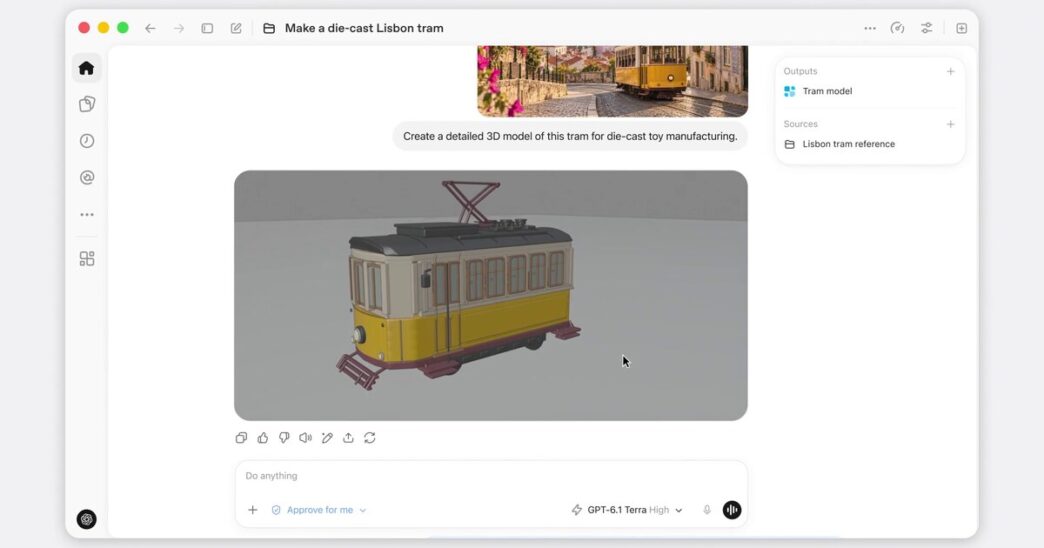
The 31-second launch video has no narration. Someone gives Terra a photo of a yellow Lisbon tram and asks for “a detailed 3D model of this tram for die-cast toy manufacturing.” Terra opens Blender and builds the tram from a plain box, adding windows, a roof, wheels and the trolley pole, while an on-screen note says the footage is “shown at actual speed” with “some sections omitted.” The model picker in the ChatGPT window reads GPT-6.1 Terra, set to High. It’s a well-chosen demo, not a measurement, and OpenAI doesn’t say how long the full job took.
OpenAI’s benchmark claims, and what they leave out
All of these numbers come from OpenAI’s launch post. On Agents’ Last Exam, a set of professional software tasks, OpenAI says Terra at medium effort scores 15 percentage points higher than GPT-5.6 Terra at about a third of the cost, performs “on par with GPT-6 Astra” and finishes tasks more than three times faster than Astra and Sol. At max effort, it claims Terra is over three times as token-efficient as Claude Opus 5.5 at a quarter of the per-token price, for “~9x lower cost per task.” The post doesn’t print the raw Agents’ Last Exam scores in its text.
The coding and accuracy claims are more specific. OpenAI says Terra solves 50.3% of Terminal-Bench 4.0 tasks at max effort, against GPT-5.6 Terra’s published 21.5%. On its internal set of error-inducing prompts, the error rate at low effort fell from 53.6% to 16.7%, and to 4.3% at max. OpenAI adds its own caveat: “For the most complex coding tasks, GPT-6.1 Sol and GPT-6 Astra remain the better choice.”
The system card addendum says OpenAI treats Terra as Critical in cybersecurity and High for biological and chemical capability under its Preparedness Framework, so it ships with the same safeguards as Sol and Astra.
What to watch next
The first independent cost-per-task numbers will tell you more than OpenAI’s charts, because Terra’s whole pitch is finishing more jobs for less money rather than winning on raw intelligence. The other open question is ChatGPT itself. OpenAI hasn’t said whether Terra will come to regular Chat or to the Free plan, where Luna is the GPT-6 model today.
Frequently asked questions
How much does GPT-6.1 Terra cost?
In the OpenAI API, standard pricing is $1 per million input tokens, $0.05 per million cached input tokens and $5 per million output tokens. Prompts over 272,000 input tokens are billed at 2x input and 1.5x output for the full request, and Batch and Flex are 50% cheaper.
Is GPT-6.1 Terra free in ChatGPT?
No. OpenAI lists Plus, Pro, Business, Enterprise and Edu, and Terra runs only in ChatGPT Work and Codex, not in regular Chat. Free users get GPT-6 Luna instead.
What is GPT-6.1 Terra’s context window?
OpenAI lists a 1,050,000-token context window, with a maximum of 922,000 input tokens and 128,000 output tokens. It accepts text and image input and outputs text. Its knowledge cutoff is June 1, 2026.
Should I use GPT-6.1 Terra or GPT-6.1 Sol?
Terra costs half as much as Sol and, according to OpenAI, finishes computer-use tasks more than three times faster. OpenAI itself recommends Sol or GPT-6 Astra for the most complex coding and in-depth research.
Sources
- OpenAI, “Introducing GPT-6.1 Terra” (October 26, 2026): openai.com
- OpenAI API docs, GPT-6.1 Terra model page (pricing, multipliers, context window, cutoff, endpoints): developers.openai.com
- OpenAI API docs, model pages for GPT-5.6 Terra, GPT-6.1 Sol, GPT-6 Astra and GPT-6 Luna (comparison prices): GPT-5.6 Terra, GPT-6.1 Sol, GPT-6 Astra, GPT-6 Luna
- OpenAI Help Center, ChatGPT release notes, “GPT-6.1 Terra” (October 26, 2026): help.openai.com
- OpenAI Help Center, Model release notes, “GPT-6.1 Terra”: help.openai.com
- ChatGPT Learn, “October 26–30, 2026”: learn.chatgpt.com
- OpenAI, “Addendum to GPT-6 Astra System Card: GPT-6.1 Terra” (October 26, 2026): deploymentsafety.openai.com
- AWS, “OpenAI GPT-6.1 Terra is now generally available on Amazon Bedrock” (October 26, 2026): aws.amazon.com
- OpenAI on X, GPT-6.1 Terra launch posts (October 26, 2026, 2:06 PM ET): launch video, availability
- OpenAI on YouTube, “GPT-6.1 Terra is now in orbit” (October 26, 2026): youtube.com
All sources checked on the morning of October 28, 2026 (ET). Benchmark figures are OpenAI’s own runs.
Last updated: October 28, 2026. To report an error, see our corrections page. Articles are drafted with AI assistance and reviewed and edited by an editor; see our editorial policy.