A Beijing physical-AI startup says it has built a single model that can run a robot’s dexterous hands through tasks it never saw in training. Nature Will introduced Natura-1 on October 13, 2026, in a PR Newswire release and a long research blog post. The company describes Natura-1 as a 50-billion-parameter mixture-of-experts model pretrained on more than one million hours of first-person human video, which drives 20-degree-of-freedom robot hands in a 100-millisecond control loop.
The headline number is a benchmark score of 53.4, against 13.5 for Physical Intelligence’s π0.5 and 16.7 for OpenAI’s GPT-6-Astra. Read the fine print, though. Natura-1 was scored on a robot with dexterous hands; both rivals were scored on a different robot with simple grippers, because neither produced a score on Nature Will’s hand platform at all.
What Nature Will says Natura-1 is
According to the blog, Natura-1 is one transformer trained jointly on language, images, video and action. It learns mainly from people: the company says its curated corpus covers one million hours of egocentric human data, made up of 61,702,471 episodes, 317,842 tasks and 14,286 scenes, mostly from paid data collection plus first-person videos from the internet. Nature Will says it reconstructs 3D hand and body motion from that footage and claims a 41% lower pose error than open-source tools on its own internal benchmark.
After pretraining, the company says, “a limited amount of robot manipulation data” adapts the model to a physical robot hand. It also argues that more human data keeps helping: between roughly 44,000 and one million hours of training data, Nature Will reports action-prediction error falling 47.7% on held-out human data and 67.7% on held-out robot data. Those are offline prediction metrics, not task success rates.
The company also claims tens of petabytes of storage and 350,000 hours of video processed per week. None of these figures has been independently checked.
The benchmark: hands versus grippers
Nature Will built its own test of 12 “capability dimensions” and ran it on a dual-arm setup of ROKAE AR5 arms with Wuji hands. The blog is candid that there is no like-for-like baseline. π0.5, a vision-language-action model we explain in our guide to Physical Intelligence’s π models, “fails even after being fine-tuned on our dexterous-hand robot data.” GPT-6-Astra, used as a code-writing robot policy, failed to score within a 60-minute limit per task.
So the company moved both rivals to an ARX AC One gripper robot, fine-tuned π0.5 on gripper demonstrations of the same tasks, and recorded 13.5 and 16.7. Natura-1 scored 53.4 in a “Base” setting and 59.1 in an “Agentic” setting, on the hand robot. The blog does not define the scoring scale or explain what the Agentic setting adds.
| Model | Robot used for scoring | Score (Nature Will) |
|---|---|---|
| Natura-1 (Base) | ROKAE AR5 arms + Wuji 20-DoF hands | 53.4 |
| Natura-1 (Agentic) | ROKAE AR5 arms + Wuji 20-DoF hands | 59.1 |
| GPT-6-Astra (coding policy) | ARX AC One grippers | 16.7 |
| π0.5 (fine-tuned) | ARX AC One grippers | 13.5 |
| π0.5 and GPT-6-Astra | ROKAE AR5 + Wuji hands | No scored result |
That makes the comparison a mix of model, hardware and test design, all chosen by the company that wins it. It does support a narrower claim: on Nature Will’s own hand platform, the two baselines it picked could not complete scored runs and Natura-1 could.
Demos: zero-shot trials and six tuned workflows
The blog’s videos fall into two groups, and the difference matters. Four benchmark tasks, such as wiping up water with a tissue and covering a pot after pouring in ingredients, are presented as zero-shot: the company says none of the tasks, scenes, objects or action combinations appear in its robot post-training data, and each clip is shown next to the closest training examples. A set of “spontaneous, unscripted” instruction trials from researchers’ daily use, plus a nearly 30-minute single-take video, makes the same zero-shot claim.
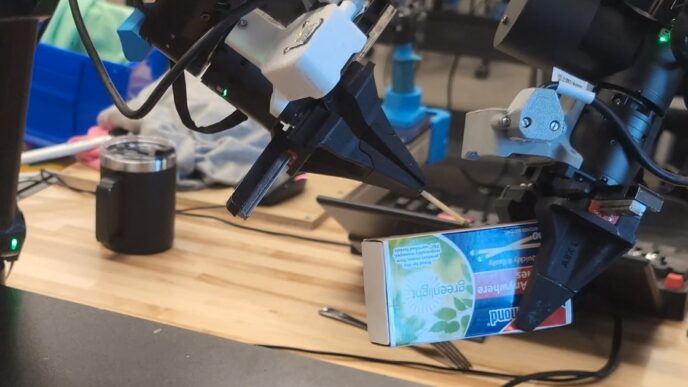
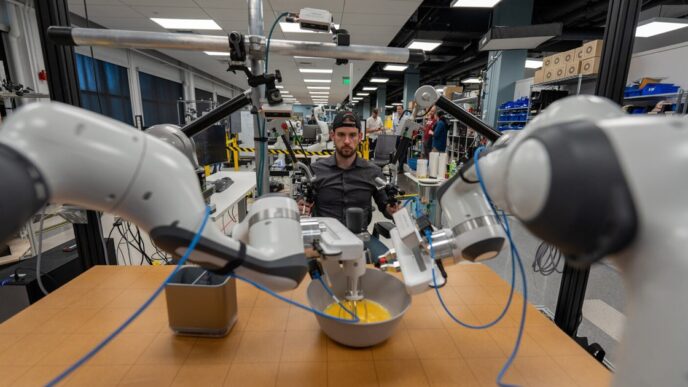
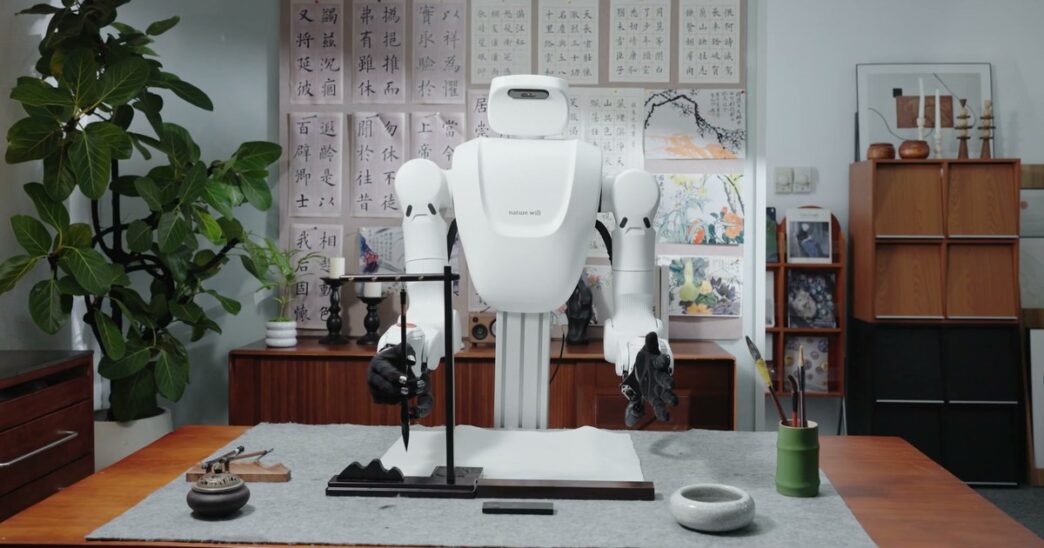
The six long-horizon showpieces are different. Making wontons, packing and labelling a shipping box, serving tea, Chinese calligraphy, applying a screen protector and making a yogurt bowl all “use additional tuning on top of Natura-1,” the company says. Those clips run up to about three minutes without human intervention, but they show what task-specific tuning can reach, not zero-shot ability. The image above comes from the calligraphy demo.
The blog also describes “emergent” behaviors, such as using a rod to drag a basket within reach or sliding a playing card over a box edge to grab it from below. Those are company-selected clips; Nature Will gives no count of failed attempts.
Who is behind Nature Will
The release names Ning Ding as founder and CEO. In April, Leiphone’s AI科技评论 reported that Ding is an assistant professor in Tsinghua University’s electronic engineering department and that the company, 自然意志 in Chinese, had raised an angel round from IDG Capital, Fengrui Capital and ZhenFund at a reported valuation of 4 billion yuan (about $600 million). The release carries a San Francisco dateline; the website is registered in Beijing.
“We believe general models that can handle every task must exist, and that those models must utilize dexterous hands,” Ding said in the release.
What has not been released
There is no paper, no model weights, no API and no product or customer named. The only citation the company offers is the blog post itself. That puts Natura-1 at the research-demo stage on our humanoid readiness scale, well short of models developers can actually try, such as Physical Intelligence’s π API beta. For background on why human video is attractive as training data, see our explainer on humanoid robot training data.
What to watch: whether Nature Will publishes a technical report with the benchmark’s scoring rules, lets outside labs run Natura-1 on their own hand hardware, or names a robot maker that will ship it.
Frequently asked questions
What is Natura-1?
Natura-1 is Nature Will’s robot foundation model, announced October 13, 2026. The company says it is a 50-billion-parameter mixture-of-experts model pretrained on more than one million hours of first-person human video and adapted with a limited amount of robot data to control 20-DoF dexterous hands.
Did Natura-1 really beat π0.5 and GPT-6-Astra?
On Nature Will’s own benchmark, Natura-1 scored 53.4 (Base) and 59.1 (Agentic) with dexterous hands, while π0.5 scored 13.5 and GPT-6-Astra 16.7 on a different robot with grippers. Neither rival produced a scored result on the hand robot. The comparison mixes models, hardware and a company-designed test.
Were the wonton and screen-protector demos zero-shot?
No. Nature Will says its six long-horizon workflows, including wontons, box packing, tea, calligraphy, the screen protector and the yogurt bowl, used additional task-specific tuning. Its benchmark tasks and researcher instruction trials are the ones presented as zero-shot.
Can developers download or use Natura-1?
Not yet. Nature Will has not released weights, a paper, an API, pricing or a product. The research blog is the only technical document so far.
Who founded Nature Will?
Nature Will’s CEO and founder is Ning Ding. Chinese tech outlet AI科技评论 reported in April 2026 that Ding is a Tsinghua University assistant professor and that the company raised an angel round from IDG Capital, Fengrui Capital and ZhenFund at a reported 4 billion yuan valuation.
Sources
- Nature Will, “The Will to Act: Introducing Natura-1,” research blog, October 2026: naturewill.com/blog/natura-1
- Nature Will via PR Newswire, “Physical AI Lab Nature Will Unveils Natura-1 as First General Foundational Model for the Physical World,” October 13, 2026, 9:00 a.m. ET: prnewswire.com
- AI科技评论 (Leiphone) via AITNT, “清华大学丁宁成立通用物理智能公司「自然意志」,估值40亿,” April 26, 2026: aitntnews.com
- DoNews, “自然意志获IDG等机构天使轮投资,估值40亿元,” April 27, 2026: donews.com
All sources accessed October 18, 2026.
Related: What is Physical Intelligence’s π0 · What is a robot foundation model · Humanoid robot training data · Physical Intelligence π API beta · More AI Models coverage
Last updated: October 18, 2026. To report an error, see our corrections page. Articles are drafted with AI assistance and reviewed and edited by an editor; see our editorial policy.