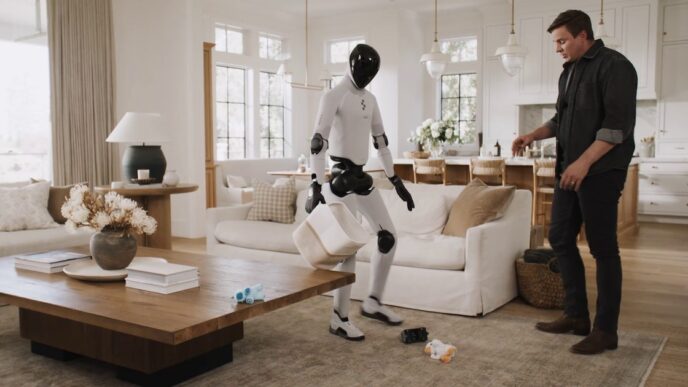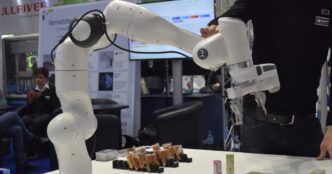
Google DeepMind’s newest robot AI can control a full humanoid “from feet to fingertips,” the company says. Unless you’re one of its early-access partners, you can’t use that part. The piece of Gemini Robotics 2 that developers can actually get their hands on is a reasoning model that plans tasks and doesn’t move a single motor.
That split is the most important thing to understand about Gemini Robotics 2, which DeepMind announced on July 30, 2026. It isn’t one model but a family of three. There’s a vision-language-action (VLA) model that controls robots, and an embodied-reasoning model, Gemini Robotics ER 2, that plans and checks progress. The third is a smaller VLA, Gemini Robotics On-Device 2, built to run on the robot itself. Only ER 2 is publicly available to developers. The VLA and the on-device model are limited to early-access partners and trusted testers. Here’s what each one does, what DeepMind has demonstrated, what it admits the models still can’t do, and what you can use today (as of October 6, 2026).
Three models, three levels of access
| Model | What it is | Who can use it (Oct 6, 2026) | Public documentation |
|---|---|---|---|
| Gemini Robotics 2 | VLA model: turns camera images and instructions into robot actions. DeepMind says it can control “full humanoids, from feet to fingertips, and other bi-arm robots.” | Early-access partners only | Blog post and safety report; no public model card found |
| Gemini Robotics ER 2 | Embodied-reasoning model (a vision-language model). Plans multi-step tasks, tracks progress and calls tools, such as a VLA or a robot API, to carry them out. Outputs text, not motor commands. | Publicly available in preview: Google AI Studio and the Gemini API; private preview on Gemini Enterprise Agent Platform | Model card, API documentation and pricing |
| Gemini Robotics On-Device 2 | Smaller, more efficient VLA that runs locally on the robot and can be adapted to new two-arm robots | Trusted testers only | Model page and model card |
If you are new to the terms, our explainer on what a vision-language-action model is covers how VLAs differ from the reasoning models that sit above them.
Gemini Robotics 2: the VLA for whole-body control
The headline model is the VLA. DeepMind’s announcement says one model can control “full humanoids, from feet to fingertips, and other bi-arm robots.” In the demonstrations DeepMind published, the same model checkpoint ran on three setups:
- Apptronik’s Apollo 2 humanoid with SharpaWave hands, which DeepMind describes as five-fingered with 22 degrees of freedom
- Apollo 2 with Inspire hands
- A Franka Duo two-arm setup with a Robotiq gripper
The tasks shown include tying knots, sealing a zip-top bag and following instructions such as putting a watering can into a particular bin on a shelf. These are company demonstrations. DeepMind has not published a full evaluation of the VLA alongside a model card, and we found no independent test of it. For what to look for in robot videos, see our guide to teleoperation versus autonomy in humanoid demos.
DeepMind is also direct about the limits. The announcement says “multi-finger dexterous manipulation remains challenging,” that “our robots have more to advance in movement speed,” and it describes a “medium to high success rate for whole-body and gripper-based dexterous tasks.” In other words, the company is not claiming reliable, production-grade dexterity. For background on why five-finger hands are hard, see our explainer on dexterous robot hands, and for a different design choice, our article on the Boston Dynamics Atlas four-finger hand.
On availability, DeepMind says, “Our VLA and On-Device models are available to early-access partners.” The Gemini Robotics models page offers a waitlist for testing the models and a Google DeepMind Accelerator for startups. Neither is open access. Ars Technica’s report on the launch reached the same reading: of the three models, only one is publicly available.
Gemini Robotics ER 2: the reasoning model you can use today
ER 2 is the “brain” layer. It does not move motors directly. It looks at images, video, audio and text and produces text: plans, object locations, progress judgements and tool calls. Google says it “hands off motor execution to any given lower level vision-language-action (VLA) model” and can also call tools such as Google Search or developer-defined functions. DeepMind says it can “plan multi-step tasks lasting several minutes” and coordinate more than one robot. Its model card says it is based on Gemini 3.5 Flash.
| Item | Published value |
|---|---|
| Model codes (Gemini API) | gemini-robotics-er-2-preview; gemini-robotics-er-2-streaming-preview (Live API) |
| Status | Preview |
| Inputs | Text, image, video, audio |
| Output | Text |
| Input token limit | 131,072 |
| Output token limit | 65,536 |
| Where to access | Google AI Studio, Gemini API; Gemini Enterprise Agent Platform in private preview |
| Base model | Gemini 3.5 Flash (per the model card) |
ER 2 pricing
Google’s Gemini API pricing page (last updated October 7, 2026) lists ER 2 preview prices per million tokens. The free tier is free of charge. Paid-tier prices are set to double on January 1, 2027.
| Paid tier, per 1M tokens | Through Dec 31, 2026 | From Jan 1, 2027 |
|---|---|---|
| Standard input | $1.00 | $2.00 |
| Standard output | $5.00 | $10.00 |
| Batch input | $0.50 | $1.00 |
| Batch output | $2.50 | $5.00 |
Preview pricing can change. Check the pricing page before you budget a project.
What Google says ER 2 can do
Google’s ER 2 post gives a few numbers. All are from Google’s own evaluations:
- Progress classification: 57.4 percent accuracy at judging how far a task has progressed, which Google says beats its previous models and competing frontier models.
- Moment finding: 91.3 percent accuracy at finding a specific moment in a video, with a mean absolute distance of 0.96 seconds, and what Google calls “4x the execution speed.”
- Instrument reading: extended from dials and sight glasses to digital displays, linear scales, rulers and liquid thermometers, tested across 10 instrument types.
- Tool orchestration: Google says ER 2 “consistently outperforms ER 1.6” across three control modes: a real VLA, a simulated VLA and a human teleoperator.
Google also built a demo in which ER 2 orchestrates Boston Dynamics Spot’s navigation and arm APIs so the robot fetches an object on a spoken command (code is on GitHub), and showed ER 2 helping an Apollo 2 humanoid and a Franka F3 Duo setup work together. These are demonstrations, not deployments.
There are use limits, too. The ER 2 model card’s acceptable-use section says not to use the model for safety-critical applications such as healthcare or transportation. Google’s robotics developer documentation also warns that the model can “hallucinate,” says “it is your responsibility to maintain a safe environment around the robot,” and says identifiable people around the robot must be notified and consent before their personal data is sent to Google, suggesting steps such as face blurring. ER 2 is meant to sit on top of a robot’s own safety systems, not replace them.
Gemini Robotics On-Device 2: local control for two-arm robots
On-Device 2 is the most efficient of the three VLAs. It runs locally rather than in the cloud, which matters for latency and for robots with weak or no network connection. DeepMind says it can adapt to a new two-arm robot “with just a few hours of adaptation time, typically with less than 200 examples.” DeepMind showed it on Dexmate, SO101 and Trossen platforms.
Its model card is unusually specific about limits. It says the model is “limited in its ability to generalise to out of distribution tasks as well as controlling high-degree-of-freedom robots.” It was evaluated mainly on standing two-arm manipulation, and mobile or whole-body control is outside its scope. The card says the model is “distributed only to Trusted Testers” and recommends layered safety measures.
The original Gemini Robotics On-Device (June 2025) was offered to trusted testers with a software development kit and adapted with 50 to 100 demonstrations. DeepMind called it the first VLA it was making available for fine-tuning.
Safety: what DeepMind tested and what it did not
DeepMind released a safety report dated July 29, 2026 and a benchmark called ASIMOV-Agentic. The dataset is on Hugging Face under a CC BY 4.0 licence, with gated access. DeepMind calls ER 2 its “safest robotics model to date.”
- Safe stopping: in lab tests on Apptronik’s Apollo 2, the report gives “99% human detection accuracy and 96% reliability in transitioning to a safe pose,” measured at 1 m and 2 m distance thresholds. The 99 percent figure is for the reasoning model and the 96 percent figure for the VLA. DeepMind’s announcement says the models can detect nearby people and bring the robot to a safe stop if someone gets too close.
- Text-only safety questions: the report says all frontier models it tested scored at least 96.0 percent at classifying safety in text. It also says a gap remains for spatial reasoning and tool use.
- No model is perfect: the report says “no model currently operates in the ideal top-right quadrant (near-zero FNR and FPR)” and that it is “best to utilize them alongside deterministic, low-level safety guardrails.”
- Not covered: the report does not evaluate a robot’s functional safety architecture. It is not a certification.
For how safety standards for robots near people work, see our guide to regulations and safety certifications for robots.
Demo, access or deployment? Reading the launch
| Evidence type | What exists for Gemini Robotics 2 |
|---|---|
| Company claims | Whole-body humanoid control, multi-minute planning, adaptation in under 200 examples, “safest robotics model to date” |
| Company demonstrations | Apollo 2 with two hand types, Franka Duo, Spot, Dexmate, SO101 and Trossen platforms |
| Company-run evaluations | ER 2 benchmark percentages; safe-stopping tests in the safety report |
| Public developer access | ER 2 only, in preview, with published pricing |
| Limited access | VLA (early-access partners), On-Device 2 (trusted testers) |
| Independent evaluation | None found for the VLA or On-Device 2 |
| Commercial deployment | None announced that we found. Apptronik describes a strategic partnership with Google DeepMind but has not published how many robots run Gemini Robotics 2. |
How Gemini Robotics got here
| Date | Release | Access at launch |
|---|---|---|
| Mar 12, 2025 | Gemini Robotics and Gemini Robotics-ER, built on Gemini 2.0; trained mainly on the ALOHA 2 two-arm platform; Apptronik partnership announced | ER to trusted testers, including Agile Robots, Agility Robotics, Boston Dynamics and Enchanted Tools |
| Jun 24, 2025 | Gemini Robotics On-Device | Trusted-tester SDK |
| Sep 25, 2025 | Gemini Robotics 1.5 and ER 1.5 | ER 1.5 through the Gemini API; the 1.5 VLA to select partners |
| Apr 14, 2026 | Gemini Robotics ER 1.6, with instrument reading developed with Boston Dynamics | Gemini API and Google AI Studio |
| Jul 30, 2026 | Gemini Robotics 2, ER 2 and On-Device 2 | ER 2 public preview; VLA and On-Device 2 limited |
The pattern has held since 2025: the reasoning model goes to developers through the Gemini API, and the action models stay with partners. Google’s developer documentation now points developers from ER 1.6 to ER 2. For how these models fit with other approaches, see our explainer on robot learning models.
If you build or buy robots
- Developers can try ER 2 today in Google AI Studio or through the Gemini API, at no charge on the free tier. You still need your own robot control stack to turn ER 2’s plans into motion.
- Robot makers who want the VLA or On-Device 2 need to join the waitlist or partner programs; there is no public download or API.
- Buyers should not read Gemini Robotics 2 as a feature of a robot they can order. We found no robot on sale that lists Gemini Robotics 2 as a shipping feature. See our best humanoid robots of 2026 guide for what is actually available, and our humanoid robot explainer for the basics.
- Comparisons with other robot AI models, such as Figure’s Helix, are difficult because each company tests on its own tasks. See our article on Figure 03 and Helix for how Figure reports its results.
The thing to watch is access. If DeepMind opens the Gemini Robotics 2 VLA beyond early-access partners, or publishes a model card for it, outside developers will finally be able to test the “feet to fingertips” claim. Until then, ER 2 is the only part of the family anyone outside DeepMind’s partner list can evaluate.
Frequently asked questions
What is Gemini Robotics 2?
Gemini Robotics 2 is a family of three Google DeepMind robot AI models announced on July 30, 2026: a vision-language-action model for whole-body control, the Gemini Robotics ER 2 reasoning model, and Gemini Robotics On-Device 2, a smaller model that runs on the robot.
Can I use Gemini Robotics 2 today?
Only the reasoning model. Gemini Robotics ER 2 is available in preview in Google AI Studio and the Gemini API, and in private preview on Gemini Enterprise Agent Platform. DeepMind says the Gemini Robotics 2 VLA and On-Device 2 are available to early-access partners only.
How much does Gemini Robotics ER 2 cost?
Google’s pricing page lists a free tier. On the paid tier, the ER 2 preview costs $1.00 per million input tokens and $5.00 per million output tokens through December 31, 2026, rising to $2.00 and $10.00 from January 1, 2027. Batch prices are half the standard rate.
Which robots has Gemini Robotics 2 been shown on?
DeepMind showed the VLA on Apptronik’s Apollo 2 humanoid with SharpaWave and Inspire hands and on a Franka Duo two-arm setup. ER 2 was shown directing Boston Dynamics’ Spot, and On-Device 2 was shown on Dexmate, SO101 and Trossen platforms. These are company demonstrations.
Does Gemini Robotics On-Device 2 run without the cloud?
Yes. DeepMind describes it as its most efficient VLA, designed to run locally on the robot. Its model card says it was evaluated mainly on standing two-arm manipulation and is limited in controlling robots with many degrees of freedom.
Is Gemini Robotics 2 safe to use around people?
DeepMind reports strong lab results, including 99 percent human detection and 96 percent reliable safe stops on Apollo 2, but its own safety report says no model is close to perfect and should be used with deterministic, low-level safety guardrails. The report does not certify any robot as safe.
Related reading
- What is a vision-language-action model?
- Robot learning models explained
- Teleoperation vs autonomy in humanoid robot demos
- Boston Dynamics Atlas four-finger hand
- Figure 03: specs, Helix and what is undisclosed
- Best humanoid robots in 2026
Sources
All accessed October 5, 2026; DeepMind and Gemini API pages re-checked October 6, 2026.
- Google DeepMind, “Gemini Robotics 2 brings whole-body intelligence to robots” (Jul 30, 2026): deepmind.google
- Google DeepMind, Gemini Robotics models page: deepmind.google/models/gemini-robotics
- Google DeepMind, Gemini Robotics On-Device page: deepmind.google
- Google DeepMind, Gemini Robotics On-Device 2 model card (Jul 30, 2026): deepmind.google
- Google DeepMind, Gemini Robotics ER 2 model card: deepmind.google
- Google, “Gemini Robotics ER 2” (Jul 30, 2026): blog.google
- Google DeepMind, “Gemini Robotics 2: Safety Evaluations” (Jul 29, 2026, PDF): storage.googleapis.com
- Google, ASIMOV-Agentic dataset (CC BY 4.0, gated): huggingface.co
- Google AI for Developers, Gemini Robotics ER 2 model page: ai.google.dev
- Google AI for Developers, Gemini Robotics overview: ai.google.dev
- Google AI for Developers, Gemini API pricing (last updated Oct 7, 2026): ai.google.dev
- Google DeepMind, “Gemini Robotics brings AI into the physical world” (Mar 12, 2025): deepmind.google
- Google DeepMind, “Gemini Robotics On-Device brings AI to local robotic devices” (Jun 24, 2025): deepmind.google
- Google DeepMind, “Gemini Robotics 1.5 brings AI agents into the physical world” (Sep 25, 2025): deepmind.google
- Google DeepMind, “Gemini Robotics ER 1.6” (Apr 14, 2026): deepmind.google
- Apptronik, Series A extension release (Feb 11, 2026), for the Google DeepMind partnership: globenewswire.com
- Ars Technica, “Google reveals Gemini Robotics 2.0, promising improved dexterity and safety” (Jul 30, 2026): arstechnica.com
Last updated: October 6, 2026. To report an error, see our corrections page. See our editorial policy. Performance figures are Google DeepMind’s own evaluations unless stated otherwise.