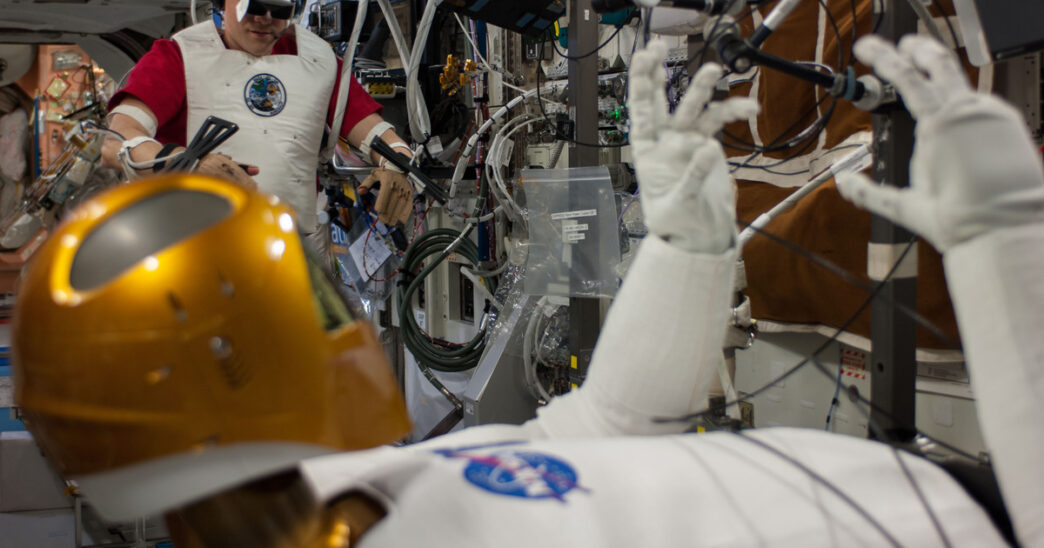
Almost every humanoid robot video raises the same question: is the robot doing this itself, or is a person controlling it? The answer is rarely binary. A robot can walk on its own while a remote operator picks the objects it manipulates; it can run a learned policy while an engineer watches and steps in; or it can replay a motion recorded once. This guide gives you a five-level vocabulary for control, summarizes what major companies have actually published about it, and ends with a checklist you can apply to any demo. It builds on our definition of a humanoid robot and the evidence tiers we use in our best humanoid robots ranking.
Why teleoperation is not the villain
Teleoperation means a human drives the robot in real time, typically through a VR headset, motion-capture suit, leader arms or a handheld controller. It is how many robots learn. Stanford’s Mobile ALOHA project (arXiv:2401.02117) used a whole-body teleoperation system to record demonstrations and then trained policies on them; the authors report that with 50 demonstrations per task, co-training with existing static data increased success rates by up to 90 percent, while the hardest task (sauteing shrimp, 20 demonstrations, five test trials) reached 40 percent. NVIDIA’s GR00T N1 paper (arXiv:2503.14734) describes a “data pyramid” whose top layer is real-robot teleoperation data, and says in its limitations that robot data scales linearly with human labor.
So teleoperation is a legitimate tool. The problem is not that people are involved. The problem is when a viewer cannot tell how much people were involved, and when a pilot-controlled clip is used as evidence that a robot is ready to work unsupervised.
A five-level control ladder
| Level | Name | What a human does | What to ask |
|---|---|---|---|
| 1 | Scripted or replayed motion | Programs or records the motion in advance | Does it still work if the object moves? |
| 2 | Direct teleoperation | Controls arms, hands and sometimes walking in real time | Who is the operator, and from where? |
| 3 | Remote assistance / shared control | Triggers or steers parts of the task while the robot handles balance and low-level motion | Which parts are the robot’s? |
| 4 | Supervised autonomy with human fallback | Watches, approves tasks, or takes over when the robot fails | How often does a person step in? |
| 5 | Autonomous task execution | Starts the task and sets up the scene | How many trials, in how many places, and how many failures? |
The Mobile ALOHA authors give a useful reason to be skeptical of Level 1 demos: they report that replaying a recorded action sequence open-loop gave zero whole-task success in their tests, because small errors accumulate. A robot that adapts has to react to what its cameras see.
What companies have actually published
| Company | Published statement | How to read it |
|---|---|---|
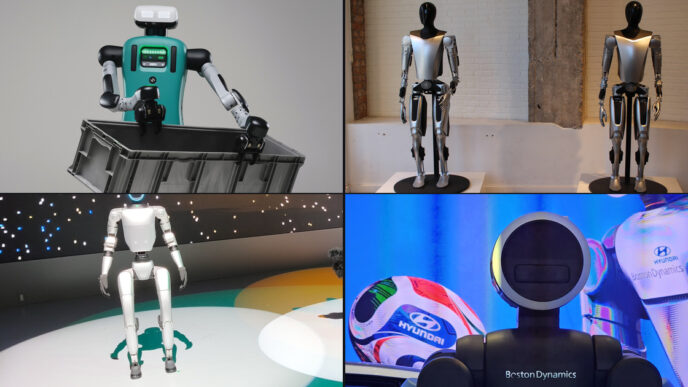
| 1X (NEO) | Its NEO page says NEO “works autonomously by default. For any chore it doesn’t know, you can schedule a 1X Expert to guide it,” that an Expert can “remotely supervise its actions at scheduled times,” and lists “Remote Control: Pilot your NEO from anywhere in the world” through a mobile app and VR device. An April 30, 2026 factory post says current units are prioritized for 1X’s internal team, with customer deliveries starting in 2026. | Level 4 by design, with Levels 2-3 available. The company is open that humans are part of the product. The autonomy level of delivered units is not independently verified. |
| Figure AI | The Helix post (Feb 20, 2025) reports training on about 500 hours of teleoperated behavior data. The Helix 02 post (Jan 27, 2026) says all of its videos are “fully autonomous, not teleoperated.” The Helix 2.5 post (Sep 17, 2026) describes a blind evaluation in 30 previously unseen homes where any human intervention for safety counted as a failure. | Training used teleoperation; the demos are claimed autonomous (Level 5 claim). These are company claims, not independently audited. |
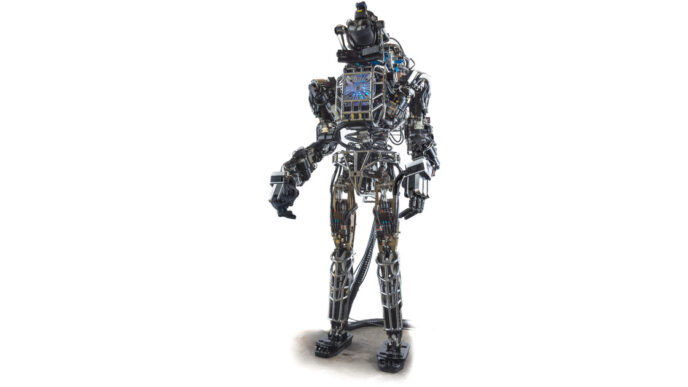
| Boston Dynamics (Atlas) | The Atlas spec sheet lists three operating modes: autonomous, VR teleoperated and tablet control. Its Jan 5, 2026 blog says Atlas can work autonomously but can also be controlled with a VR headset or tablet. | Teleoperation is a documented product mode, not a hidden one. |
| Tesla (Optimus) | At the Oct 10, 2024 We, Robot event, Bloomberg (citing people familiar) and a Morgan Stanley note reported that humans remotely assisted Optimus robots for conversation and drink service; The Verge noted a robot saying “Today, I am assisted by a human.” Tesla’s July 2026 update says early Optimus builds will be used in its Optimus Academy for training data collection. | Reports, not a Tesla breakdown. Tesla does not say how its training data is collected. |
| Agility Robotics (Digit 5) | The Digit 5 announcement says it “will be capable of operating autonomously during normal work” and describes the FORT pendant as a redundant manual override. | Forward-looking autonomy claim; the pendant is a safety and setup device, not a work mode. |
On Tesla, see our longer Optimus status page, and for Agility’s safety approach, Digit 5 specs and safety design.
Why the distinction matters for AI claims
Many 2026 humanoid headlines rely on vision-language-action models, which map camera images and an instruction to robot actions. Those models are trained on demonstrations, and the demonstrations are often teleoperated. That is why “trained from teleoperation” and “autonomous at run time” can both be true of the same robot. If you want the model side of the story, read What is a vision-language-action model?
Control mode is also separate from deployment status. A robot can be autonomous in a lab video and still be a pilot unit; it can be remote-assisted and still be earning revenue. Keep two questions apart: who controls the robot, and where is it actually working?
The home-robot twist: remote operators and privacy
When the robot is in a living room, remote assistance is also a privacy question. 1X has said, according to a Humanoids Daily report of its October 2025 briefing, that its remote sessions require user approval, that faces are blurred and that owners can set no-go zones. That reporting is secondary, so check 1X’s own policies before you buy. For a Wall Street Journal demo, the same report says the reporter did not see NEO do anything autonomously; treat this as one account of an early demo, not a verdict on the product. Eric Jang of 1X compared the model to how Waymo vehicles are supervised, with the robot acting autonomously and calling for human help when needed (as reported).
Whether other home-oriented humanoids will use remote operators, and what data they would see, is not publicly confirmed.
A checklist for reading any demo
| Question | Good sign | Warning sign |
|---|---|---|
| Is the control mode stated? | Caption or post says autonomous, teleoperated, or mixed | No statement, or wording like “AI-powered” with no detail |
| Is the footage continuous and real speed? | One take, labeled playback speed | Cuts, 2x-10x speed with no label |
| How many attempts? | Trial counts and success rate | One successful clip only |
| Same place as training? | New rooms, new objects, blind evaluation | A set that matches the training environment |
| What counts as a failure? | Human intervention counted as failure | Operator resets not mentioned |
| Where is the compute? | Onboard, or networking latency disclosed | Offboard compute not disclosed |
| Independent observers? | Customer, journalist or third party present | Only the company’s own videos |
| What happens next? | Pilot, customer or deployment status documented | “Coming soon” with no dates or customers |
What we do on this site
When we describe a demo we say who controlled it if the maker has said, and “not publicly confirmed” if not. We label statements such as “fully autonomous” as company claims unless independent testing exists. See our editorial policy.
Frequently asked questions
Is teleoperation cheating in a humanoid robot demo?
Not by itself. Teleoperation is a standard way to collect training data, and several companies and research groups say so openly. It becomes misleading when a video implies autonomy without saying a person was in control, or when remote help is left out of claims about readiness for work.
Can you tell from a video whether a robot is teleoperated?
Not reliably. Cuts, sped-up footage and a single successful take are warning signs, but a smooth video can still be piloted and a clumsy one can be autonomous. The dependable evidence is a written statement of the control mode, plus trial counts and failure rates.
What did reporters find about Tesla’s 2024 We, Robot event?
Bloomberg, citing people familiar with the matter, and a Morgan Stanley analyst note reported that people remotely helped control Optimus robots that served drinks and chatted. Reports said the walking was AI-driven. Tesla did not publish a breakdown at the event; these are reports, not a Tesla confirmation.
Will home humanoid robots be remotely operated by company staff?
For 1X NEO, the company says so: NEO is meant to work autonomously by default, and owners can schedule a 1X Expert to guide it through chores it does not know. For other home-oriented humanoids we could not find a published statement, so it is not publicly confirmed.
Does ‘fully autonomous’ mean no human was ever involved?
No. It usually describes how the robot performed a specific task in a specific video or test. Humans still build the training data, set up the scene, supervise safety and reset the task between trials. Ask what a human did during the run and how many attempts were made.
Related reading
- What is a humanoid robot? Definition, types and 2026 examples
- What is a vision-language-action model?
- Best humanoid robots in 2026
- Tesla Optimus status, October 2026
- Agility Digit 5: specs, safety design and availability
Sources
All accessed October 4, 2026.
- 1X, NEO product page: 1x.tech/neo
- 1X, “Introducing NEO” (Oct 28, 2025): 1x.tech
- 1X, “Building NEO Factory” (Apr 30, 2026): 1x.tech
- Figure AI, “Helix: A Vision-Language-Action Model for Generalist Humanoid Control” (Feb 20, 2025): figure.ai
- Figure AI, “Helix 02” (Jan 27, 2026): figure.ai
- Figure AI, “Helix 2.5: zero-shot generalization in 30 homes” (Sep 17, 2026): figure.ai
- Boston Dynamics, Atlas spec sheet (Jan 2026): bostondynamics.com (PDF)
- Boston Dynamics, “Enterprise Robotics Redefined” (Jan 5, 2026): bostondynamics.com
- Tesla, “Q2 2026 Update” (Jul 22, 2026): ir.tesla.com (PDF)
- Agility Robotics, “Agility Unveils Digit 5” announcement: agilityrobotics.com
- Fu et al., “Mobile ALOHA: Learning Bimanual Mobile Manipulation with Low-Cost Whole-Body Teleoperation,” arXiv:2401.02117: arxiv.org
- NVIDIA et al., “GR00T N1: An Open Foundation Model for Generalist Humanoid Robots,” arXiv:2503.14734: arxiv.org
- Ars Technica, “Reports: Tesla’s prototype Optimus robots were controlled by humans” (Oct 2024) (secondary): arstechnica.com
- The Verge, report on human-controlled Optimus robots at the We, Robot event (Oct 13, 2024) (secondary): theverge.com
- Humanoids Daily, “1X Details NEO’s ‘Human-in-the-Loop’ Strategy and Hardware as $20,000 Pre-Orders Go Live” (Oct 28, 2025) (secondary): humanoidsdaily.com
Last updated: October 4, 2026. To report an error, see our corrections page. Articles are drafted with AI assistance and reviewed and edited by an editor; see our editorial policy.