Ubitium, a Düsseldorf semiconductor startup, raised $14 million in new seed funding on October 13 to build what it calls a universal processor for Physical AI: one chip meant to handle sensing, inference and real-time control instead of a stack of specialized parts. Ibex Investors led the round. OpenOcean, existing backers KBC Focus Fund, Runa Capital and Inflection, and Quantum Systems co-CEO Florian Seibel (investing personally) joined. Total seed funding is now $18 million since the 2024 founding.
Robot companies usually buy that stack as separate DSPs, NPUs and CPUs, then spend engineering time gluing them together on a power budget. Ubitium’s bet is that Physical AI workloads change too fast for fixed partitions. Whether that becomes a humanoid bill-of-materials story is still ahead of the product calendar. What the company has today is first silicon, a 2027 evaluation plan and a primary press release with hard numbers.
What Ubitium says it built
Ubitium’s architecture is a reconfigurable RISC-V array that allocates the same silicon to signal processing, AI inference and control at runtime. Co-founders Hyun Shin Cho (CEO) and Martin Vorbach (CTO) argue that autonomous machines have to perceive, think and act at once, often on battery, and that stitching DSP + NPU + CPU together adds transfers and complexity Physical AI cannot afford.
“Physical AI machines bring a whole new set of computing challenges, and the inference isn’t the hardest one,” Cho said in the company’s release. “Sensing the real world and controlling the machine in it are just as hard, and today those still run on separate chips. We built one Physical AI processor that does all three, proved it in silicon in a year, and this funding turns it into a product.”
The company says it holds 17 granted patents on the core technology, with more pending, and that Vorbach’s prior reconfigurable-computing work accounts for more than 200 patents licensed by major semiconductor firms. Those are company claims; we haven’t audited the patent portfolio.
UB108 today, UB410 in 2027
| Chip | What Ubitium says | Status |
|---|---|---|
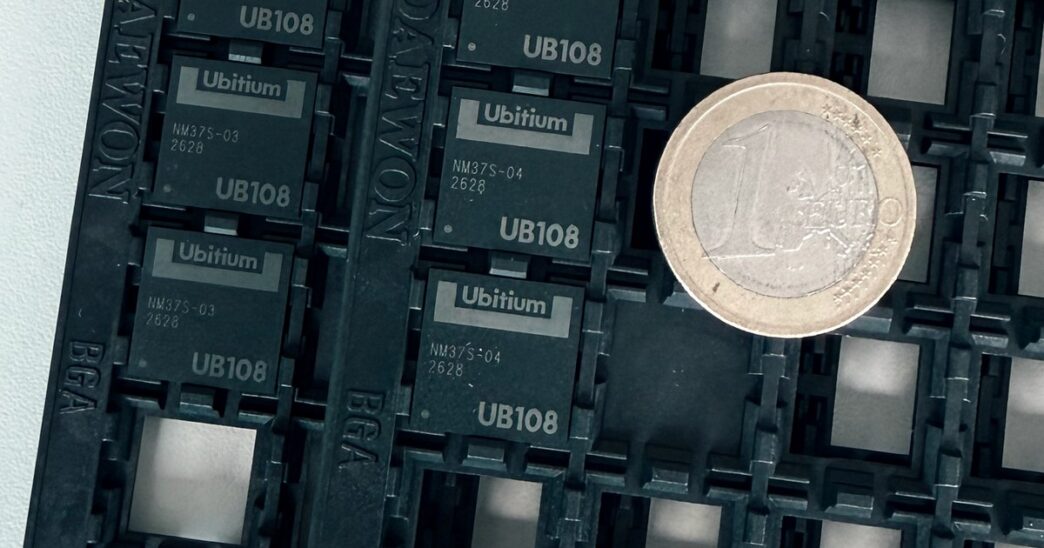
| UB108 | 256 processing elements; Samsung 8 nm; demonstrated signal processing, AI inference and real-time control on one reconfigurable array | First silicon returned (company) |
| UB410 | 4,096 processing elements; first commercial processor; evaluation units planned | Tape-out and eval units targeted for 2027 |
Initial customers, per the release, are building the sensing layer of Physical AI: high-resolution radar and audio systems where embedded chips already ship in volume. Autonomous systems, including drones, are named as the target for the full perceive-think-act loop. Humanoid robots are mentioned in investor commentary as part of the long-term market, not as a current design win.
Who put money in, and why they say they did
Ibex Investors led. OpenOcean’s Tom Henriksson framed the problem as machines that cannot run on “a patchwork of repurposed chips.” Florian Seibel, co-founder and co-CEO of defense tech company Quantum Systems, said onboard perceive-think-act under power and weight limits is why he invested personally. KBC Focus Fund’s Rudi Severijns pointed to first silicon in a year as proof of the earlier bet. Inflection’s Jonatan Luther-Bergquist said the thesis now covers “from drones to humanoids.”
Those quotes are in Ubitium’s own release. They are investor marketing, not independent diligence. For how we track other robotics and embodied-AI rounds, see our 2026 robotics funding tracker.
How to read this against humanoid timelines
A chip announcement is not a robot announcement. Ubitium is selling a processor story with working first silicon and a 2027 eval schedule. It has not published a customer list, a wattage/TOPS sheet for UB410, a price or a design win inside a named humanoid. Compare that to robot-company model releases such as Unitree’s UnifoLM WLA, where the artifact is software you can inspect, or to Atlas and Apollo status pages, where the artifact is a platform already in pilots.
The useful test over the next year is whether radar and audio customers actually ship UB108-class parts, and whether the UB410 eval units arrive in 2027 with numbers a robot integrator can put in a spreadsheet. Until then, treat the $14 million as confirmed fundraising and the architecture claims as company-described.
What we don’t know yet
- Performance numbers. No public TOP/W, latency or memory figures for UB108 or UB410.
- Named customers. “Initial customers” in radar and audio are not identified.
- Humanoid design wins. Investor quotes gesture at humanoids; the product roadmap leads with sensing and drones.
- Price. Not disclosed.
Frequently asked questions
How much did Ubitium raise?
Ubitium announced $14 million in new seed funding on October 13, 2026, bringing total seed funding to $18 million since it was founded in 2024. Ibex Investors led; OpenOcean, KBC Focus Fund, Runa Capital, Inflection and Florian Seibel participated.
What is Ubitium building?
A reconfigurable RISC-V processor meant to run signal processing, AI inference and real-time control on one chip for Physical AI machines (robots, drones, vehicles, industrial equipment), instead of separate DSP, NPU and CPU parts.
What chips does Ubitium have?
UB108 (256 processing elements on Samsung 8 nm) is first silicon that the company says already demonstrated the three workloads on one array. UB410 (4,096 processing elements) is planned as the first commercial part, with evaluation units targeted for 2027.
Is this a humanoid robot company?
No. Ubitium is a semiconductor startup. Its near-term customers are described as radar and audio sensing; drones and other autonomous systems are the stated path to a full perceive-think-act loop. Humanoids appear in market commentary, not as a shipped product.
Where is Ubitium based?
Düsseldorf, Germany. It was founded in 2024 by Hyun Shin Cho and Martin Vorbach.
Sources
- Ubitium, “Ubitium Raises $14 Million to Build the First Universal Processor for Physical AI,” October 13, 2026: ubitium.com
- Tech.eu, Tamara Djurickovic, “Ubitium raises $14M to bring universal computing to physical AI,” October 13, 2026: tech.eu
- SiliconANGLE, Kyt Dotson, October 13, 2026: siliconangle.com
- OpenOcean, “Why we invested in Ubitium,” October 13, 2026: openocean.vc
Related: Robotics funding tracker 2026 · Robot companies directory · More robot-company coverage
Last updated: October 14, 2026. To report an error, see our corrections page. Articles are drafted with AI assistance and reviewed and edited by an editor; see our editorial policy.