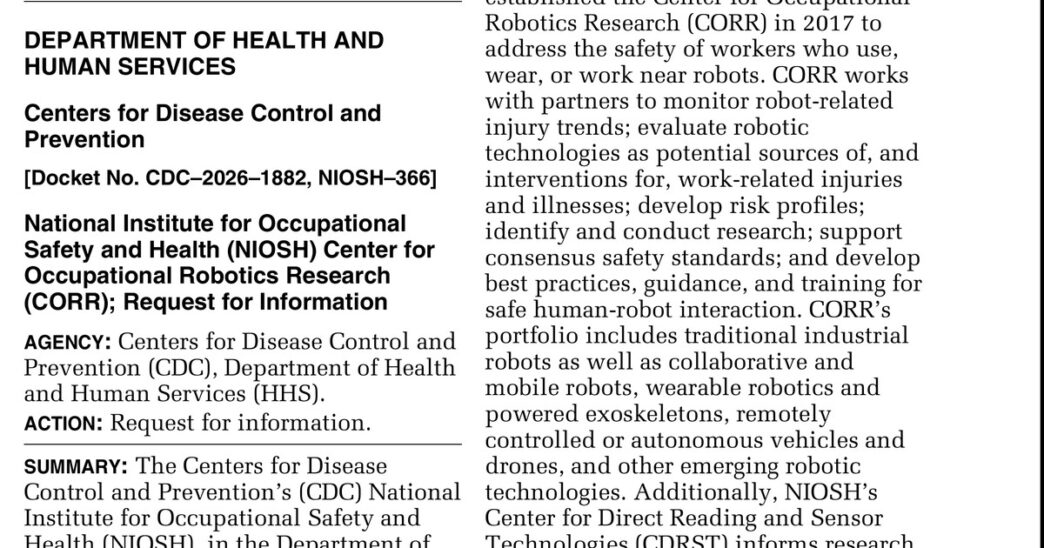
The National Institute for Occupational Safety and Health (NIOSH), the federal research agency for worker safety, published a NIOSH humanoid robot Request for Information in the Federal Register on November 23, 2026. The two-page notice (91 FR 75513) asks eight questions about humanoid robots in workplaces, from which tasks they could take on to which hazards and safety controls should come first. Comments are open until February 22, 2027, under docket CDC-2026-1882 (NIOSH-366).
It is not a new rule. The notice says it “is for information-gathering purposes only and does not propose new regulations, requirements, or policies,” and the Regulations.gov docket is filed as “Nonrulemaking.” What it does show is a federal safety agency asking about humanoids as their own category, separate from factory robot arms. We read the full notice, checked the docket on Regulations.gov, and set each of the eight questions next to the standards and rules that already exist, in the US and abroad.
- What it is: a Request for Information from NIOSH’s Center for Occupational Robotics Research, part of the CDC, published November 23, 2026, on “research priorities and prevention needs related to humanoid robots in workplaces.”
- What it is not: a regulation. It proposes no rules, and OSHA’s robotics page still says there are “currently no specific OSHA standards for the robotics industry.”
- Deadline and how: comments by February 22, 2027, through Regulations.gov (docket CDC-2026-1882) or by mail. No email. Everything submitted is posted publicly, including personal information.
- The gap: the notice never mentions falls, balance or power loss, the hazard that most separates a walking robot from a bolted-down arm. Question 7, on design features and safety controls, is where commenters can raise it.
What NIOSH published, and what it is not
NIOSH is the part of the Centers for Disease Control and Prevention that researches workplace injuries and recommends ways to prevent them. It set up its Center for Occupational Robotics Research (CORR) in 2017 “to address the safety of workers who use, wear, or work near robots,” according to the notice. CORR’s portfolio already covers industrial arms, collaborative and mobile robots, exoskeletons, drones and autonomous vehicles. The notice lists its current work: surveillance of robot-related injury claims, studies of how a robot’s speed, trajectory and design affect workers’ trust and workload, and approaches to “visibility, separation, and collision avoidance.”
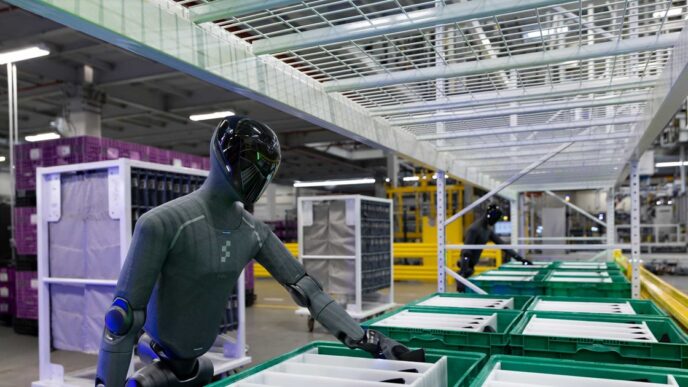
Humanoids get their own paragraph. NIOSH says they “may combine bipedal or other human-like mobility with manipulation, perception, remote operation, autonomous functions, and software that can be updated or adapted,” and that these traits “may create questions that are not fully answered by experience with fixed industrial robots or other established robot types.” It says it wants evidence about both benefits and hazards. The notice was filed on November 20 and is signed by NIOSH Director John J. Howard.
The notice also points to a second NIOSH group, the Center for Direct Reading and Sensor Technologies, as relevant to “robot-mounted sensors, workplace monitoring, worker-worn sensors, alarm performance” and sensor data quality. That matters because the sensors that keep a humanoid away from people usually ride on the robot itself, not on a fixed cell.
The baseline is thin. A NIOSH study of Bureau of Labor Statistics records, summarized in NIOSH’s July 2023 eNews, counted 41 robot-related worker deaths in the US from 1992 to 2017. Stationary robots accounted for 83% of them and mobile robots for 17%, and more than three-quarters happened while the robot was powered to operate on its own, often during maintenance. That data set predates humanoids in workplaces, which is why the notice asks what injury, near-miss or exposure data would help.
The eight questions, and what already covers each one
The notice’s questions are short. The table below gives each one in NIOSH’s words or a close paraphrase, what already exists that bears on it, and the gap as we see it. The middle column draws on the ISO, EU, Korean and Chinese documents we have covered; links to those explainers follow the table.
| NIOSH question | What already exists | Gap we see |
|---|---|---|
| (1) What tasks could humanoids perform, and how do their risks and benefits differ from other robots? | The draft ISO 25785-1 covers robots that “could become unstable in the absence of power,” including bipedal ones | The draft is not published, so there is no finished definition to work from |
| (2) How might they affect workers’ awareness, trust, workload, training and safety behavior? | NIOSH’s own studies of robot arms and mobile robots | None of the listed NIOSH studies involves a humanoid |
| (3) Which hazards come first, and what injury, near-miss or exposure data would help? | NIOSH’s study of 41 robot-related deaths, 1992 to 2017; OSHA notes many robot accidents happen during programming, maintenance and setup | No humanoid-specific injury data source is named in the notice |
| (4) What tests or measures are needed for realistic work conditions? | ISO 25785-1 committee draft (comment period closed July 8, 2026); US technical report ANSI/A3 TR R15.108 in development | Nothing finished to certify a humanoid against |
| (5) What helps or hinders organizations in keeping up safety practices? | South Korea’s supervised trial of 20 Robros IGRIS-C humanoids at four sites, conditional on risk assessments | We have not seen published trial results |
| (6) How could sensors or wearables support worker safety? | Speed and separation monitoring, now part of ISO 10218-2:2025 | The sensors move with the robot, so fixed-cell validation methods don’t carry over cleanly |
| (7) Which design features and safety controls should come first? | Controlled stops before power is cut (Agility’s Category 1 stop on Digit; Robros says IGRIS-C sits down after a fault-related shutdown) | Falls and power loss are not mentioned anywhere in the notice |
| (8) What research, standards or partnerships should NIOSH prioritize? | ISO’s robotics committee TC 299 drafting ISO 25785-1; China’s six recommended national humanoid standards, in force April 1, 2027 | China’s six do not include a dedicated safety standard |
The middle column comes from our guide to ISO safety standards for humanoid robots, our explainer on how humanoid robot safety systems work, and our coverage of South Korea’s fence-free Robros trial and China’s first humanoid standards.
We also searched the notice’s full text for terms a humanoid safety engineer would expect. “Fall,” “balance,” “stability” and “battery” appear zero times. OSHA, ISO and cybersecurity are not named either. The only “power” in the text is “powered exoskeletons.” Some trade coverage of the notice has led with the risk of a humanoid falling when its power is cut; that is a fair point, but it comes from the coverage, not from NIOSH’s text.
How it compares with what other governments are doing
The US is asking questions. Other places have moved to rules, trials or standards, and the dates are close together.
| Jurisdiction | Instrument | Binding? | Key date |
|---|---|---|---|
| United States | NIOSH Request for Information (research); OSHA has no robotics-specific standard | No | Comments due February 22, 2027 |
| European Union | Machinery Regulation (EU) 2023/1230, written with self-evolving and autonomous mobile machines in mind | Yes, for products sold in the EU | Applies January 20, 2027 |
| South Korea | Occupational Safety and Health Standards Rules, Article 223 (1.8-meter fence or sensor devices); regulatory sandbox special case for 20 IGRIS-C robots | The rule is; the trial is a supervised exception | Special case approved October 13, 2026 |
| China | Six national humanoid standards (GB/T 48317 series and a simulation-platform spec); MIIT’s L0-L5 intelligence scale (SJ/T 12355-2026) | No, recommended | National standards in force April 1, 2027; MIIT standards in force from November 2026 |
| International (ISO) | ISO 25785-1, dynamically stable industrial mobile robots | Voluntary standard | Still a committee draft |
The EU rows are covered in more depth in our explainer on the EU Machinery Regulation and humanoid robots, and China’s newest scale in our L0-L5 explainer.
How to comment, and what is worth sending
Anyone can comment: companies, workers, unions, safety professionals, insurers, researchers and members of the public. The notice gives two routes and rules out a third.
- Online: go to the docket on Regulations.gov (CDC-2026-1882). The notice itself is document CDC-2026-1882-0001, and the “Comment” button is on that page. Regulations.gov lists the closing time as 11:59 PM Eastern on February 22, 2027, and the docket is set not to accept late comments.
- By mail: NIOSH Docket Office, Robert A. Taft Laboratories, MS C-34, 1090 Tusculum Avenue, Cincinnati, Ohio 45226-1998. NIOSH has to receive it by the deadline.
- Not by email. The notice says so directly. Every submission must include the agency name and the docket number (CDC-2026-1882, NIOSH-366).
Comments are posted “without change,” including any personal information. Leave out names of injured workers, customer names you can’t share and anything confidential. Numbering your answers (1) through (8) to match the questions makes them easier to use. The window is 91 days.
Who has the most useful evidence depends on the question. Sites running humanoid pilots can speak to questions 3 and 5 with near-miss counts, stop events and what changed in training, stripped of identifying details. Makers can answer question 7 by describing what their robot does when it loses power or a sensor fails, and question 4 by publishing the test protocol behind any safety claim. Workers and safety staff are best placed to answer question 2, on trust, workload and whether a human-shaped machine changes how close people stand. Our readiness scale is a useful filter here: most humanoids in the news are demos or pilots, and evidence from a real pilot site is worth more than a demo video.
Our take: a research agenda that arrives before the robots do
This notice is modest by design. NIOSH can’t write enforceable rules; that is OSHA’s job, and OSHA has no robotics standard to amend. But research agendas shape what gets measured, and what gets measured shapes the standards that come later. A humanoid-specific docket in late 2026, with US humanoid deployments still mostly pilots, gives the industry a chance to put real data on the record before the first serious injury does it for them.
Two things would make the result more useful. The first is falls. A walking robot that loses power can fall onto the person who stopped it, which is why Agility added a controlled stop and why Robros says IGRIS-C sits down after a fault. A notice that never says “fall” is relying on commenters to bring it up, and they should, under question 7. The second is software. NIOSH flags robots whose software “can be updated or adapted,” and the EU has already decided that safety functions which keep learning need outside assessment. A NIOSH research program that tests a robot once and ignores later updates would miss the problem the EU is legislating for.
Our read: the notice is worth answering, especially for anyone running a pilot. Until ISO 25785-1 is published, the comments in this docket may be the largest public record of how humanoids actually behave around US workers.
Frequently asked questions
Is NIOSH regulating humanoid robots?
No. The November 23, 2026 notice is a Request for Information. It says it is for information-gathering only and does not propose new regulations, requirements or policies. NIOSH is a research agency; enforceable workplace safety rules come from OSHA, which has no robotics-specific standard.
When is the deadline to comment on the NIOSH humanoid robot RFI?
Comments must be received by February 22, 2027. Regulations.gov lists 11:59 PM Eastern that day as the closing time, and the docket does not accept late comments.
How do I submit a comment?
Online at Regulations.gov under docket CDC-2026-1882, or by mail to the NIOSH Docket Office in Cincinnati. Include the agency name and docket number (CDC-2026-1882, NIOSH-366). NIOSH does not accept comments by email, and all comments are posted publicly without change.
Does OSHA have a standard for humanoid robots?
No. OSHA’s robotics page says there are currently no specific OSHA standards for the robotics industry. Employers still have general workplace safety duties, and buyers usually map humanoids onto ISO and ANSI industrial robot standards plus a site risk assessment.
Sources
- Federal Register: NIOSH Center for Occupational Robotics Research (CORR); Request for Information, 91 FR 75513, November 23, 2026 (document 2026-23799)
- govinfo (U.S. Government Publishing Office): official PDF of the notice, pages 75513-75514
- Regulations.gov: docket CDC-2026-1882, “Research priorities and prevention needs related to humanoid robots in workplaces” (Nonrulemaking)
- Regulations.gov: document CDC-2026-1882-0001 (comment page; closes February 22, 2027, 11:59 PM ET)
- OSHA: Robotics overview (“There are currently no specific OSHA standards for the robotics industry”)
- NIOSH eNews, July 2023: robot-related deaths at work in the US, 1992-2017
- Layne, American Journal of Industrial Medicine (2023): Robot-related fatalities at work in the United States, 1992-2017
- RoboticaGuide: ISO and safety standards for humanoid robots (ISO 10218, ISO/TS 15066, ISO 25785-1 status)
- RoboticaGuide: humanoid robot safety systems (ISO/CD 25785-1 definition, Agility and Robros stop behavior, ANSI/A3 TR R15.108)
- RoboticaGuide: EU Machinery Regulation 2027 and humanoid robots
- RoboticaGuide: South Korea’s Robros IGRIS-C special case and Article 223
- RoboticaGuide: China’s first national humanoid robot standards
- RoboticaGuide: China’s L0-L5 humanoid robot levels (SJ/T 12355-2026)
All sources accessed November 23, 2026.
Last updated: November 23, 2026. To report an error, see our corrections page. See our editorial policy.