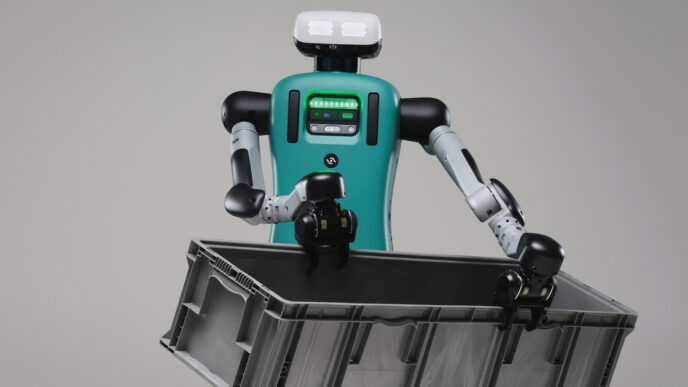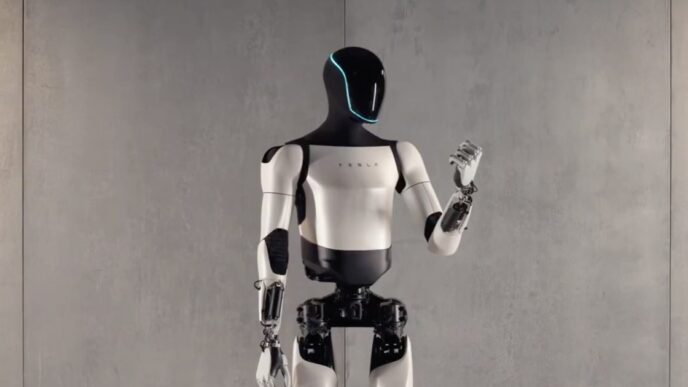
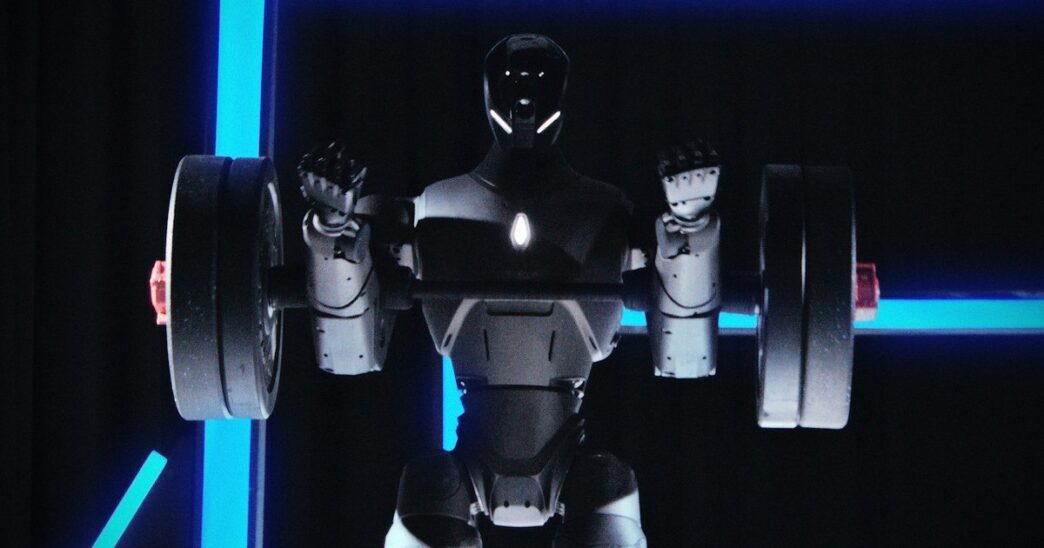
Foundation Future Industries, the San Francisco startup behind the Phantom humanoid, unveiled Phantom MKII on November 18, 2026. Its spec page claims a 200-pound (90 kg) payload, IP67 weatherproofing and a 4-to-6-hour runtime for a 6-foot, 195-pound robot. Fast Company reported the launch that day, alongside Cortex II, the AI system Foundation says runs the machine.
The unveiling landed in the middle of a funding scramble. CNBC reported on November 14 that Foundation missed its October 30 payroll, and on November 22 that staff health coverage had been ended retroactive to October. Reuters reported on November 19 that South Korea’s Base Group is considering a $150 million investment, a figure that comes from the CEO’s emails to staff, not from Base. We read Foundation’s Phantom, Cortex and press pages and those reports, set the numbers next to the humanoids we already track, and sorted what is a company claim from what is reported.
- What launched: Phantom MKII, a second-generation humanoid for heavy industry and defense, and Cortex II, its control AI, on November 18, 2026. Foundation’s Cortex page still says “Coming soon.”
- Company-stated specs: 6.0 ft, 195 lb, 200 lb / 90 kg payload (“close carry”), 4-6 hours, 29 degrees of freedom, 3 kWh battery, IP67. Foundation says the specs “describe shipping capability”; production is planned for 2027. No price, customer or unit count is published.
- Against Atlas, Digit 5 and Figure 03: the payload claim is the standout, about 1.0 times the robot’s own weight versus 0.56 for Atlas’s 50 kg instantaneous rating. IP67 is not unique, because Boston Dynamics lists it for Atlas too.
- The cash question: CNBC reports staff were last paid on October 15 and that health coverage was ended retroactive to October, citing unnamed sources and a staff memo; Foundation did not immediately comment. Base Group confirmed only that it is “considering an investment.” We found no report that a deal has closed.
What Foundation says Phantom MKII can do
Foundation’s Phantom page opens with a big claim: “We built MKII to be stronger than any human, or robot, because the work demands it to be truly scalable.” The page lists five headline numbers and a short feature list. We put them in one table and added what each number leaves out.
| Spec | What Foundation’s page says | What it leaves out |
|---|---|---|
| Height and weight | 6.0 ft; 195 lb (about 88 kg) | Whether the weight includes the battery |
| Payload | “200 lbs / 90 kg”; “200 lb close carry payload. And climbing.” | Standing or walking, one hand or two, and for how long. Fast Company’s lead says the robot can “carry 200 pounds while walking through rain, snow, and dust,” which is Foundation’s description, not a test result we can see |
| Runtime | 4-6 hours | The load and the task behind the range. DroneNews, summarizing Fast Company, says the battery lasts up to six hours and less under heavy loads |
| Battery | 3 kWh, “Power for a full working shift” | Pack weight and swap or charge time. A full 8-hour shift is longer than the 4-6 hours listed |
| Degrees of freedom | 29 | What is counted. Our DoF explainer shows vendors count hands and waist differently |
| Weather | “Weatherproof IP67,” “Rain, dust, heat, snow” | Who tested it and to what standard. The page shows a weather test in Livermore, California |
| Joints | Modular joints that “swap out so the work doesn’t stop” | Swap time and whether it works in the field |
| Production | “Built for mass production. Scaling 2027.” “Designed in California, made in the USA” | Volumes, a factory and a start date. The early-2027 start comes from Fast Company, via DroneNews |
| Price, units, customers | None. The page offers a sales call: “Tell us the job and we will show you the machine doing it” | Everything a buyer would need |
One phrase matters more than the numbers: “Specifications describe shipping capability.” Foundation’s press page adds that specifications “are subject to change” and that “application imagery and concepts of employment shown are illustrative.” Because production is planned for 2027, these read as targets for units that will ship, not measurements from robots a customer can buy now.
How the numbers compare with Atlas, Digit 5 and Figure 03
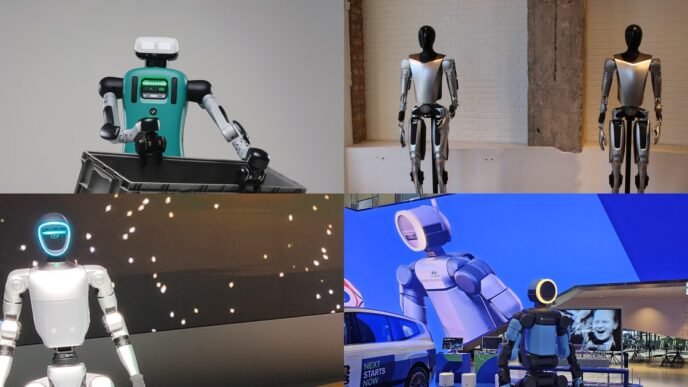
We already track published specs for the best-known humanoids in our best humanoid robots table, all from the makers’ own materials. Here is Phantom MKII beside three of them, with one added column that is our own arithmetic: payload divided by the robot’s own weight.
| Robot | Weight | Payload as published | Payload / own weight | Runtime as published |
|---|---|---|---|---|
| Foundation Phantom MKII | 195 lb (88 kg) | 200 lb / 90 kg “close carry” | 1.03 | 4-6 hours |
| Boston Dynamics Atlas | 198 lb (90 kg) | 50 kg instantaneous; 30 kg sustained | 0.56 instantaneous; 0.33 sustained | About 4 hours; about 2 hours heavy lifting; 3-minute battery swap |
| Agility Digit 5 | 284 lb (129 kg) | 50 lb (22.7 kg) repeated lift | 0.18 | 90 minutes; 9-minute charge |
| Figure 03 | 61 kg | 20 kg | 0.33 | 5 hours |
The ratio shows why Foundation leads with payload. If the figure holds up, MKII would carry about its own weight, roughly twice Atlas’s instantaneous rating and three times its sustained one. But the definitions do not match. Atlas gives separate instantaneous and sustained figures, Digit 5 gives a repeated-lift figure, and Foundation gives one “close carry” number with no duty cycle. Compare the ratios as an order of magnitude, not a ranking.
Two other numbers deserve a second look. First, IP67 is not a differentiator on its own: Boston Dynamics’ Atlas spec sheet lists IP67 as well. The open question is the test, not the rating. Second, the battery. Spread over the listed runtimes, 3 kWh implies an average draw of about 500 to 750 watts (3,000 Wh over 6 and 4 hours), assuming all of the capacity is usable. That pack is about three times the 0.972 kWh we list for the Unitree H2 and 3.6 times the 842 Wh for 1X NEO. It is a big battery for a 195-pound machine, and the page says nothing about its weight. Our battery and runtime guide explains why “hours” figures from different makers are hard to compare.
On degrees of freedom, MKII’s 29 is about half of the 56 Boston Dynamics lists for Atlas. That is a design choice, not a flaw, and fewer joints can mean lower cost and less to maintain. It does mean the robot’s dexterity will depend on a hand design that Foundation’s page does not describe.
What Foundation has shown so far
The Phantom page includes two clips under “Tested in the open.” One is a payload lift on a lifting stand (2:17) and the other a weather run through dust and water in Livermore, California (0:53). Both are Foundation’s own footage. Neither comes with a load weight, a test protocol or an outside witness, and a lift on a stand is not the same as carrying a load across a floor. Foundation’s home page also says Phantom MKII “goes into the mines, the ports, construction sites and the frontlines,” but names no customer for MKII work.
The software side is thinner still. The Phantom page says MKII “combined with Cortex II learns a new task from human demonstrations,” and that “One command center controls a thousand robots working as a team.” Foundation’s Cortex page has one line: “Coming soon.” Interesting Engineering, citing Fast Company, says some tasks need as few as 60 demonstrations; we could not read that passage in Fast Company’s own text, so we treat it as reported, not confirmed. Our guide to teleoperation versus autonomy lists the questions to ask of any demo: who was in control, how many takes, and what was cut.
The cash question: what is reported
The spec sheet is Foundation’s account. The funding story comes from outside reporting, and Foundation did not respond to requests for comment in either report. CNBC’s November 14 report, citing people familiar with the matter, says Foundation has not paid employees since missing its October 30 payroll, and that the company also ran short in August, when staff waited about two days after an existing investor provided a bridge loan. CNBC also says CEO Sankaet Pathak is the sole board member, that he is seeking hundreds of millions of dollars at a $3 billion valuation, and that a memo told staff he was working on money for back wages. Reuters, citing Pitchbook, says Foundation has raised $11 million from investors including Tribe Capital, Defined and Gaingels.
Reuters’ November 19 report is where Base Group comes in. Emails from Pathak to employees, seen by Reuters, say the Seoul-based conglomerate would invest $150 million and set up a joint venture to supply aluminum for the robots and lithium for their batteries. Pathak wrote on November 8 that the payroll problem was “a timing issue, not an existential one for the company.” Base’s spokesperson confirmed only that it “was considering an investment in Foundation.” So the accurate wording is that Base is considering an investment, with the $150 million figure and the joint venture coming from Foundation’s CEO. Reuters also notes that Democratic senators asked Base in August about a $2 million payment to the Trump Organization in 2025, and that Base did not address those questions. Eric Trump is an investor and adviser to Foundation, according to Fast Company.
CNBC also reports that Pathak borrowed $4.6 million from the company in 2025 to buy a home in California. Pathak told employees the loan was agreed in August 2025 and “had no relationship to the current cash situation,” according to Reuters.
CNBC added more on November 22. A staff memo it obtained says health benefits through the administrator Rippling were ended retroactive to October, “because our last pay run through Rippling was in October,” and that COBRA coverage would be offered for November. Foundation blamed Rippling in the memo and said it would reimburse COBRA premiums; Rippling told CNBC that clients that cannot meet payroll and benefits obligations “for multiple months” are warned and then terminated. CNBC’s sources say employees were last paid on October 15, that Pathak has told staff he is in talks with three or four venture firms, including existing investor Tribe Capital, about a bridge loan, and that he expects the possible Base money as early as December or January. The next scheduled payday is November 30. A Foundation spokesman did not immediately respond to CNBC. As of November 23 we found no report that the Base investment has closed or that back pay has been made.
| Claim | Who says it | Status |
|---|---|---|
| 200 lb payload, 4-6 h, IP67, 29 DoF | Foundation’s Phantom page | Company claim; no independent test |
| Production early 2027; parts cost cut “about half” | Fast Company interview, via DroneNews | Reported company statements |
| Cortex II learns from “as few as 60” demonstrations | Interesting Engineering, citing Fast Company | Second-hand; Cortex page says “Coming soon” |
| Thousand-robot “command center” | Foundation’s Phantom page | Company claim; nothing shown |
| $24 million in Pentagon contracts | Widely reported; CNBC’s sources say it stems from Foundation’s 2024 acquisition of Boardwalk Robotics | Disputed attribution; Foundation did not comment to CNBC |
| Missed October 30 payroll | CNBC, unnamed people with direct knowledge | Reported; no Foundation response in the piece |
| Health coverage ended retroactive to October; bridge-loan talks | CNBC (November 22), staff memo and unnamed people; Rippling statement | Reported; Foundation blames Rippling and says it will reimburse COBRA; no comment to CNBC |
| Base Group $150 million | Pathak’s emails, seen by Reuters | Base confirms it is “considering an investment” only; not closed |
| Talks to supply up to 1,000 Phantom MK1 robots to the Israel Defense Forces | Financial Times, via Fast Company | Reported; Pathak says “very early exploration conversations” and “literally nothing actively going on” |
The defense question
Foundation’s home page calls it “the only US humanoid company committed to heavy industry and defense work.” Fast Company quotes Pathak saying that “We’re not anti-weaponization and warfare” and that arming its machines is “not something we have a blanket policy of just saying we’re not going to do.” He told the magazine the company would consider it if the U.S. military asked, and that most current defense work is logistics. That is a stance, not a product: Foundation has not shown or announced an armed Phantom.
The policy backdrop is moving. On November 21, countries at the UN Convention on Certain Conventional Weapons meeting in Geneva agreed to “elaborate” an instrument on lethal autonomous weapons over the next two years, according to Al Jazeera, which reports 128 countries agreeing, while key arms-producing nations including the United States, Russia and Israel opposed the push for legally binding rules. Campaigners called the mandate “watered down.” That outcome does not bind any company, and we have not seen the final UN text, so treat the details as reported.
Our take: a spec sheet and a story, not yet a product
On our readiness scale, the evidence we can see puts Phantom MKII at Level 2, a demo: company footage and a spec sheet, with no named customer, no price and no delivery date. Foundation has previously said its machines were tested with Ukrainian forces, according to Fast Company, but that is the company’s statement and it does not carry over to MKII.
The payload claim is the open question. If a production MKII carries 200 pounds while walking, for a full cycle, in rain, it would beat every spec in our table. If “close carry” means a short lift near the body, as the lifting-stand footage might suggest, the number is closer to what Atlas already publishes. The company can settle it with a test protocol or a customer trial. The cash question is separate and could matter more: a 2027 production plan needs the money to arrive first.
Signals that would change this read: a published Cortex II spec; a named MKII customer or pilot; a test video with load, distance and time; Base Group’s decision and any closing announcement; and confirmation from Foundation that staff have been paid. We will update this page if any of those appear.
Frequently asked questions
What is Foundation’s Phantom MKII?
Phantom MKII is the second-generation humanoid from Foundation Future Industries, unveiled on November 18, 2026 for heavy industry and defense work. Foundation says it stands 6.0 ft, weighs 195 lb, carries 200 lb, runs 4 to 6 hours on a 3 kWh battery, has 29 degrees of freedom and is rated IP67. Production is planned for 2027.
Is Phantom MKII’s 200-lb payload verified?
No. The figure comes from Foundation’s own spec page, which calls it a “close carry” payload and says specifications describe shipping capability. The company’s footage shows a payload lift on a stand, but no independent test, load weight or protocol has been published.
How much does Phantom MKII cost and can you buy one?
Foundation has published no price, delivery date or customer for Phantom MKII. Its website offers a sales call and says production is “Scaling 2027.” Fast Company, as summarized by DroneNews, reports production starting in early 2027.
Is Base Group investing $150 million in Foundation?
Not confirmed. Reuters reported on November 19 that emails from Foundation’s CEO put a Base Group investment at $150 million, but Base’s spokesperson said only that it was considering an investment. CNBC reported on November 22 that the CEO has told staff the money could land as early as December or January, and that the funding has not been finalized. We found no report that a deal has closed.
Sources
- Foundation: Phantom MKII page (specifications, field tests, Cortex II, fleet claim)
- Foundation: home page (defense and heavy-industry positioning)
- Foundation: press page (press kit, specification and imagery disclaimers)
- Foundation: Cortex II page (“Coming soon”)
- Fast Company (Chris Stokel-Walker): Foundation unveils Phantom MKII and its CEO won’t rule out arming it, November 18, 2026
- DroneNews: Foundation unveils the Phantom MKII humanoid (summary of Fast Company), November 18, 2026
- Interesting Engineering: Phantom MKII: Foundation unveils 2nd-gen battlefield humanoid robot, November 20, 2026
- CNBC: “Foundation robot startup runs out of cash after founder borrows millions,” November 14, 2026 (updated November 16)
- CNBC: “Eric Trump-backed robot startup Foundation drops employee healthcare,” November 22, 2026
- Reuters via The Korea Times: South Korean firm plans $150 million lifeline for Eric Trump-backed robot maker, November 19-20, 2026
- Al Jazeera: Nations agree to “elaborate” on rules for AI-run “killer robots” by 2028, November 21, 2026
- Foundation Robotics on YouTube: “The World’s Strongest Humanoid – Phantom MK2”
- RoboticaGuide: Best Humanoid Robots in 2026 (Atlas, Digit 5, Figure 03 published specs)
- RoboticaGuide: Humanoid Robot Battery and Runtime Limits (Unitree H2 and 1X NEO battery capacity)
Sources accessed November 22, 2026; Foundation pages, CNBC (November 22) and the YouTube video rechecked November 23, 2026.
Last updated: November 23, 2026. To report an error, see our corrections page. See our editorial policy.