China now has an official L0-L5 humanoid robot scale for how intelligent a robot is. The Ministry of Industry and Information Technology (MIIT) posted Announcement No. 30 of 2026 on November 16, approving 274 industry standards. Five of them are humanoid robot standards managed by MIIT’s Humanoid Robot and Embodied Intelligence Standardization Technical Committee (MIIT/TC8), and the one getting the attention is SJ/T 12355-2026, “Humanoid robots: Classification of intelligent capabilities.” All five took effect on the day they were published.
The other four cover robot training grounds, training data, electric joints and dexterous hands. We read MIIT’s own list of the 274 standards, which gives each one’s scope in a paragraph, and compared it with the explanation that Chinese media carried. The short version: the scale has six levels and four dimensions, but the public record defines only its two ends. Here’s what the standards cover, how they relate to the national standards China published in September, and how an L-number on a spec sheet should be read.
- What: five humanoid robot industry standards, SJ/T 12353 to SJ/T 12357-2026, approved in MIIT Announcement No. 30 (dated November 10, posted November 16, 2026) and in force from publication.
- The L0-L5 scale: SJ/T 12355 grades intelligence on four dimensions (perception and cognition, decision-making and learning, execution, collaboration and interaction), from L0 “preset execution” to L5, “relatively high autonomy and self-evolution.”
- Legal force: none on its own. Under China’s Standardization Law, industry standards are recommended, not mandatory.
- The catch: the public summaries don’t define L1 to L4 or say how a robot is tested or who assesses it. No maker has published a grade yet.
The five standards, from MIIT’s own list
MIIT’s annex lists the five in its electronics section, which holds 92 of the 274 approvals. The titles below are our translations; the scope column summarizes the annex’s own paragraph for each standard.
| Standard | Title (our translation) | What the annex says it covers |
|---|---|---|
| SJ/T 12353-2026 | Humanoid robots: Technical specification for training ground construction | Construction principles, functional zones, layout, equipment, safety and ethics, environmental control, network facilities and test methods; for planning, design, construction and acceptance of training grounds |
| SJ/T 12354-2026 | Humanoid robots: Training data management requirements | Management of training data through collection, processing, storage, transmission, use, circulation and destruction |
| SJ/T 12355-2026 | Humanoid robots: Classification of intelligent capabilities | The architecture, grading framework, level definitions and assessment methods for intelligent capabilities; for R&D, testing, evaluation and selecting robots for an application |
| SJ/T 12356-2026 | Humanoid robots: Technical specification for electrically driven integrated joints | Appearance and structure, interfaces, performance, safety, electromagnetic compatibility and test methods for motor-driven joints; excludes the small joints used in dexterous hands |
| SJ/T 12357-2026 | Humanoid robots and embodied intelligence: Technical specification for dexterous hands | Appearance and degrees of freedom, motion, sensing, grasping and manipulation, interfaces, electromagnetic compatibility, environmental adaptability and reliability, plus modeling and simulation guidance |
The same annex also approves SJ/T 12398-2026, technical requirements for embodied-intelligence data generation systems, filed under artificial intelligence rather than humanoids. It too took effect on publication. The MIIT/TC8 secretariat confirmed the five-standard batch to The Paper on November 17 and said the committee would next work on rolling the standards out and tying them to testing and certification, training platforms and data.
How the L0-L5 humanoid robot scale works, as far as it’s public
The explanation published with the standards, as carried by Sina Tech and in English by 36Kr, breaks a humanoid’s intelligence into four dimensions: perception and cognition (understanding the environment), decision-making and learning (planning a task on its own), execution (doing the work precisely) and collaboration and interaction (working with people). “Intelligent autonomy” runs through all four, and the six levels climb from L0, “preset execution,” to L5, a robot with “relatively high autonomy and self-evolution capability.”
A robot doesn’t get a single number. The standard reports results in three layers:
- A capability profile, a radar chart showing strengths and weak spots across the four dimensions.
- A base level, used for broad classification and described as a safety floor.
- A composite level, which reflects how balanced the robot is overall and is meant for comparing products.
That explanation says the industry has lacked a common yardstick, so every maker describes its robot’s “intelligence” in its own terms, and buyers can’t compare products. That’s the problem the scale is meant to fix. What we couldn’t find is the middle of the ladder. None of the reports we read, and nothing MIIT posted, says what separates L2 from L3, which tasks a robot is tested on, whether a teleoperated robot can score, or which labs may issue a grade. The announcement says electronics industry standards are published through the China Electronics Standardization Institute; the level definitions are in that text, which we haven’t seen.
The other four standards are more hands-on. The China News Service summary says the joints standard targets torso and leg joints and the hand standard aims to fix interfaces that don’t match between suppliers, which matters for makers that pair one supplier’s hand with another supplier’s arm. The training-ground standard, per the same explanation, splits a site into scenario training, data center, maintenance, storage and office zones, with an optional mixed virtual-and-real test area, and requires physical, data and ethical safeguards: collision prevention and emergency braking, anonymized and encrypted data, and a ban on prohibited scenarios. The explanation says a large number of humanoid data-collection and training centers are in use or being built across China, and SJ/T 12354 is meant to move them toward common data formats, labeling rules and quality checks for robot training data.
How it compares with China’s other robot rules and with car autonomy levels
It’s the second set of official Chinese humanoid standards we’ve covered in two months, and it comes from a different body. In September, the State Administration for Market Regulation issued the GB/T 48317 national standards, whose Part 1 lists 52 drafting organizations, including Unitree, UBTECH and XPENG, and which take effect on April 1, 2027. MIIT’s batch ranks lower, as industry rather than national standards, but it’s already in force. And the L0-L5 framing isn’t new to Chinese regulators: GB/T 40429-2021, proposed by MIIT and drafted under China’s national auto standards committee, gave China its own driving-automation levels.
| Scale or rule | What it measures | Levels | Status |
|---|---|---|---|
| SJ/T 12355-2026 (MIIT) | A humanoid’s intelligent capability on four dimensions | L0 to L5, reported as a profile, a base level and a composite level | Recommended industry standard, in force since November 16, 2026 |
| GB/T 48317-2026 (SAMR) | Technical requirements: perception, decision-making, motion control, task operation | None; technical requirements (drafters told CCTV grasp success should exceed 90% for rigid objects) | Recommended national standard, effective April 1, 2027 |
| GB/T 40429-2021 and SAE J3016 | Driving automation in cars | Level 0 to Level 5 (six levels) | GB/T 40429 recommended national standard, in force since March 1, 2022 |
| RoboticaGuide readiness levels | How far a robot has moved from demo to paid work | Level 1 render to Level 6 open availability | Our editorial scale |
| AgiBot Worken | Robot output: active robots x autonomous hours x output efficiency | None; a single number | One company’s proposal, October 2026 |
The car precedent is the useful one. When the national auto standards committee announced GB/T 40429 in 2021, it said China needed its own scale because the SAE J3016 levels were being understood inaccurately, defined inconsistently and applied loosely, including in company product promotion. Car buyers spent years decoding “L2+” and “L3-ready.” Humanoid makers are about to be handed the same vocabulary.
Our take: a capability grade is not a deployment grade
A shared scale is better than every maker inventing its own, and the three-layer design is smarter than a single number. A base level that works as a floor should stop a robot with one strong skill, say fluent conversation, from passing itself off as a high-level machine when its hands can’t keep up. If the full text backs that up, buyers will have a useful tool.
But SJ/T 12355 measures what a robot can do, not where it works. A robot could earn a high grade in a test hall and still sit at Level 2, demo, on our readiness scale, with no paying customer. That’s a different question from the one AgiBot’s Worken metric tries to answer, and from what the draft robot ID code would track. Grades will be most useful as one line in a tender, next to uptime and safety certification, not as a headline.
So when an “L3 humanoid” claim appears, and given the car industry’s history it will, ask four things: base level or composite level; which edition of SJ/T 12355; who did the assessment; and on which tasks. Until a maker answers those, treat the L-number as a company claim. Nobody has published a grade yet. XPENG, whose IRON is due on stage at its AI Day on November 25, says in its November 19 release that IRON performs tasks autonomously “without teleoperation,” but it doesn’t cite a level. We’ll add it to our IRON coverage if XPENG does.
Frequently asked questions
What is SJ/T 12355-2026?
It’s a Chinese electronics industry standard, “Humanoid robots: Classification of intelligent capabilities,” approved by MIIT in Announcement No. 30 of 2026 and in force since its publication on November 16, 2026. It grades a humanoid’s intelligence from L0 to L5 across perception and cognition, decision-making and learning, execution, and collaboration and interaction.
What do the L0 to L5 levels for humanoid robots mean?
According to the explanation published with the standards, L0 is “preset execution” and L5 is a robot with relatively high autonomy and the ability to improve itself. The public summaries don’t describe L1 to L4. Results are reported as a capability profile, a base level and a composite level.
Are China’s humanoid robot standards mandatory?
No. Under China’s Standardization Law, industry standards such as the SJ/T series are recommended standards, and the GB/T 48317 national standards are also recommended. They gain force when buyers, tenders or certification schemes require them.
Which humanoid robot standards did MIIT release in November 2026?
Five: SJ/T 12353 (training ground construction), SJ/T 12354 (training data management), SJ/T 12355 (intelligent capability classification), SJ/T 12356 (electrically driven integrated joints) and SJ/T 12357 (dexterous hands). All took effect on publication.
Sources
- MIIT: Announcement No. 30 of 2026 and annex listing 274 industry standards, dated November 10, posted November 16, 2026 (in Chinese)
- State Administration for Market Regulation: Standardization Law of the People’s Republic of China, Article 2 (in Chinese)
- The Paper: MIIT releases five humanoid robot standards, November 17, 2026 (in Chinese)
- China News Service: five humanoid robot standards take effect, November 18, 2026 (in Chinese)
- Sina Tech: MIIT’s five humanoid robot standards and the intelligence grading scale, November 19, 2026 (in Chinese)
- 36Kr: MIIT unveils 5 humanoid robot industry standards, November 2026
- National Technical Committee of Auto Standardization: GB/T 40429-2021 “Taxonomy of driving automation for vehicles” released, September 17, 2021 (in Chinese)
- XPENG: XPENG to showcase its Physical AI push at annual AI Day, November 19, 2026
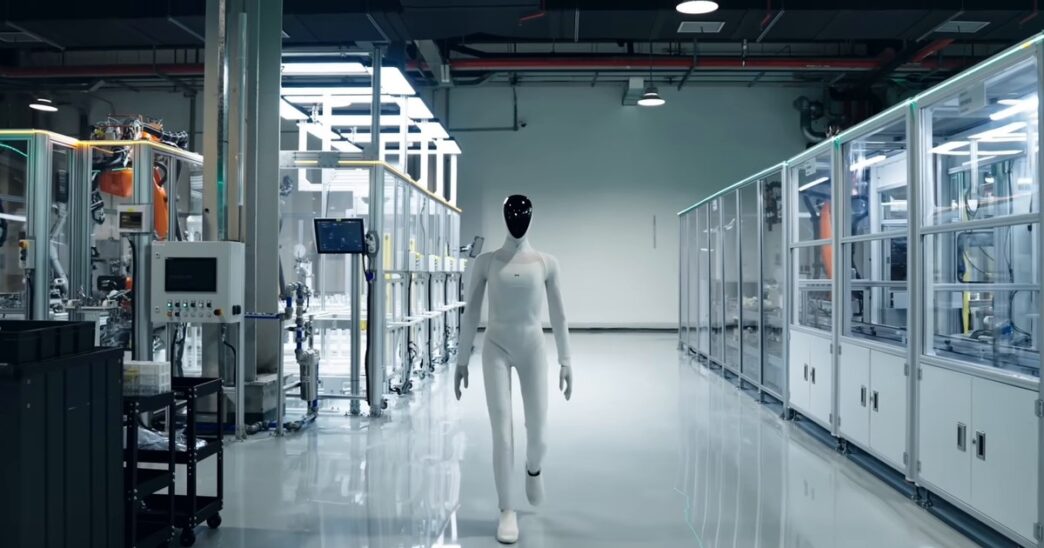
- XPENG (YouTube): “XPENG Robotics Production Line Officially Launched,” September 8, 2026 (source of the featured image)
All sources accessed November 20, 2026.
Last updated: November 20, 2026. To report an error, see our corrections page. See our editorial policy.