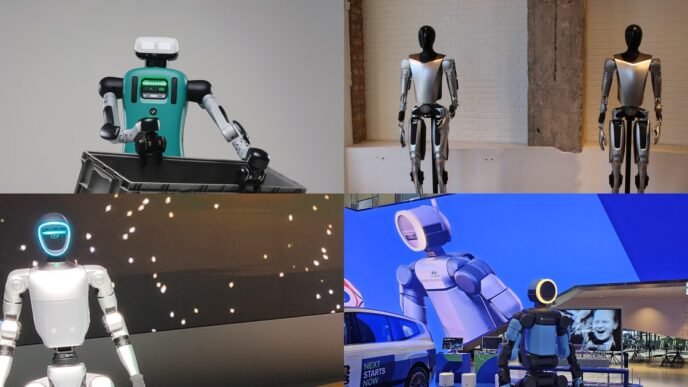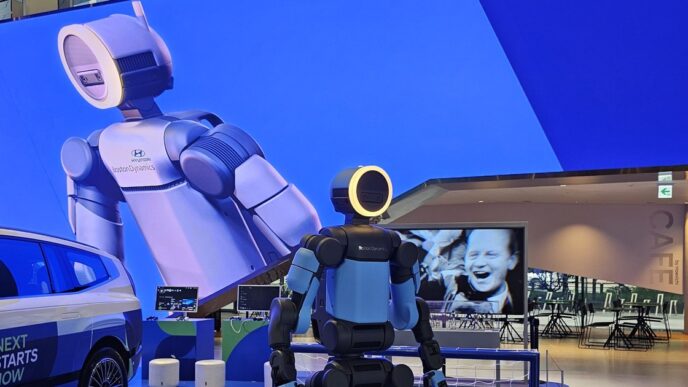
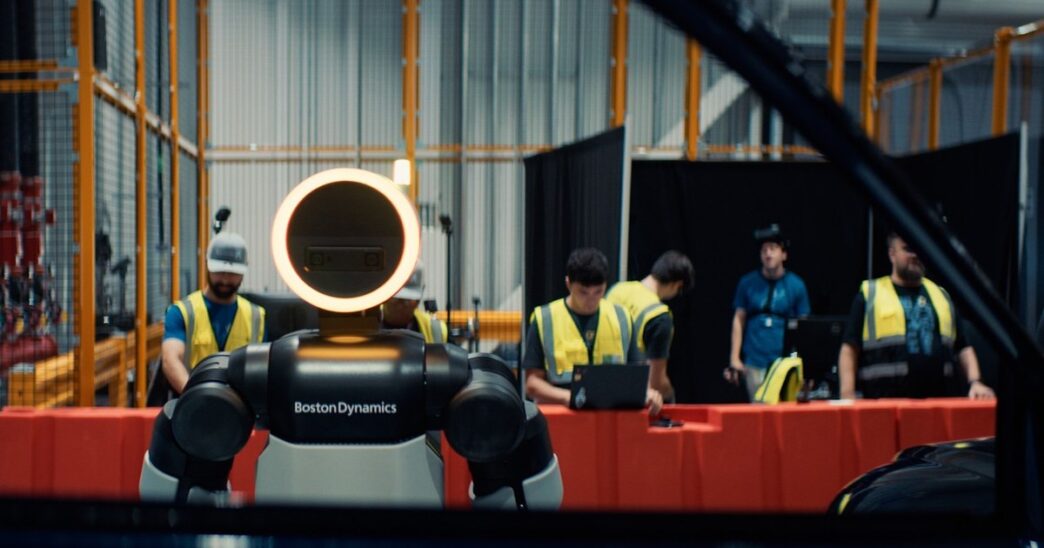
Hyundai Motor Group now owns all of Boston Dynamics. Hyundai Glovis, one of the group companies that holds Boston Dynamics shares, said in its third-quarter report, filed with Korea’s Financial Supervisory Service on November 16, 2026 (Korea time), that every put and call option on Boston Dynamics common stock was exercised and extinguished during the quarter. Those options were SoftBank’s way out. SoftBank told Hyundai in July that it was using its put option to sell its last 9.65% stake. With the options gone, Korean outlets including The Korea Herald and Financial News report that Chairman Chung Euisun and Hyundai group companies now hold 100% of the Atlas maker.
The same filing has Boston Dynamics’ own numbers, and they explain why the Hyundai Boston Dynamics ownership story matters more than a change on a shareholder register. We opened the Glovis quarterly and half-year reports on DART, Korea’s disclosure system, and rebuilt the robot maker’s results quarter by quarter. Revenue is growing. Losses are growing much faster.
- Ownership: all put and call options on Boston Dynamics shares were exercised and extinguished in Q3 2026 (Hyundai Glovis filing). SoftBank’s last 9.65% went to Hyundai shareholders, leaving Chung Euisun and group companies with 100%, as reported.
- Revenue: 136.0 billion won (about $102 million) in the first nine months of 2026, up 29% from a year earlier.
- Loss: 626.6 billion won (about $469 million) net loss over the same nine months, up 77%. That’s 4.6 won lost for every won of revenue.
- The catch: the 30,000-robot-a-year Atlas factory is a Hyundai target, not an order book, and the 2029 or 2030 IPO talk comes from unnamed sources. Hyundai has set no listing timeline.
What the Glovis filing says, and what it doesn’t
Hyundai took control of Boston Dynamics from SoftBank in 2021, and SoftBank kept a minority stake under a shareholders’ agreement that gave it a put option. On July 16, 2026, Hyundai Motor Group published a statement confirming that SoftBank had served notice of exercising that option and that the group’s shareholders were pursuing “the acquisition of SoftBank’s entire stake.” Hyundai didn’t name a price then, and it hasn’t since.
The Glovis filing closes the loop. Two notes in its consolidated statements matter. The derivatives note says the call and put options tied to Boston Dynamics common stock were all exercised and extinguished during the quarter, and the embedded put-option liability that Glovis carried at the end of 2025, 11.5 billion won, is now zero. The associates note shows how Glovis’s own stake grew this year:
| Period end | Glovis stake in Boston Dynamics | Money Glovis put in | Source |
|---|---|---|---|
| End of 2024 | 10.95% | – | Q3 2026 report |
| End of 2025 | 11.25% | 89.1 billion won during 2025 | Q3 2026 report |
| June 30, 2026 | 11.39% | 63.1 billion won in H1 2026 | H1 2026 report |
| September 30, 2026 | 12.47% | 46.5 billion won in Q3 (109.7 billion won for the nine months) | Q3 2026 report |
The first-half money and the third-quarter money did different jobs. In the first half, Glovis paid in 63.1 billion won and its stake barely moved, by 0.14 points, which is what you’d expect when every shareholder chips in new capital at the same time. In the third quarter, 46.5 billion won (about $34.8 million) lifted its stake by 1.08 points, which fits Glovis buying part of SoftBank’s block. That reading of the first-half payment is ours. The filing only describes it as an additional payment.
What the filing doesn’t show is the full picture. It covers Glovis’s slice only. It doesn’t list the other buyers, how SoftBank’s 9.65% was split among them, or the total price. The 100% figure comes from the Korean reports, which say Chung, HMG Global, Glovis and other existing shareholders bought the shares among themselves. That fits Hyundai’s July statement, which said “the relevant shareholders” would decide how to allocate the shares. Hyundai Motor Group hasn’t published a closing announcement of its own.
Boston Dynamics’ revenue and losses, quarter by quarter
Because Glovis accounts for Boston Dynamics as an associate, its reports include a short summary of the robot maker’s financials. Boston Dynamics is private and doesn’t publish results, so this is the only regular public look at them. The nine-month figures are in the Q3 report and the six-month figures are in the H1 report filed August 14. The third-quarter-only rows are our subtraction.
| Period | Revenue | Net loss | Loss per won of revenue |
|---|---|---|---|
| H1 2025 | 66.9 billion won | 241.9 billion won | 3.6 |
| Q3 2025 (derived) | 38.5 billion won | 112.3 billion won | 2.9 |
| 9 months 2025 | 105.4 billion won | 354.1 billion won | 3.4 |
| H1 2026 | 81.3 billion won | 388.8 billion won | 4.8 |
| Q3 2026 (derived) | 54.7 billion won | 237.8 billion won | 4.3 |
| 9 months 2026 | 136.0 billion won (+29%) | 626.6 billion won (+77%) | 4.6 |
Four things stand out.
- Losses are growing faster than sales. Over nine months, revenue rose by 30.6 billion won while the net loss grew by 272.5 billion won. Roughly nine extra won of loss came with every extra won of revenue.
- The third quarter was the best for sales and still deep in the red. Q3 revenue of 54.7 billion won was up 42% from a year earlier, but the Q3 loss of 237.8 billion won (about $178 million) more than doubled. Alpha Biz reported the same quarterly loss.
- The cushion shrank fast. In Glovis’s summaries, Boston Dynamics’ net assets (assets minus liabilities) fell from 568.0 billion won on June 30 to 274.8 billion won on September 30. Total assets dropped from 985.8 billion won to 673.4 billion won in one quarter. At this year’s pace of about 70 billion won lost a month, Boston Dynamics needs regular new money from its owners, and those owners are now all Hyundai.
- It flows into Hyundai’s results. Glovis booked a 76.1 billion won equity-method loss on Boston Dynamics for the nine months. That’s its 12.47% share. The rest lands on the other Hyundai holders.
Two cautions about these figures. Revenue here is the figure in Glovis’s associate summary. Boston Dynamics hasn’t published its own numbers, and it doesn’t say how much comes from Spot, Stretch or Atlas. Dollar conversions use one day’s rate for figures earned over nine months, so treat them as approximate.
The Atlas plan: company targets, not filed numbers
The filing says nothing about Atlas. The robot plans come from Hyundai’s own announcements. At CES in January 2026, Hyundai Motor Group said it would build a U.S. robotics plant with “an annual capacity of 30,000 units,” as part of a $26 billion U.S. investment over four years from 2025. It also set the rollout order. Starting in 2028, Atlas would work at Hyundai Motor Group Metaplant America (HMGMA) in Savannah, Georgia, on processes “such as parts sequencing.” By 2030 it would move on to component assembly. Hyundai’s July 16 statement repeated the 2028 start and called the 2030 assembly work subject to “continued technology validation, operational readiness and business requirements.”
Put that next to what we have reported this autumn. In October, two Korean papers said Boston Dynamics had asked suppliers, led by Hyundai Mobis, to prepare parts for 10,000 Atlas robots, citing unnamed sources and no signed orders. In November, Boston Dynamics put Atlas on scooter wheels to push its actuators to the limit, the kind of hardware validation a robot needs before volume production. Seoul is also funding domestic humanoid actuators and batteries, which would give the same supply chain a policy tailwind.
A 30,000-unit plant is a big jump from where Boston Dynamics is now. Hyundai hasn’t published an Atlas price, so we can’t turn the target into revenue. Here’s the scale question it raises. Boston Dynamics’ current annual revenue run rate, about 180 billion won (roughly $136 million), comes from robots already on sale, such as Spot and Stretch. Atlas hasn’t shipped at commercial volume. Capacity isn’t demand. Hyundai hasn’t said how many Atlas units its own plants will take, and outside customers haven’t announced any orders.
How it compares: Boston Dynamics, Agility and Unitree
Three of the best-known humanoid makers now sit under three different kinds of owner, and that decides how much the public gets to see. Figures below come from each company’s filings as we reported them. Yuan amounts use the ECB rate for November 16, 2026 (6.6665 yuan per dollar).
| Boston Dynamics | Agility Robotics | Unitree | |
|---|---|---|---|
| Owner | Hyundai Motor Group companies and Chung Euisun, 100% (Q3 2026, as reported) | Public on Nasdaq (AGLT) since November 5, 2026 | Public on Shanghai’s STAR Market (688836) since August 19, 2026 |
| Nine-month 2026 revenue | 136.0 billion won (about $102 million), +29% | Not compared here (see our listing report) | 1.817 billion yuan (about $273 million), +55.71% |
| Nine-month 2026 bottom line | Net loss of 626.6 billion won (about $469 million) | Not compared here | Net profit of 386.7 million yuan (about $58 million) |
| Capacity claim | 30,000 units a year at a planned U.S. plant (Hyundai target) | RoboFab designed for 10,000 robots a year (Agility figure) | None used here |
| Where results appear | Only in Hyundai affiliates’ filings | SEC filings from now on | Shanghai exchange quarterly reports |
Unitree shows that a humanoid maker can make money, though its Q3 2026 profit fell as R&D spending more than tripled. Agility shows the other route to cash. It raised about $465 million gross in its SPAC merger and Nasdaq listing and now has to report to public shareholders every quarter. Boston Dynamics is going the opposite way. It is losing far more than either and has dropped its last outside shareholder, so its only regular disclosure will be a line or two in Hyundai affiliates’ reports. For a broader view of where robot money went this year, see our robotics funding tracker.
Our take: full ownership buys speed, not a business model
The buyout is mostly about who pays for the next three years. A minority shareholder with a put option is someone waiting to be paid out. Once SoftBank is gone, Hyundai can pour capital into Boston Dynamics, sign group supply deals and send Atlas units to its own factories without arguing over valuation with anyone outside the family. Korean outlets made the same point, and the filing gives it a number. The Q3 loss alone was 237.8 billion won.
That freedom has a cost for everyone outside Hyundai. Boston Dynamics’ first big Atlas customer will be its owner. A Hyundai plant ordering Atlas is a transfer inside the group, not proof that a car or logistics company outside it would pay for one. Until an outside buyer signs, the 30,000-unit capacity says more about Hyundai’s confidence than about the market. The deployment plan is careful in a good way, though: parts sequencing first, assembly only after validation. It’s the same logic behind the logistics jobs Agility and Figure chose first: humanoids win first on simple, repetitive handling.
We’d read the IPO talk with care. Korean reports say sources expect a listing around 2029 or 2030, once production ramps. Hyundai has given no timeline. Based on this year’s numbers, a listing would need several quarters of Atlas revenue to tell a story different from the one in Glovis’s filing.
Filed, targeted or reported: how solid each claim is
- Filed (Glovis Q3 and H1 reports): options exercised and extinguished; Glovis at 12.47%; 46.5 billion won in Q3 and 109.7 billion won over nine months; Boston Dynamics’ revenue of 136.0 billion won and net loss of 626.6 billion won for the nine months; net assets of 274.8 billion won at September 30.
- Company targets (Hyundai): a 30,000-unit-a-year U.S. robotics plant, Atlas at HMGMA from 2028 on parts sequencing, assembly by 2030.
- Reported, not filed: 100% ownership by Chung and group companies (Korea Herald, Financial News, Alpha Biz; consistent with Hyundai’s July statement); the 2029 or 2030 IPO window (unnamed sources); the 10,000-unit Atlas parts request (October reports).
- Not disclosed: the total price paid for SoftBank’s 9.65%, an Atlas price, Atlas units built or shipped, and how revenue splits by product.
Frequently asked questions
Does Hyundai own 100% of Boston Dynamics?
Yes, according to Korean reports of Hyundai Glovis’s Q3 2026 filing. The filing says all put and call options on Boston Dynamics common stock were exercised and extinguished in the third quarter, which completed the purchase of SoftBank’s remaining 9.65% stake. Chung Euisun and Hyundai Motor Group companies now hold all the shares. Hyundai hasn’t published a separate closing announcement.
How much revenue does Boston Dynamics make?
Boston Dynamics’ revenue for the first nine months of 2026 was 136.0 billion won, about $102 million at the November 16 ECB rate, up 29% from 105.4 billion won a year earlier, according to the summary in Hyundai Glovis’s Q3 2026 report. Third-quarter revenue alone was about 54.7 billion won.
Is Boston Dynamics profitable?
No. It lost 626.6 billion won, about $469 million, in the first nine months of 2026, up from 354.1 billion won a year earlier. That’s about 4.6 won lost for every won of revenue. The third-quarter loss alone was about 237.8 billion won.
When will Boston Dynamics go public?
There is no official date. Korean outlets cite unnamed sources who say a listing could come around 2029 or 2030, once Atlas production ramps up, and they note that no timeline has been set. Hyundai Motor Group hasn’t announced IPO plans.
Sources
- Hyundai Glovis, quarterly report for the period ended September 30, 2026 (DART, filed November 16, 2026): notes on associates (Boston Dynamics stake, summary financials) and derivatives (options extinguished)
- Hyundai Glovis, half-year report for the period ended June 30, 2026 (DART, filed August 14, 2026): note on associates
- Hyundai Motor Group: “Hyundai Motor Group’s Statement on Boston Dynamics,” July 16, 2026
- Hyundai Motor Group: AI robotics strategy at CES 2026 (30,000-unit plant, Atlas at HMGMA from 2028)
- The Korea Herald: “Hyundai Motor takes full ownership of Boston Dynamics,” November 17, 2026
- Financial News: “Hyundai Motor Group Secures 100% Stake in Boston Dynamics,” November 17, 2026
- Alpha Biz: “Hyundai Glovis Raises Boston Dynamics Stake to 12.47%,” November 2026
- Boston Dynamics (YouTube): “Inside the Robotics Race,” September 30, 2026
- European Central Bank euro foreign exchange reference rates (USD/KRW and USD/CNY cross rates for November 16, 2026)
All sources accessed November 17, 2026.
Last updated: November 17, 2026. To report an error, see our corrections page. See our editorial policy.