Before a robot sets a box on a crowded shelf, NTT wants it to watch a short video of what happens next. The Japanese telecom group announced on November 11, 2026 that it has built a world model that generates a predicted clip for each move a robot is considering, checks whether the load collapses or something falls, and lets the robot pick the move most likely to work. In NTT’s own shelf-loading test, that raised the success rate from 73.1% to 92.3%.
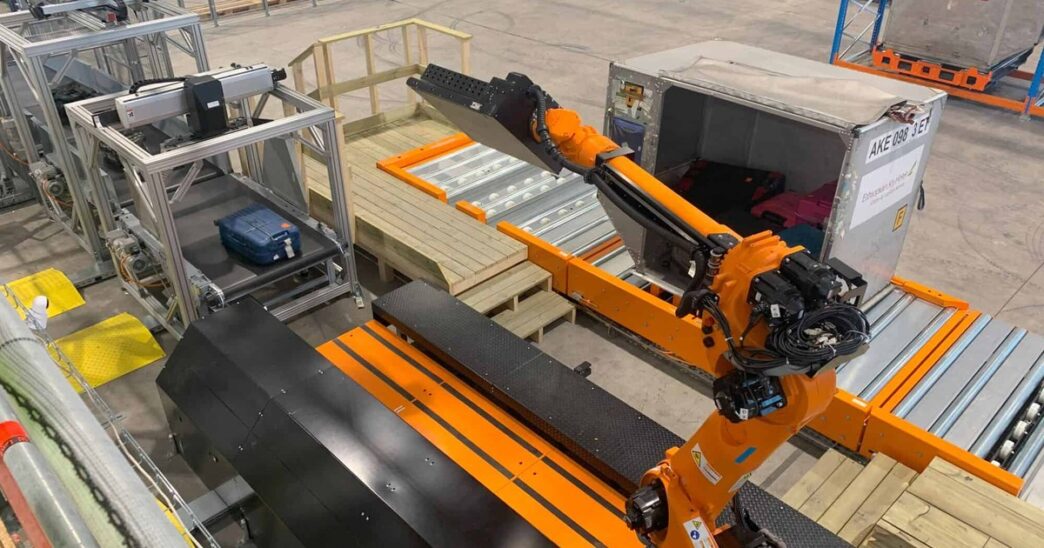
The first job NTT has in mind is loading and unloading airport baggage, with field trials planned alongside Mujin, the Tokyo robotics company whose software already runs bag-loading robots and in which NTT holds a stake. That makes the NTT world model less of a lab curiosity than most world-model news. It’s also built on a single small-robot test, with no trial count, timing or paper published so far.
- What: an NTT world model that adds a “physics control adapter” (estimates each object’s position, orientation, velocity and mass, then applies equations of motion) to a video-generation model, so it can preview and score a robot’s candidate moves before they’re made. Announced November 11, 2026.
- Result (NTT’s test): success in a shelf-loading task with a small robot rose from 73.1% to 92.3% with the model screening moves. On the OBJ3D video benchmark it scored 7.81 LPIPS, against 7.92 for the best academic method and 21.90 for NVIDIA Cosmos Predict 2.5 (lower is better).
- Next: field trials with Mujin on airport baggage loading, no date or airport named. NTT shows the technology at its invitation-only R&D Forum, November 18 to 25.
- The catch: NTT hasn’t published how many trials or objects the 73.1% and 92.3% cover, how long a prediction takes, or a paper, code or weights. It’s a research result, not a product.
How the NTT world model checks a move before the robot makes it
The system sits beside a robot’s existing controller rather than replacing it. Whatever already plans the robot’s motion, whether a vision-language-action model or a classic motion planner, proposes several candidate actions. For each one, NTT’s world model takes the robot’s camera feed and generates a short video of the predicted outcome. A second stage looks at the predicted end state and scores it. One of NTT’s demo screens shows four action plans for a Franka research arm stacking blocks on a shelf, scored 0.815, 0.283, 0.383 and 0.882, with the last one flagged as the best. Another shows a plan scored 0.03 and marked as a failure.
The new part is what NTT calls the physics control adapter. Ordinary video-generation models learn what scenes tend to look like, so they can let an object vanish halfway through a clip or bend in ways nothing real does. NTT’s adapter first splits the scene into objects, estimates physical quantities for each (position, orientation, velocity, angular velocity, mass and inertia, per NTT’s architecture diagram), and works out the next state with equations of motion. The video model then generates frames conditioned on that calculated state. NTT says it’s the first in the world to put this kind of adapter inside a video-generation model, and that writing the physics down explicitly is what lets the model handle scenes that weren’t in its training data.
There’s a side benefit NTT stresses: because the adapter outputs its estimated masses and velocities, an engineer can see why the model predicted a fall. According to MONOist, which attended NTT’s briefing, the model infers those quantities from image features rather than by labeling materials with words like “cloth” or “plastic.”
A second opinion, not a robot brain
That design puts NTT on a different path from the world action models we’ve covered this fall. NVIDIA’s GR00T 2 and LiberAI’s Liber-0 predict future video and output the robot’s actions themselves; they want to be the robot’s brain. NTT’s model doesn’t produce actions at all. It grades actions something else produced.
For anyone running robots today, that’s the more practical pitch. A warehouse or airport doesn’t have to swap out a planner that already works to try it; the world model is a veto layer on top. The cost is time. Generating several video futures for every move would be far too slow, so, according to MONOist, NTT plans to run predictions for only a few seconds at the risky, high-choice moments, such as the instant an item is set down, and to do the heavy computing on AI servers such as multi-access edge computing (MEC) sites. NTT, which sells network and edge-computing services, hasn’t published a latency figure.
What 73.1% to 92.3% does and doesn’t show
Taken at face value, the shelf test is a big improvement. A 73.1% success rate means 26.9% of attempts failed; at 92.3%, 7.7% did. By our calculation, that’s about 71% fewer failed attempts. But NTT’s release describes the test in one sentence: a shelf-loading task “using a small robot to simulate the stacking of items,” compared with and without the technology. It doesn’t give the number of trials, the number or type of objects, how the candidate moves were generated, or how much extra time screening added to each pick. A percentage with three significant figures and no denominator is hard to judge.
The benchmark table needs a closer read too. On OBJ3D, a public set of synthetic videos of objects colliding, NTT’s model scored 7.81 on LPIPS, a measure of how similar predicted frames look to the real ones. The best previous academic method, OCK (presented at ICCV 2025), scored 7.92, and NVIDIA’s Cosmos Predict 2.5 scored 21.90. Against OCK, the gain is 0.11 points, about 1.4% by our calculation. The much larger gap with Cosmos is partly a before-and-after comparison: MONOist reports that NTT builds on open-source video models such as Cosmos Predict 2.5. And LPIPS measures how alike two videos look, not whether a robot made the right call, which is the number a baggage handler would care about.
We’ve seen this pattern before. Odyssey’s record Physics-IQ score turned out to be a best-of-eight run, and GR00T 2’s 95% came from tasks chosen partly because the model could learn them. NTT’s figures aren’t inflated in the same way as far as we can tell. They’re just thin.
Why suitcases are a hard first test
NTT picked airport baggage because it’s exactly where a learned model runs out of examples. Bags differ in size, shape, weight and stiffness, and NTT says conventional robot control can’t easily tell in advance whether a placement will topple a stack or knock a bag off. Collecting training data for every possible bag isn’t realistic, which is the case for a model that reasons from physics instead of memory.
There’s a problem a camera can’t solve, though: a suitcase’s weight is hidden inside it. A bag packed with books on one side behaves differently from one stuffed with clothes, and the two can look identical. MONOist reports that NTT is looking at feeding in information the video can’t provide, such as pre-measured weights, torque sensors in the robot arm and tactile sensors, to fill that gap. None of that is in the November 11 results.
Mujin already loads bags; NTT wants to be the check
Mujin isn’t starting from zero. Its robotic bag-loading system, run by its MujinOS software, has been deployed with baggage-systems maker Vanderlande in a live airport, loading bags into standard airport containers. Mujin says its robots plan motions in real time without being taught each bag, and that one operator can supervise several robot cells. Its software already does 3D perception, motion planning and load-placement optimization.
The two companies aren’t strangers. NTT and its subsidiary NTT Docomo Business invested in Mujin through a third-party share allotment under a capital and business alliance signed on December 1, 2025, and that announcement already listed world models among the NTT technologies to be combined with MujinOS. The baggage trial is the first concrete product of that deal we’ve seen.
So the field trial, as NTT describes it, would test whether a physics-based preview can catch bad placements that a production planner misses. NTT hasn’t named an airport, a start date or a scale for the trials, and Mujin’s newsroom had no statement on the world model when we checked. NTT also says it will consider working with robot service providers and logistics companies, and later take the technology into manufacturing, construction and retail.
For buyers of warehouse and baggage robots, the useful question is narrow: how many dropped or toppled items does the screening prevent per thousand placements, and how many seconds does it add? The shelf test hints at the first number. Nobody has published the second.
What to watch at NTT’s R&D Forum
NTT will exhibit the technology at its R&D Forum 2026, an invitation-only event at its Musashino R&D Center that runs November 18 to 20 and November 24 to 25. The forum’s program lists a November 25 technical seminar, “The Evolution of AI Robotics and a Physics-Informed World Model for Predicting Physical Behavior,” with Isamu Arase, chief executive of Mujin Japan, and Jun Shimamura, an executive research engineer at NTT’s Human Informatics Laboratories. That session is the most likely place for trial details, a latency figure or the size of the shelf test. Until NTT shares those numbers or a paper, the 92.3% is a promising lab result, and the baggage hall is where it gets tested for real.
Frequently asked questions
What is NTT’s physics control adapter?
It’s the part of NTT’s world model that estimates physical quantities for each object in a scene, such as position, orientation, velocity and mass, and calculates how those objects will move using equations of motion. The video-generation model then uses those results to produce a predicted clip of what happens after a robot’s move.
How much did the NTT world model improve robot success?
In NTT’s shelf-loading test with a small robot, the success rate rose from 73.1% without the technology to 92.3% with it. NTT hasn’t said how many trials or objects that test included.
Does the NTT world model control the robot?
No. It works with an existing controller, such as a vision-language-action model or a motion planner. That controller proposes candidate moves, and NTT’s model predicts and scores the outcome of each so the robot can choose the one most likely to succeed.
When will robots use this for airport baggage?
NTT says airport baggage loading and unloading is the first application and that it plans field trials with Mujin, which already deploys bag-loading robots with Vanderlande. No airport, start date or commercial timeline has been announced.
Can I download NTT’s world model?
Not as of November 11, 2026. NTT hasn’t released code, weights or a paper for the model. It’s being shown at the invitation-only NTT R&D Forum 2026 from November 18 to 25.
Sources
- NTT: “NTT Develops Physical AI Technology That Predicts the Future Before Robots Move to Prevent Failures,” November 11, 2026 (test results, Figures 1 to 7, Table 1)
- NTT: Japanese-language release of the same announcement, November 11, 2026
- MONOist (ITmedia): report on NTT’s physics-based world model and briefing, November 11, 2026 (base models, prediction timing, MEC, extra sensors)
- Mynavi News: report on NTT’s world model and its November 10 media briefing, November 11, 2026
- NTT R&D Forum 2026: dates, venue and technical seminar program
- Mujin: announcement of the NTT and NTT Docomo Business capital and business alliance, December 2, 2025 (Japanese)
- Mujin: “Robotic Bag Loading” application page (Vanderlande deployment, MujinOS)
All sources accessed November 11, 2026.
Last updated: November 11, 2026. To report an error, see our corrections page. Articles are drafted with AI assistance and reviewed and edited by an editor; see our editorial policy.