Bedrock Robotics, the San Francisco startup that retrofits excavators to dig on their own, has raised a $600 million Series C at a $4.1 billion post-money valuation. The company announced the round on Monday, October 26. CapitalG, Alphabet’s growth fund, and Emergence Capital co-led it. The Bedrock Robotics Series C brings total funding to nearly $1 billion, two years after the company was founded and about 15 months after it came out of stealth.
The valuation has more than doubled since February, when Bedrock raised $270 million at $1.75 billion. What changed in between is that its excavators started doing paid work on real job sites with nobody in the cab.
- The round: $600 million Series C at a $4.1 billion post-money valuation, announced October 26, 2026.
- Who led it: CapitalG and Emergence Capital, with new investors USIT, Bessemer Venture Partners and Temasek.
- Status: confirmed by the company. Fully autonomous excavators have done paid work on live sites since mid-August 2026, Bedrock says.
- The catch: Bedrock doesn’t publish prices, revenue or how many machines it runs. Its customer growth figure (“more than doubled since 2025”) has no base number.
Bedrock Robotics Series C: who invested and how much
New investors in the round are the US Innovative Technology Fund (USIT), Bessemer Venture Partners and Temasek, Singapore’s state investment company. Existing backers 8VC, Georgian, Valor Equity Partners, Xora, Eclipse, Perry Creek Capital and Nvidia also put in money. Bedrock didn’t say how the $600 million splits among them.
Here’s how fast the price has climbed, based on the company’s own releases.
| Round | Date | Amount | Valuation |
|---|---|---|---|
| Seed and Series A | July 2025 (out of stealth) | $80 million combined | Not disclosed |
| Series B | February 4, 2026 | $270 million | $1.75 billion |
| Series C | October 26, 2026 | $600 million | $4.1 billion post-money |
That’s a 2.3x jump in about nine months. Our robotics funding tracker follows this year’s other big rounds. Bedrock is a different kind of bet: it sells an upgrade for machines contractors already own, not a new kind of robot.
What Bedrock actually builds
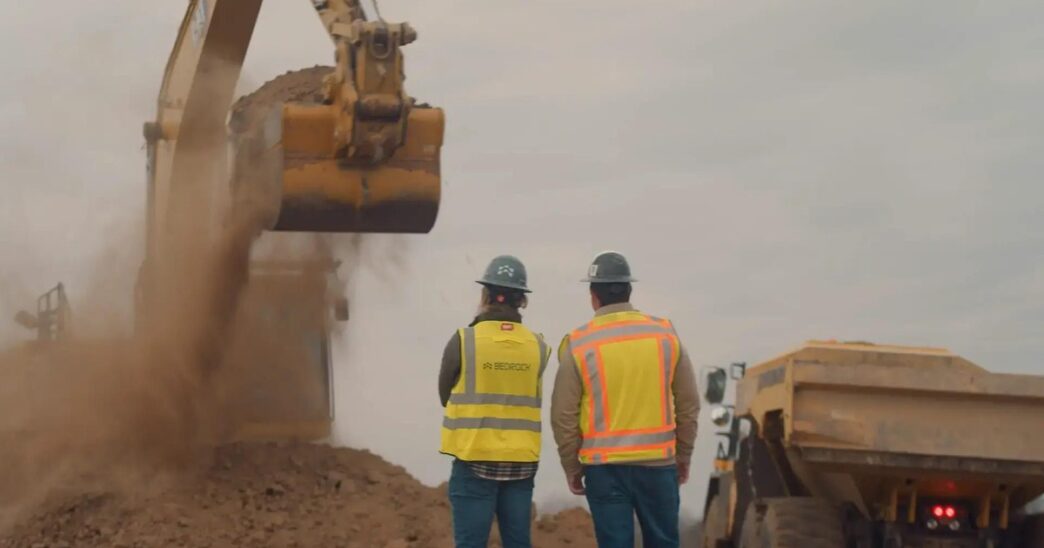
Bedrock makes a self-driving kit that bolts onto existing construction equipment, starting with excavators. Its Series B release said the long-term plan includes bulldozers and loaders, with fleets that coordinate across a whole site. The founders come mostly from Waymo. CEO Boris Sofman led Waymo’s self-driving truck program, which has since shut down, and before that co-founded Anki, the company behind the Cozmo toy robot. CTO Kevin Peterson and Ajay Gummalla, vice president of engineering and infrastructure, are also Waymo veterans. Co-founder Tom Eliaz came from Segment and Twilio.
Excavators are a hard place to start. Unlike a car, an excavator is an articulated machine that changes the ground it’s working on with every scoop. Bedrock argues that’s also why the need is big: it takes five years or more to master running one, the company told TechCrunch.
Where the autonomous excavators work now
In February, Bedrock said it was targeting its first fully operator-less excavator deployments with customers in 2026. It now says it hit that in mid-August, with autonomous excavators doing paid work on live commercial sites. TechCrunch lists three: a water treatment facility in Nevada, an earthwork site run by Champion Site Prep in Texas, and a 1.2 million-cubic-yard civil sitework project with Zachry Construction.
The newest partner is Haydon, an employee-owned general contractor based in Tempe, Arizona. It’s starting with fully autonomous earthwork on a remote site in Texas and plans to use Bedrock-equipped machines on projects including data centers, water plants and healthcare buildings. Haydon will also test trench work and larger machine models. “For us, the biggest win is a safer, more predictable job site,” said Katie Haydon, the company’s CEO and chair.
Bedrock also named new customers that push it into the Midwest and South Atlantic: Wagner Construction in Minnesota, Smith Trucking Company in Florida, B&S Site Development in Virginia, Native Excavating in Colorado, Clarkson Construction in Missouri, C.W. Matthews in Georgia, and some ArchKey Solutions projects in Arkansas. The release doesn’t say which of those are running fully autonomous machines today and which are earlier-stage contracts.
Why investors are paying up
The pitch is the construction labor shortage. The Associated Builders and Contractors trade group estimates that more than 40% of construction workers will retire in the next five years, TechCrunch notes. Bedrock’s release cites survey figures saying 87% of construction firms have openings for hourly craft jobs and 88% say those roles are as hard or harder to fill than a year ago.
“We have proven that fully autonomous excavators can perform real work of value alongside the crews and workflows already in place on job sites,” Sofman said in the release. “The next challenge is delivering that capability to more contractors as a dependable part of how projects get built.” CapitalG general partner Derek Zanutto said construction “sits at the foundation of nearly every major economic and industrial ambition in the United States.”
Bedrock is using the money to expand deployments and the field teams behind them. It hired Amy Jones Satrom as vice president of operations, after work at Amazon, Nuro and Uber, and Lando Juarez as general counsel. Juarez was head of legal for Uber’s autonomous mobility and delivery business.
What Bedrock hasn’t said
The company hasn’t disclosed revenue, what it charges contractors, how many machines run its system or how many hours they’ve worked without an operator. It also hasn’t published safety data from the live sites. Those are the numbers that would show whether a $4.1 billion price reflects a business or an expectation. Until they appear, the confirmed facts are the money, the investors, the named sites and the August milestone.
Frequently asked questions
How much did Bedrock Robotics raise in its Series C?
Bedrock Robotics raised $600 million at a $4.1 billion post-money valuation, announced on October 26, 2026. CapitalG and Emergence Capital co-led the round, which brings Bedrock’s total funding to nearly $1 billion.
What does Bedrock Robotics make?
It makes autonomy technology that retrofits existing heavy equipment, starting with excavators, so the machines can dig and load without an operator in the cab. It works with general contractors rather than selling new machines.
Are Bedrock’s excavators really fully autonomous?
Bedrock says fully autonomous excavators began doing paid work on live commercial job sites in mid-August 2026, including sites in Nevada and Texas. It hasn’t published hours worked, intervention rates or safety data, so the details rest on the company’s account.
Who founded Bedrock Robotics?
Bedrock was founded in 2024 by CEO Boris Sofman, a former Waymo trucks leader and Anki co-founder, CTO Kevin Peterson and Ajay Gummalla, both Waymo veterans, and Tom Eliaz, formerly of Segment and Twilio.
How much does Bedrock’s system cost?
Bedrock hasn’t published pricing. It works directly with contractors, and none of its announcements give a per-machine or per-project price.
Sources
- Bedrock Robotics, “Bedrock Robotics Raises $600 Million Series C to Scale” (press release, October 26, 2026): globenewswire.com
- TechCrunch, Kirsten Korosec, “This startup’s self-driving excavators help dig up $600M in new funding” (October 26, 2026): techcrunch.com
- Bedrock Robotics, “Bedrock Robotics Raises $270 Million in Series B Funding” (press release, February 4, 2026): prnewswire.com
- CapitalG, “Doubling Down on Bedrock”: capitalg.com
- Emergence Capital, “Built on Bedrock”: emcap.com
- Bedrock Robotics, “Autonomous Excavation on a Live Jobsite” (official YouTube channel, October 26, 2026): youtube.com
- Bedrock Robotics news page: bedrockrobotics.com
All sources accessed October 28, 2026, between about 10:15 and 10:45 AM ET.
Last updated: October 28, 2026. To report an error, see our corrections page. Articles are drafted with AI assistance and reviewed and edited by an editor; see our editorial policy.