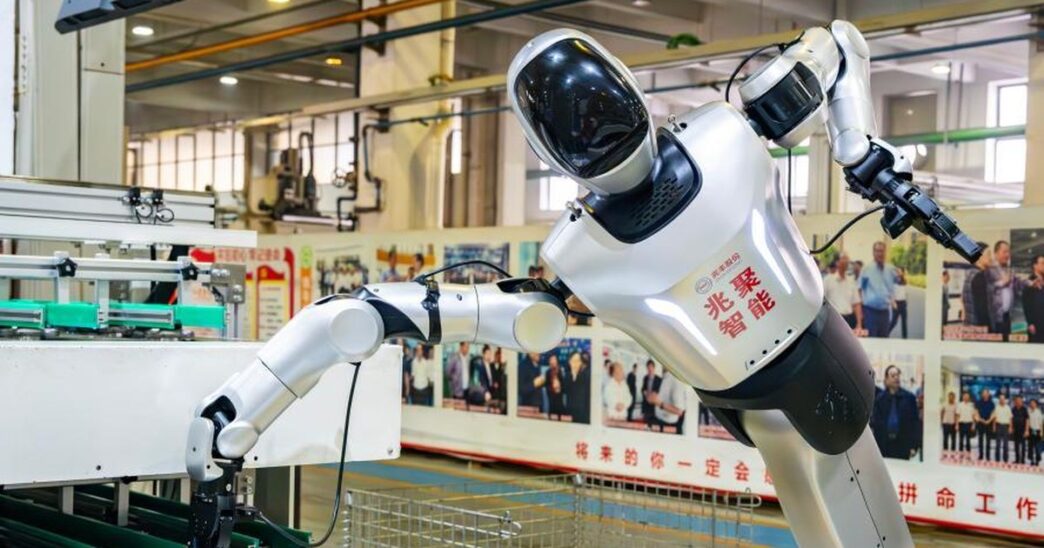
Fifteen humanoid robots are loading auto parts on a Hangzhou line — and each cycle still takes more than half a minute. On October 15, 2026, a Yicai (第一财经) reporter walked the Xiaoshan plant of Zhaofeng (兆丰股份) and counted 15 Leju Robotics Kuafu (夸父) humanoids at 15 stations, gripping small parts and feeding the line. The robot bends, reaches, twists, grasps, straightens up, moves to the line on its wheeled base and sets the part down. Yicai’s on-site timing: more than 30 seconds end to end.
That is the story in one number. The companies’ own launch release puts a single loading cycle at under 40 seconds, and Securities Times (证券时报), also on site, reported that a human worker at the same station takes about 15 seconds. Zhaofeng’s chairman wants the robot cycle under 15 seconds within about a year. Until then, this is a pilot-scale loading deployment with company-reported success rates — not a claim that humanoids have replaced the line.
What Yicai saw on the Zhaofeng line
Zhaofeng and Leju chose loading (上料) as the first factory scenario for the joint work. Kong Aixiang, Zhaofeng’s chairman, told Yicai he initially expected a humanoid to work like a phone — buy it, charge it, plug it in. Instead, early units fell, could not stand reliably and could not hold parts. Grasp training alone took about 15,000 attempts while the team retuned force and models, he said.
Ke Zhendong, Leju’s executive vice president, told the reporter that hitting above 95% success in a controlled lab is comparatively easy, but factories add people walking through, machine noise and lighting changes — so datasets have to be corrected in the real environment.
The figures Yicai attributes to the companies for the 15 Kuafu units now:
| KPI (company-sourced unless noted) | Figure |
|---|---|
| Robots on line | 15 Kuafu (Yicai on-site count; same figure in Leju’s launch release) |
| Robot configuration | Wheeled base + humanoid upper body with two arms, all 15 units (Cailian Press) |
| Stations / part types | 15 stations; 10+ part types |
| Grip inner diameter | 80–120 mm |
| Job success rate | ~98% |
| Cumulative run time | ~1,000 hours |
| Parts involved in production | >60,000 |
| Robot cycle time | >30 seconds (Yicai timing); 35–40 seconds (Cailian Press); under 40 seconds (Leju release) |
| Human worker, same station | ~15 seconds (Securities Times; Cailian Press) |
| Grasp training before workable grip | ~15,000 attempts (Kong) |
Label those KPIs carefully. They come from executives speaking to Yicai and Securities Times and from the companies’ own release, not from an independent audit we ran. Deployment status: pilot / early production loading on one auto-parts process — not full factory replacement.
Leju confirms 15 robots — and how slow is slow
A Hangzhou.com.cn / China News Service photo story dated October 15 shows robots on the same kind of Hangzhou auto-parts line (photos credited Oct 13) and says “nearly 20” humanoids were deployed for loading and unloading. Yicai’s reporter, on site October 15, counted 15. Leju’s own launch release, carried on October 16 by Gasgoo with images credited to Leju, also says 15 Kuafu units are in routine operation (常态化运行). We use 15.
The speed figures line up more closely than they first look. Yicai timed a full cycle at more than 30 seconds; the release says a single loading cycle takes no more than 40 seconds. Securities Times reported the same under-40-second figure and set it against about 15 seconds for a human worker at that station, which is where our “twice as slow” headline comes from. A Zhaofeng representative also told Securities Times the robots had run on site for more than two months without a fault. That is a company statement we have not verified.
One detail the launch reports did not mention: these Kuafu units do not walk. Cailian Press (财联社), which also visited the plant, reported on October 18 that all 15 robots on the line use a wheeled base under a humanoid upper body with two arms. It timed a single load at 35 to 40 seconds, against about 15 seconds for a skilled line worker. Asked why the whole deployment is wheeled, Leju executive vice president Ke Zhendong said wheeled robots can reach industrial volume sooner, legged humanoids suit outdoor inspection on rough ground, and the full humanoid form is still the long-term goal. So this line tests Leju’s upper-body skills and data loop, not two-legged walking.
Kong told Yicai he wants single-task loading under 15 seconds within a year — or even six months — and more part types in the grasp set. If cycles hit 15 seconds, he said payback versus labor cost might show in about three to four years. He also floated inspection with cameras and probes as a next step toward lights-out work. General manager Kong Chenhuan described engineers’ idea of overnight changeover calibration across 20-plus stations to reclaim two to three hours of production time — still a wish list, not a live Kuafu feature in the article.
Why Leju and Zhaofeng keep talking about “real machine” data
Yicai’s piece spends as much time on data as on the robots. Chang Lin, Leju’s CEO, sketched a training stack: pretrain for generality at rough accuracy, mid-train on about a thousand hours of real-machine range data, then post-train with hundreds more hours toward roughly 95% — and said further gains need data flowing back from live deployments. Leju’s release adds a skills toolchain that splits loading into more than 30 basic modules, plus safety checks for dropped parts, collisions and overspeed; those are company descriptions, not features we tested. Open Atom Open-Source Foundation figures quoted in the Yicai story argue that global compliant physical-interaction data is still tiny relative to what general embodied models would need.
Zhaofeng recently donated an auto-parts loading real-machine dataset to the Open Atom OpenLET community; Wang Song of OpenLET’s technical committee told Yicai the stable loading scene can yield more than 40,000 real-job rows in a month. That is a company/community claim about data volume, not proof that other factories can copy the 98% figure tomorrow.
For how to read pilots like this against demos and commercial fleets, see our humanoid readiness levels. Related factory context: Korea’s factory humanoid pilots and our roundup of 2026 humanoid production numbers.
Zhaofeng and Leju set up a joint venture that includes robot training work on October 27, 2025, according to Securities Times. That timeline matches the grind Kong described: standing, grasping and line timing had to be learned on the floor, not assumed from a catalog. Other China factory humanoid stories we have tracked often stop at staged demos; this one at least puts a reporter next to fifteen named units on a named loading process.
What this is — and what it is not
It is a named customer site (Zhaofeng Xiaoshan), a named robot (Leju’s Kuafu, here on a wheeled base), a reporter on the floor, and a robot cycle (30-plus seconds by Yicai’s watch, under 40 by the companies’ own figure) that is still more than twice a human worker’s roughly 15 seconds at the same station, per Securities Times. It is not evidence that Hangzhou auto-parts plants have swapped out their loading crews, and it is not an independently verified 98% benchmark. Watch whether Zhaofeng publishes a 15-second cycle with the same success rate — and whether the fleet grows beyond the 15 robots Leju now confirms.
Frequently asked questions
How many Leju Kuafu robots are on the Zhaofeng line?
Yicai’s reporter counted 15 Kuafu humanoids across 15 stations at Zhaofeng’s Xiaoshan auto-parts plant on October 15, 2026. Leju’s own launch release gives the same number. An earlier China News Service / Hangzhou.com.cn photo story said “nearly 20.”
What tasks are the robots doing?
Loading (上料): grasping small auto parts (about 80–120 mm inner diameter) and placing them for the production line. Zhaofeng and Leju chose loading as the first joint factory scenario. All 15 units run on wheeled bases rather than legs, according to Cailian Press. It is not presented as full line replacement.
How fast is a cycle, and what success rate do they claim?
Yicai timed a cycle at more than 30 seconds, and the companies’ release says under 40 seconds. Securities Times reports a human worker takes about 15 seconds at the same station. Company figures via Yicai put job success around 98%, cumulative run time around 1,000 hours and parts involved above 60,000. Those KPIs are company-sourced, not an independent audit.
Is this a commercial full replacement of workers?
No. Treat it as a pilot / early production loading deployment. Zhaofeng’s own near-term goal is cutting cycle time toward 15 seconds and expanding part types — a sign the robots are still more than twice as slow as a human worker at that station.
What is OpenLET doing with Zhaofeng’s data?
Yicai reports Zhaofeng donated a real-machine auto-parts loading dataset to the Open Atom OpenLET community, with claims of more than 40,000 real-job rows collectible per month once the scene is stable. That is reported community/company framing about training data, not a RoboticaGuide measurement.
Sources
- Yicai (第一财经), Zheng Xutong, “非人类员工进汽车零部件工厂打工:抓零件练了1.5万次,” October 16, 2026: yicai.com/news/103397266.html
- Hangzhou.com.cn / China News Service, “Humanoid robots join the workforce at auto parts factory in Hangzhou,” October 15, 2026 (photos Oct 13, Wu Junyi): en.hangzhou.com.cn
- Securities Times (证券时报), Li Xiaoping, “兆丰股份’新同事’:15台机器人上岗 上料成功率98%,” October 15, 2026, 10:00 p.m. Beijing time: stcn.com
- Leju Robotics and Zhaofeng joint release as carried by Gasgoo (盖世汽车), “15台’夸父’人形机器人进驻汽车产线常态化作业,” October 16, 2026 (images credited to Leju Robotics): gasgoo.com
- Cailian Press (财联社), Wang Biwei, “人形机器人’上工’记,” October 18, 2026, 9:16 p.m. Beijing time: cls.cn
All sources accessed October 17–19, 2026.
Related: Humanoid readiness levels · Korea factory humanoids · Humanoid production numbers 2026 · Robot Companies · Humanoid Robots
Last updated: October 19, 2026. To report an error, see our corrections page. Articles are drafted with AI assistance and reviewed and edited by an editor; see our editorial policy.