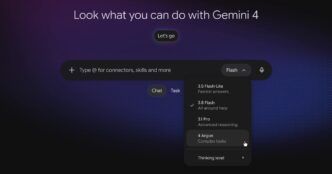
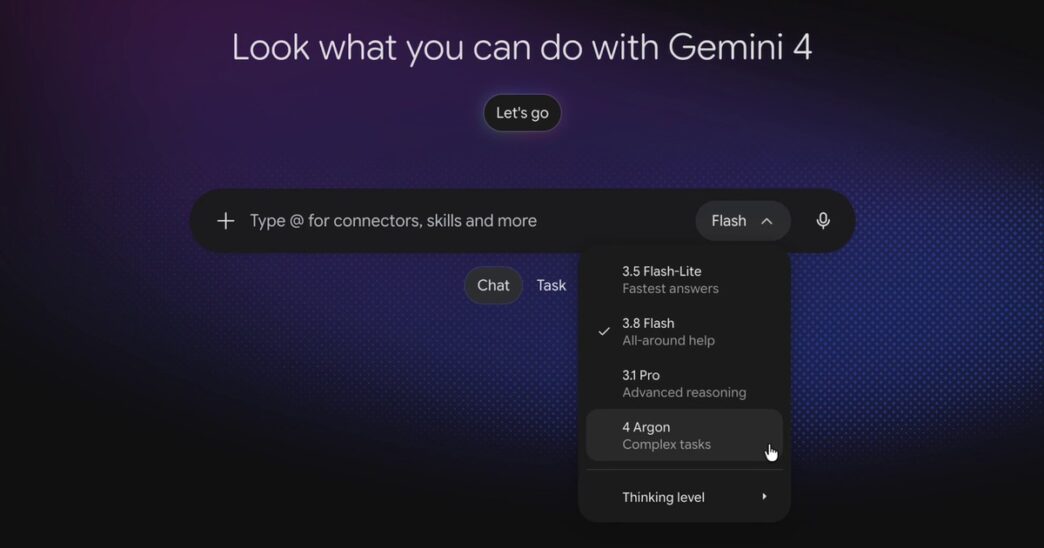
Gemini 4 Argon costs $2 per million input tokens and $10 per million output tokens on Google’s API, but only until November 30. On December 1 the price doubles to $4 and $20, the same rate Anthropic charges for Claude Opus 5.5. There is no free API tier, and Google’s $19.99 AI Pro plan, which does get Argon in the Gemini app, doesn’t unlock it in AI Studio.
Google made Argon generally available on October 13, about two weeks after announcing it on September 30 for a small group of cyber defenders. The launch post is about what the model can do. The pricing page, the plan pages and the model card are where you find what it costs, who can use it, and where it loses to rivals by Google’s own count.
Gemini 4 Argon price on the API, tier by tier
Google’s Gemini API pricing page, which we checked on October 14, 2026, lists four ways to buy gemini-4-argon. Each one doubles on December 1.
| Per 1M tokens | Input (to Nov 30 / from Dec 1) | Output, incl. thinking (to Nov 30 / from Dec 1) | Cached input (to Nov 30 / from Dec 1) |
|---|---|---|---|
| Standard | $2.00 / $4.00 | $10.00 / $20.00 | $0.10 / $0.20 |
| Batch | $1.00 / $2.00 | $5.00 / $10.00 | $0.05 / $0.10 |
| Flex | $1.00 / $2.00 | $5.00 / $10.00 | $0.05 / $0.10 |
| Priority | $3.60 / $7.20 | $18.00 / $36.00 | $0.18 / $0.36 |
Three details change the bill. Output pricing includes thinking tokens, so Argon’s reasoning is billed at the output rate. Caching is implicit only; explicit caching isn’t supported. And there’s one rate at any prompt length, with no long-context surcharge listed. By our arithmetic from Google’s rates, a 100,000-token prompt with a 10,000-token answer costs about $0.30 now and $0.60 from December 1.
Is Gemini 4 Argon free? Not on the API, and not in every paid plan
The pricing page shows “Not available” in every Free-tier column for Argon. You need a paid Gemini API project.
The consumer side splits in a way that’s easy to miss. In the Gemini app and AI Mode in Search, Argon is rolling out to Google AI Pro ($19.99 a month) and Google AI Ultra (from $99.99 a month), according to Google’s app release notes. Google’s subscriptions page doesn’t list it for the free tier or the $4.99 AI Plus plan. But in Google AI Studio, the developer playground, Google’s AI plans page says plainly that “Gemini 4 Argon is not available on the Free or Google AI Pro plans.” Pro subscribers get Argon in the chat app, not in AI Studio, and among consumer plans, Google’s launch post lists Antigravity access for Ultra only. App limits are compute-based and refresh every five hours up to a weekly cap, per Google’s limits page; there’s no published Argon prompt count.
The one free route is narrow: Google will give 10,000 scientists Antigravity’s highest usage tier free for six months, by application, “subject to eligibility, capacity, and selection.”
How the December price lines up with Opus, Astra and Sol
We checked the rivals’ official price pages on October 14. Standard API rates per million tokens:
| Model | Input | Output |
|---|---|---|
| Gemini 4 Argon (to Nov 30) | $2 | $10 |
| Gemini 4 Argon (from Dec 1) | $4 | $20 |
| Claude Opus 5.5 | $4 | $20 |
| Meta Muse Wonder | $4 | $20 |
| Claude Sonnet 5.5 | $2 | $10 |
| GPT-6.1 Sol | $2 | $10 |
| GPT-6 Astra (short context) | $10 | $50 |
So the introductory price matches Anthropic’s and OpenAI’s mid-tier models, and the list price matches Anthropic’s and Meta’s big ones. Per-token prices aren’t the whole story: tokenizers differ, and OpenAI charges higher long-context rates above a prompt-size threshold. Cost per finished job is a better yardstick. On the independent Vals Index, updated October 13, Argon ranks first at 68.90% and costs $15.68 per test run at its $4/$20 list rate. Opus 5.5, at the same per-token price, scores 66.97% and costs $32.14, because it used about twice as many input tokens and more than three times as many output tokens.
Where Google’s own table shows Argon losing
Google’s launch post says Argon outperforms other frontier models “on benchmarks across domains.” The model card is more mixed. Google’s table compares Argon with GPT-6 Astra, Claude Fable 5.1 and Claude Opus 5.5. Its methodology page says Argon was run at its highest thinking setting and that rival scores mostly come from the providers’ own reports or public leaderboards, so treat this as Google’s compilation, not a same-lab test.
| Benchmark (Google’s table) | Gemini 4 Argon | GPT-6 Astra | Claude Fable 5.1 | Claude Opus 5.5 |
|---|---|---|---|---|
| Vals Index | 68.9% | 63.1% | 65.8% | 67.0% |
| Harvey’s Legal Agent Benchmark | 19.6% | 5.4% | 6.7% | 3.8% |
| GraphWalks, 256K to 1M (BFS F1) | 84.2% | 71.8% | 65.0% | 66.8% |
| FrontierSWE v2 | 55.0% | 65.5% | 56.3% | 62.3% |
| Terminal-Bench 4.0 | 57.4% | 58.2% | 57.9% | 66.4% |
| Terminal-Bench Science 0.1 | 57.6% | 68.1% | 52.6% | 63.3% |
Argon wins clearly on legal and finance agent work and on very long inputs. It comes last of the four on FrontierSWE v2 and Terminal-Bench 4.0, two agentic coding tests, which sits awkwardly with a launch pitched heavily at software engineers. The table also leaves out Claude Sonnet 5.5, which Vals ranks second at 67.04% and which costs $2/$10.
The 1M limit is shared, and other specs
Google calls Argon’s 1,048,576-token limit “unified,” and the model page means it literally: input and output share it, so a 900,000-token prompt leaves about 148,000 tokens for the answer. Default output is 65,536 tokens; going higher needs what Google calls long decode. Argon reads text, images, video, audio and PDFs and writes text only, with three thinking levels and computer use in preview. The model card gives a March 2026 knowledge cutoff and a sparse mixture-of-experts design, but no parameter count.
A safety finding worth reading before you build on it
The model card says Google “cannot rule out” that Argon reached its critical capability levels for biological risk and for cyberattacks, and can’t rule out a lower-tier threshold it calls a TCL for stealth and situational awareness, where Argon passed 14 of 15 challenges. In each case Google says it built safeguards it assesses bring the risk below those levels. Separately, defenders in its Fairwind Program can apply for Argon “without cyber guardrails.” Google’s price footnote applies to “the Argon model intended for public access only,” and it hasn’t said what that guardrail-free version costs.
The date to watch is November 30, when the introductory rate ends. Google also promised “the rest of the Gemini 4 family,” and a smaller, cheaper Argon sibling would change the math above more than anything on today’s price list.
Frequently asked questions
How much does Gemini 4 Argon cost?
On the Gemini API, Standard pricing is $2 per million input tokens and $10 per million output tokens (thinking tokens included) through November 30, 2026. From December 1 it’s $4 and $20. Cached input is $0.10, then $0.20, and Batch and Flex are half the Standard rate.
Is Gemini 4 Argon free?
No. Google’s pricing page lists Argon as not available on the free API tier, and the Gemini app offers it on Google AI Pro and Ultra, not the free plan. The only free access Google has announced is an application-based program giving 10,000 scientists six months of Antigravity’s top usage tier.
Can Google AI Pro subscribers use Gemini 4 Argon?
Yes in the Gemini app and AI Mode in Search, where it’s rolling out to Pro and Ultra. No in Google AI Studio: Google’s AI plans page says Argon isn’t available on the Free or Google AI Pro plans there. Ultra subscribers, or anyone with a paid API key, can use it in AI Studio.
What is Gemini 4 Argon’s context window?
Google lists 1,048,576 tokens as a unified limit shared by input and output. Default output is 65,536 tokens; long decode allows up to the full window. The knowledge cutoff in the model card is March 2026.
Is Gemini 4 Argon cheaper than Claude Opus 5.5?
Until November 30, yes: $2/$10 per million tokens against Opus 5.5’s $4/$20. From December 1 the per-token prices are the same. On the Vals Index, Argon’s cost per test run at list price was $15.68 against $32.14 for Opus 5.5, because it used fewer tokens.
Sources
All accessed October 14, 2026, between about 8:40 and 8:55 AM ET.
- Google, Koray Kavukcuoglu, “Gemini 4 Argon: Built to solve your hardest problems” (Oct 13, 2026; GA, access by plan, intro price and Nov 30 footnote, Fairwind, scientist program): blog.google
- Google, “Gemini 4 Argon: our next era of frontier intelligence” (Sep 30, 2026; Fairwind rollout): blog.google
- Google AI for Developers, Gemini API pricing (Argon Standard, Batch, Flex, Priority; free tier “Not available”; implicit caching only; grounding): ai.google.dev/gemini-api/docs/pricing
- Google AI for Developers, Gemini 4 Argon model page (unified 1,048,576-token limit, 65,536 default output, long decode, modalities, capabilities): ai.google.dev
- Google AI for Developers, Google AI plans (Argon not available on Free or Google AI Pro in AI Studio): ai.google.dev
- Google, Gemini subscriptions page (AI Plus $4.99, AI Pro $19.99, AI Ultra $99.99/$199.99; US prices): gemini.google/subscriptions
- Google, Gemini app release notes, Oct 13, 2026: gemini.google/release-notes
- Google, Gemini Apps limits and feature availability: support.google.com
- Google DeepMind, Gemini 4 Argon model card (benchmark table, knowledge cutoff, architecture, Frontier Safety assessment): deepmind.google
- Google DeepMind, Gemini 4 Argon evaluation methodology: deepmind.google
- Vals AI, Vals Index leaderboard (updated Oct 13, 2026): vals.ai
- Anthropic, Claude API pricing (Opus 5.5, Sonnet 5.5): platform.claude.com
- OpenAI, API pricing (GPT-6 Astra, GPT-6.1 Sol): developers.openai.com
- Meta, Model API pricing and rate limits (Muse Wonder): dev.meta.ai
- Google Gemini on X, Argon launch video (featured image source), Oct 13, 2026: x.com/GeminiApp
Related: Muse Wonder costs $4/$20 per million tokens · Claude Haiku 5.5 price and benchmarks · Gemini Robotics 2 explained · More LLM news
Last updated: October 14, 2026. To report an error, see our corrections page. Articles are drafted with AI assistance and reviewed and edited by an editor; see our editorial policy.