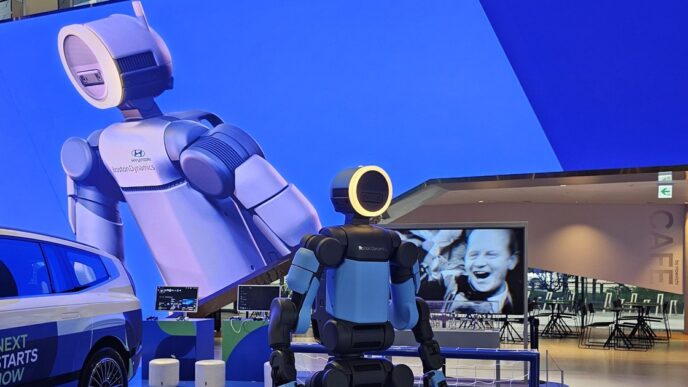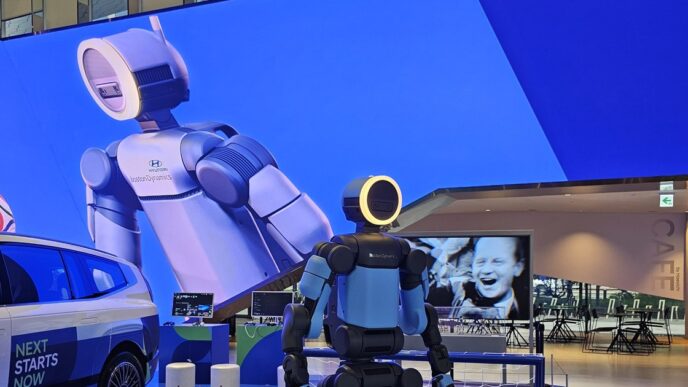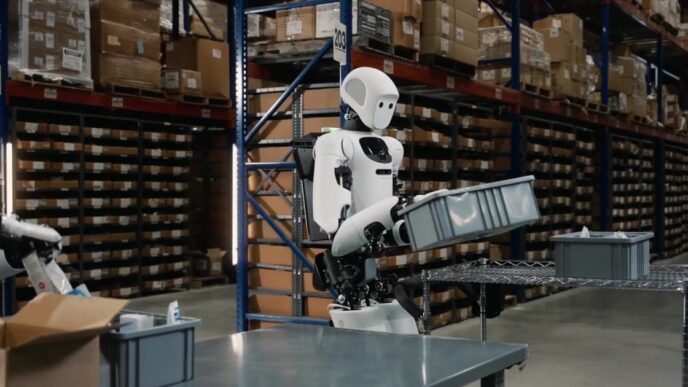
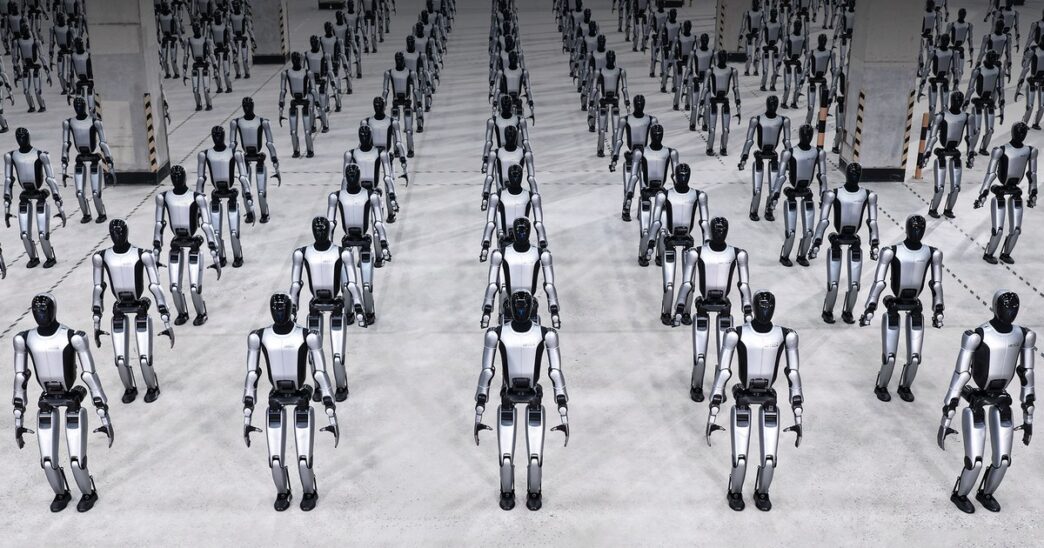
Shanghai wants 8,000 humanoid robots working in its factories by 2028. The target is one line in a new city action to “accelerate the development of new-generation intelligent manufacturing,” launched on Monday, October 12, at the opening of the 26th China International Industry Fair (CIIF), alongside goals for 500 advanced smart factories, more than 2,000 AI manufacturing use cases and an industrial robot density of 600 per 10,000 workers.
It’s a plan, not a deployment count. The figures come from The Paper, whose reporter said they were provided by the fair’s organizing committee, and the same wording ran in Yicai, the Shanghai Securities Journal and other outlets. When we checked Monday morning, we couldn’t find the full text on the Shanghai government’s website or that of its Commission of Economy and Informatization, so the targets below are what those outlets reported the city announced. The reports don’t say how much money is behind it, which companies are involved, or what counts as a humanoid “entering” a factory.
The 2028 targets
The action has “four major projects” and 19 key tasks, according to The Paper. Guandian reported that Zhang Ying, a deputy secretary-general of the Shanghai municipal government, launched it on stage. The headline numbers, as reported:
| Target for 2028 | As reported |
|---|---|
| Humanoid robots | Push 8,000 humanoid robots into factories |
| Industrial robot density | 600 robots per 10,000 workers |
| Smart factories | Full smart-factory coverage of the city’s key manufacturers; full coverage of AI applications in smart factories; 500 “advanced-level” smart factories |
| AI in manufacturing | More than 2,000 AI application scenarios; 10 industry-specific (“vertical”) large models; 300 “high-level” AI agents; new infrastructure for next-generation manufacturing |
| Industry size | AI-enabled intelligent manufacturing equipment industry above ¥200 billion; intelligent manufacturing systems integration industry at ¥100 billion |
The four projects are broad: strengthening the supply of technology, equipment and services; building an “AI plus manufacturing” foundation that is “data-driven, model-supported, scenario-led, secure and controllable”; tiered cultivation of smart factories across design, production, operations and supply chains; and an ecosystem push covering platforms, pilot testing, industrial clusters, standards and talent.
Where Shanghai says it starts from
The Paper also reported the city’s current baseline, again citing the organizing committee: Shanghai has 2 national “leader-level” and 28 national “excellence-level” smart factories, its intelligent manufacturing systems integration industry is worth more than ¥60 billion, and intelligent manufacturing equipment output tops ¥150 billion.
Those labels come from China’s four-tier smart-factory grading scheme: basic, advanced, excellence and leader level. The 500 “advanced-level” factories in the 2028 target are the second tier. Shanghai’s Commission of Economy and Informatization opened 2026 applications for that tier in a September 24 notice posted on the city government’s website.
So the systems-integration goal means growing that business from more than ¥60 billion to ¥100 billion by 2028. The equipment goal is harder to compare: the target counts “AI-enabled” new equipment, while the baseline is total equipment output, and the reports don’t define either. There’s no baseline at all for humanoids in Shanghai factories today.
How big is 8,000 humanoids?
For scale, IDC said on September 29 that global humanoid robot shipments reached nearly 25,000 units in the first half of 2026, up 432.1% from a year earlier, with more than 19,000 shipped in China. Most of those robots didn’t go to factories: research and education, performances and exhibitions, and government data-collection centers made up 69% of first-half shipments, IDC said, though it added that industrial manufacturing, retail and logistics are growing.
Against that, 8,000 humanoids in one city’s factories by 2028 is roughly a third of the world’s first-half shipments (our arithmetic). It’s ambitious for factory work specifically, where today’s humanoid deployments are mostly pilots. At the same CIIF opening, Unitree founder Wang Xingxing said his company and other robot makers have factory pilots under way but still need better generalization and efficiency before large-scale use (our report on his remarks).
What does 600 robots per 10,000 workers mean?
Robot density is the standard measure of factory automation: the number of industrial robots in use per 10,000 manufacturing employees. In its April 8, 2026 release, the International Federation of Robotics put China at 166 for 2024, after recalculating with updated labor-market data from China’s National Bureau of Statistics. South Korea led the world at 1,220, Singapore had 818 and the United States 307. The global average was 132.
Shanghai’s 600 target is far above China’s national figure, but the comparison is rough. The reports don’t give Shanghai’s current density or say whether the city counts the way the IFR does, and a manufacturing hub is likely to run above a national average that includes rural regions.
What the plan doesn’t tell you yet
- What “into factories” means. A paid, working deployment, a pilot cell and a robot on a demo line would all be very different things. The reports don’t say which counts.
- Who pays. No budget was reported. Shanghai’s existing policies hint at the tools: in July 2026 the city’s Commission of Economy and Informatization said it would provide up to ¥10 million to support embodied-AI robots in real manufacturing settings and up to ¥20 million for AI pilot-testing bases in manufacturing. Its August 2025 “AI plus manufacturing” implementation plan already called for practical deployment of “multiple types of embodied intelligence represented by humanoid robots” in typical scenarios.
- Which robots. No robot makers were named in the coverage we read.
- Safety rules. Nothing in the reports addresses how humanoids working near people will be certified. Internationally, the main standard for balancing industrial robots is still a draft (see our guide to ISO safety standards for humanoids).
Why it matters outside China
City targets like this can create early demand for domestic robot makers, which helps them build volume and cut costs. That’s one reason Chinese companies dominate humanoid shipments: IDC said Chinese manufacturers accounted for more than 95% of global shipments in the first half. Buyers in the US face a different picture, since the Federal Communications Commission has added “foreign-produced advanced robotic devices” to its Covered List (our FCC buyer’s guide explains the effect). And the factory and warehouse jobs Shanghai is targeting are the same ones Western robot makers are chasing, as our look at humanoids in warehouse logistics shows.
The real test is whether the full document appears with definitions and money attached, and whether yearly counts show up. We’ll update this story if Shanghai publishes it.
Frequently asked questions
What is Shanghai’s 8,000 humanoid robot target?
It’s a goal in Shanghai’s new action to accelerate new-generation intelligent manufacturing, launched on October 12, 2026, at the China International Industry Fair. As reported by The Paper and others, the city aims to push 8,000 humanoid robots into factories by 2028.
Are 8,000 humanoid robots already working in Shanghai factories?
No. It’s a 2028 target. The reports give no current count of humanoids in Shanghai factories, and robot makers at the same event described factory use as pilots.
What other targets are in the Shanghai plan?
By 2028, as reported: industrial robot density of 600 per 10,000 workers, 500 advanced smart factories, more than 2,000 AI manufacturing scenarios, 10 vertical AI models, 300 AI agents, an AI-enabled smart equipment industry above ¥200 billion and a systems integration industry of ¥100 billion.
Has Shanghai published the full plan?
We couldn’t find the full text on official Shanghai government websites on the morning of October 12. The figures come from The Paper, which cited the fair’s organizing committee, and from other Chinese outlets that ran the same wording.
How does 600 robots per 10,000 workers compare?
The International Federation of Robotics put China’s national robot density at 166 per 10,000 manufacturing employees for 2024, South Korea’s at 1,220 and the US at 307. Shanghai’s current figure and counting method weren’t reported.
Sources
All accessed October 12, 2026.
- Yu Kai, “上海:到2028年,推动8000台人形机器人进工厂” (Shanghai: push 8,000 humanoid robots into factories by 2028), The Paper, October 12, 2026: thepaper.cn; republished with credit by 21st Century Business Herald (21jingji): 21jingji.com
- Shanghai Securities Journal / cnstock.com, report on Wang Xingxing and the Shanghai action, October 12, 2026, republished by 10jqka: news.10jqka.com.cn
- Jin Yezi, “上海启动加快发展新一代智能制造行动,实施四大工程、19项重点任务” (Shanghai launches action to accelerate new-generation intelligent manufacturing), Yicai, October 12, 2026: yicai.com
- Guandian, “上海启动新一代智能制造行动 实施四大工程19项重点任务” (launch by Zhang Ying), October 12, 2026: guandian.cn
- Shanghai Municipal Commission of Economy and Informatization, “上海市进一步推动’AI+制造’发展的若干措施” (Hu Jing Xin Ruan [2026] No. 403), published July 17, 2026: sheitc.sh.gov.cn
- Shanghai Municipal Commission of Economy and Informatization et al., “上海市加快推动’AI+制造’发展的实施方案” (Hu Jing Xin Ruan [2025] No. 556), published August 19, 2025: sheitc.sh.gov.cn
- Shanghai Municipal Commission of Economy and Informatization, notice on 2026 applications for Shanghai advanced-level smart factories (Hu Jing Xin Zhi [2026] No. 600), September 24, 2026 (PDF on shanghai.gov.cn): shanghai.gov.cn
- IDC, global humanoid robot tracker summary (Chinese), September 29, 2026: idc.com
- International Federation of Robotics, “Robot Density Surges in Europe, Asia, and Americas,” April 8, 2026: ifr.org
Related: Unitree’s Wang Xingxing on GPT-6 and a one-to-two-year tipping point · ISO safety standards for humanoid robots · More policy and safety coverage
Last updated: October 12, 2026. To report an error, see our corrections page. Articles are drafted with AI assistance and reviewed and edited by an editor; see our editorial policy.