A robotics startup called LiberAI says its new robot brain, Liber-0, can do tasks it was never shown on a robot. In LiberAI’s own test, announced on November 3, 2026, the Liber-0 world action model succeeded in 36.0% of 600 attempts at 60 tabletop tasks that GPT-6 made up for it. Simple pick-and-place jobs worked 63.5% of the time. Multi-step jobs, such as opening a drawer, putting a pen in a pouch and storing the pouch, worked 10.5% of the time.
Those are modest numbers, and LiberAI presents them that way. The interesting part is how Liber-0 got there: mostly from people. LiberAI says the model learned from more than 2.2 million hours of human experience, from web video to recordings made with its own sensor glove, and that 10,000 hours of glove data taught robots more than 2 million hours of web video did.
- What: Liber-0, a world action model from LiberAI that predicts both future video frames and robot actions, pretrained on more than 2.2 million hours of human experience.
- Headline result: 36.0% success over 600 trials on 60 GPT-6-proposed tasks without task-specific robot demos: 63.5% pick-and-place, 34.0% other short tasks, 10.5% multi-step.
- Data claim: 10,000 hours of glove recordings beat 2 million hours of web video, and glove data matched full robot training with 75% fewer robot demos.
- The catch: all results are LiberAI’s own tests on its own robot. No weights, price or outside evaluation has been announced, and multi-step success is low.
What the Liber-0 world action model is
Liber-0 is what the field now calls a world action model. Instead of only mapping what a robot sees to what it should do, it also predicts what the scene will look like next. Our explainer on world action models covers the idea and the other companies chasing it. The practical benefit is that the model can learn from video that has no robot actions attached, because predicting the next frame is useful practice on its own.
LiberAI’s technical blog says Liber-0 uses a Mixture-of-Transformers design with separate language, vision and action “experts” that share attention. It is also trained on visual question answering, image segmentation, image editing and video understanding, so it knows what objects are and how far along a task is. For multi-step jobs, LiberAI says Liber-0 can optionally hand planning to a reasoning model such as OpenAI’s GPT-6 Astra, which then sets the intermediate goals.
LiberAI is a Beijing-based startup, according to The Robot Report. It announced Liber-0 through a press release datelined New York. The same report names Songming Liu as LiberAI’s founder and CEO.
The 36% zero-shot test, and what zero-shot means here
LiberAI asked GPT-6 to propose 60 tabletop tasks in three groups of 20: pick-and-place, short non-pick-and-place jobs, and harder multi-step jobs. Each task got 10 trials. Examples included putting a pen in a pencil case, pushing a drawer closed, and the drawer-pen-pouch sequence.
| Task group (20 tasks each) | Liber-0 success | GPT-6 Astra alone |
|---|---|---|
| Pick-and-place | 63.5% | 8.3% |
| Short non-pick-and-place | 34.0% | 5.0% |
| Challenging multi-step | 10.5% | 1.7% |
| Overall | 36.0% (600 trials) | Not given as one figure (180 trials) |
The definition matters. LiberAI calls this “task-level zero-shot generalization”: the tested model saw robot data during pretraining, but not robot demonstrations collected for these particular tasks. That is narrower than “a robot that does anything you ask,” and LiberAI says so. The GPT-6 Astra comparison ran the language model directly as the robot’s controller with three trials per task. LiberAI reports that Astra took 87.3 seconds of reasoning per decision on average and 17.8 minutes to finish the tasks it did complete.
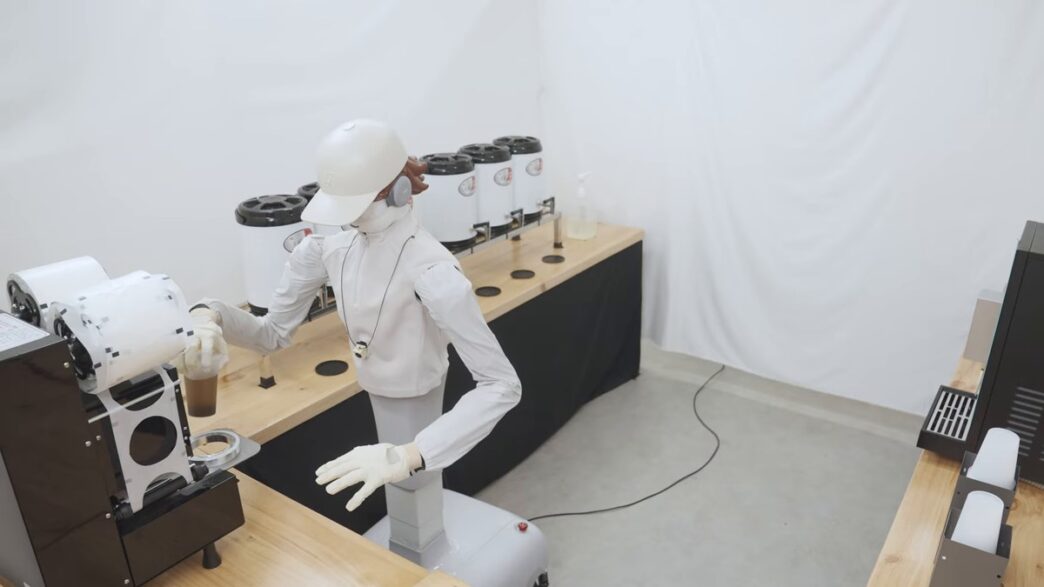
The blog doesn’t say whether the optional Astra planner was switched on during Liber-0’s own multi-step trials. LiberAI also shows a fully autonomous milk tea demo, but that one was not zero-shot: it says Liber-0 was adapted to that workflow.
Why the glove data mattered more than web video
Robot training data is scarce because every example normally needs a person teleoperating a robot, as our piece on humanoid robot training data explains. Human video is plentiful, but it doesn’t say exactly how fingers moved, and human bodies don’t match robot bodies.
LiberAI’s fix is the LiberSense Glove, a wearable that records hand poses and trajectories alongside first-person and wrist-camera video. LiberAI says it is 0.3 mm thick and weighs 131 g, and that collecting data with it needs no robot on site. In LiberAI’s controlled tests, each data source was used alone for pretraining, followed by the same robot post-training. The results, reported as progress scores from 0 to 100 that give credit for partial completion:
- Glove beat web video at a 200-to-1 disadvantage. Even at 2 million hours, web human video reached 64.6 on pick-and-place and 51.2 on other manipulation, below what 10,000 hours of glove recordings scored.
- Fewer robot demos. On eight tasks, 25% of the robot demonstration pool plus all the glove data scored 75.6, against 72.8 for the full robot pool alone. The two full pools held equal numbers of demonstrations.
- New skills from gloves. A policy whose robot demos covered only pick-and-place scored 2.2 on other tasks. Adding glove recordings of folding, pressing and opening raised that to 47.5, and broader glove data to 54.6, near the 56.3 of a policy with robot demos for everything.
- More people helped. Keeping the number of glove episodes fixed but spreading them over 100 demonstrators instead of one raised the glove-only score from 12.7 to 40.1.
LEO, the robot built to move like a person
Data is only half of LiberAI’s argument. The other half is hardware. Its robot platform, LEO, has dexterous hands (WUJI2 hands in the tests), a slim forearm, a wrist with three rotational degrees of freedom and a bending waist, and its chest and wrist cameras sit where the glove-collection cameras do. A “Unified Embodiment Representation” tells the model the body’s dimensions and how its joints move.
To test whether that matters, LiberAI compared LEO with a platform built on Tianji Marvin M6 arms on knob turning, slipper arranging and drawer opening. LEO scored 28.3 points higher on average. The comparison is LiberAI’s, on tasks LiberAI chose to show off human-like wrists, so read it as a design argument rather than a fair hardware shootout.
How the Liber-0 numbers stack up, and what’s missing
On LiberAI’s internal benchmarks, the fully pretrained checkpoint scored 81.4 on pick-and-place and 72.3 on other tasks before any robot post-training, and 83.6 and 73.8 after. LiberAI reads the small gain as a sign that pretraining already did most of the work.
Several things are missing:
- Independent testing. Every number comes from LiberAI’s own lab, tasks and scoring. None of the tasks are on a public leaderboard, and the GPT-6 Astra baseline is a language model, not a competing robot model such as Physical Intelligence’s pi0 or Gemini Robotics 2.
- Access. LiberAI hasn’t announced open weights, an API or a price. The public can try an online simulation where you upload objects, but that version was post-trained on 100 hours of simulated teleoperation data.
- Touch. The glove records motion, not contact or force. LiberAI says tactile and force sensing, needed for insertion, fastening and soft materials, is future work.
- Hard tasks. 10.5% on multi-step jobs means about nine failures in ten. LiberAI itself says performance on challenging, long-horizon tasks “remains limited.”
Coverage of the launch in The Robot Report ran as sponsored content, which is worth knowing if you see it cited as independent reporting.
What to watch next
The test that would matter is someone else running Liber-0, or its glove-heavy recipe, on their own tasks. Watch for a paper with full task lists, a weights or API release, and a version of the glove that records touch. If glove data keeps beating robot demos when outsiders check, it would change how cheaply robots can be taught.
Frequently asked questions
What is Liber-0?
Liber-0 is a world action model from the startup LiberAI, announced November 3, 2026. It jointly predicts future video frames and robot actions, and LiberAI says it was pretrained on more than 2.2 million hours of human experience, including web video and recordings from its LiberSense Glove.
What does zero-shot mean for Liber-0?
LiberAI uses it to mean the tested model was never trained on robot demonstrations collected for the specific tasks, though its pretraining did include robot data. On 60 such tasks proposed by GPT-6, it reports 36.0% success over 600 trials.
How well does Liber-0 do on multi-step tasks?
LiberAI reports 10.5% success on its 20 challenging multi-step tasks, against 63.5% on pick-and-place and 34.0% on short non-pick-and-place tasks. The company says long-horizon performance remains limited.
What is the LiberSense Glove?
It is LiberAI’s data-collection glove, which records hand poses and trajectories with synchronized first-person and wrist-camera video. LiberAI says it is 0.3 mm thick and weighs 131 g. It doesn’t record touch or force yet.
Can I download or use Liber-0?
Not as a model. LiberAI hasn’t announced open weights, an API or pricing. It offers an online simulation where users upload objects and watch a version of Liber-0 handle them.
Sources
- LiberAI: “Liber-0: Emergent Zero-Shot Capabilities in Multi-Step Manipulation from 2.2 Million-Hour Human Experience,” technical blog, November 2026
- LiberAI via ACCESS Newswire: “LiberAI Introduces Liber-0 for Zero-Shot Robot Manipulation,” November 3, 2026
- LiberAI official YouTube channel: “Introducing Liber-0 | Zero-Shot, Multi-Step Robot Manipulation”
- The Robot Report (sponsored content): “LiberAI Unveils Liber-0,” November 4, 2026
All sources accessed November 4, 2026.
Last updated: November 4, 2026. To report an error, see our corrections page. Articles are drafted with AI assistance and reviewed and edited by an editor; see our editorial policy.