Scale AI and Hugging Face have released FineART, an open robot dataset of 40,543 recorded episodes, or 1,718 hours of two-armed manipulation, in which every episode is broken into short, timestamped steps with plain-English labels. Scale published the FineART dataset on October 29, 2026, together with FineART-VLA, a robot model trained on it that writes out its next step in words before it moves. Both are free to download from Hugging Face.
The companies call it the largest open robot dataset with subtask labels. That’s their claim, not an independent ranking, but the numbers are checkable: the dataset card, the model weights and the training code are public. Here’s what’s in the release, what the results do and don’t show, and what you’d need to use it.
- What it is: 40,543 episodes (1,718 hours) across 151 tasks, with 533,913 timestamped subtask labels, about 13 per episode.
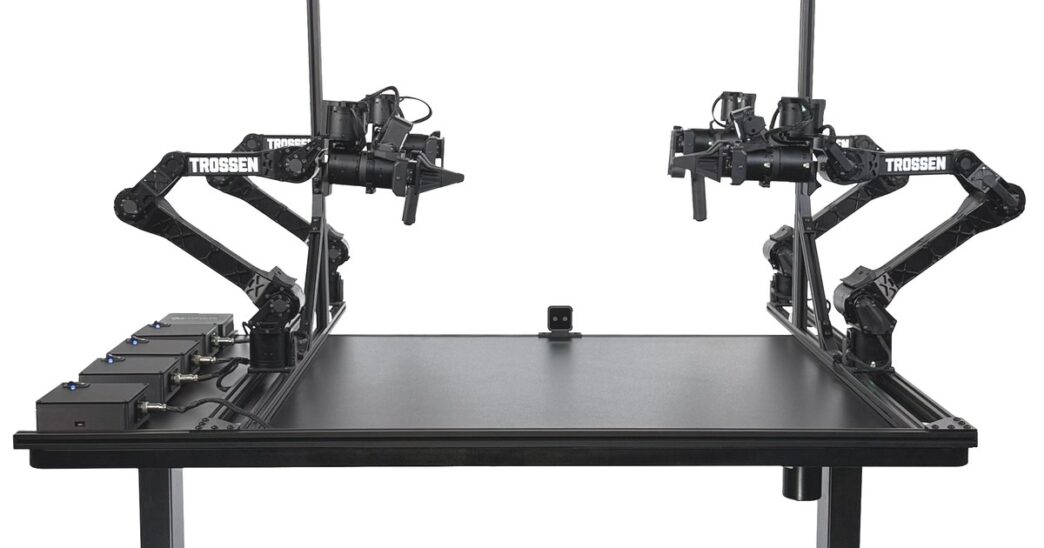
- The robot: every episode was recorded on a Trossen Robotics Stationary AI, a two-armed ALOHA-style tabletop robot.
- The model: FineART-VLA, built on Physical Intelligence’s open π0.5 model, predicts its next subtask in language and then acts on it.
- Licenses: the dataset is CC BY 4.0. The model weights are under the Gemma license.
- The catch: the results are the authors’ own lab tests on tabletop tasks, not a deployment.
What’s in the FineART dataset
An episode is one complete attempt at a task, recorded from start to finish. FineART has 40,543 of them, spread over 151 tasks. Scale’s announcement says 77% of the data covers pick-and-place and sorting, and the other 23% covers harder, contact-rich work: textiles, cables, tool use and precision insertion.
The part that sets it apart is the labeling. Each episode carries a task-level instruction, such as “unpack the box,” plus a sequence of subtask annotations. Each annotation marks where a step begins and ends and describes it in a short caption, the way a person would explain the job: open the box with a box cutter, unfold the flaps, remove the items. Across the dataset that adds up to 533,913 labeled steps.
Scale describes a three-stage pipeline behind the labels. One team collected the episodes, a second annotated each subtask and a third checked quality. The episodes are human demonstrations: operators drove the robot by teleoperation to record each attempt, which is the standard way to collect this kind of training data. None of it is footage of a robot working on its own.
The technical details on the Hugging Face dataset card are consistent across the release:
- Hardware: a Trossen Stationary AI, an ALOHA-style bimanual (two-armed) robot, used for every episode.
- Cameras: four views (one high, one low and one on each wrist) at 640×360 pixels and 30 frames per second.
- Robot data: 14 dimensions of joint and gripper state and action, seven per arm.
- Format: LeRobot dataset format, so it loads with Hugging Face’s open-source LeRobot library.
- License: CC BY 4.0, which allows commercial use with attribution. The dataset isn’t gated.
Trossen, which sells the robot, posted a short clip about the dataset on its official YouTube channel the same day Scale announced it.
Why subtask labels matter
Most open robot datasets pair a demonstration with a single instruction for the whole task. A model trained that way learns to map “unpack the box” to a long stream of motor commands, with no explicit idea of which step it’s on. When one step goes wrong, there’s nothing in the training signal that says where the plan broke.
Scale’s argument is that multi-step jobs depend on each step going right, so the data should say what the steps are. With step labels, a model can be trained to name the step it’s working on and to take a new step-by-step instruction from a person. The arXiv paper notes that large single-arm datasets reach hundreds of thousands of trajectories but usually carry one instruction per episode, and that existing two-armed datasets label subtasks for only part of their hours.
That’s the gap FineART targets. Whether finer labels beat simply collecting more data is an open research question, and this release is one data point in it, not the answer.
FineART-VLA: a model that names its next step
A vision-language-action (VLA) model takes camera images, a text instruction and the robot’s joint readings, and outputs motor commands. FineART-VLA splits that into two jobs. A planning side looks at the scene and predicts the next subtask in words. A control side turns that subtask into a short chunk of actions. Scale calls this LeRobot’s first open “System 1-System 2” VLA, borrowing the fast-and-slow thinking terms from psychology.
The model card says FineART-VLA starts from Physical Intelligence’s openly released π0.5 model, converted into LeRobot’s format, and is then trained further on FineART. Its training mix is 30% subtask prediction and 70% action training. It uses three of the four cameras and outputs 50-step action chunks. The weights are a single download of roughly 9 GB, released under Google’s Gemma license because the model’s language backbone is a Gemma model.
What the results show, and what they don’t
The paper reports three headline results, all from the authors’ own tests on real robots:
- Spatial instructions: training on FineART’s subtask labels raised success at following instructions such as left, right or middle from 32.0% to 100.0%.
- Long tasks with coaching: on long tasks the model hadn’t seen, success rose from 16.0% to 76.0% when a person fed it step-by-step subtask instructions.
- A new robot: the model matched a baseline on a different robot with 10 times less fine-tuning data, according to the paper.
Scale’s announcement says the work involved 3,400 real-world evaluations. Those are meaningful numbers for a research release, but read them with the setup in mind. The 76% figure depends on a human supplying the steps; it isn’t the robot planning a long job alone. The tests are tabletop manipulation in a lab, run by the people who built the model. On our readiness scale, this is research and demo-stage evidence, not a pilot or a commercial deployment, and no customer use was announced.
The data also comes from a single robot design with modest 640×360 cameras. That makes it consistent, which helps training, but a model that learns only from it will need adaptation for other arms, grippers and cameras. The cross-robot result suggests that adaptation can be cheaper, not that it’s unnecessary.
Who can use FineART, and what you need
Anyone can download the dataset, and the CC BY 4.0 license permits commercial use as long as you credit the source. Scale’s post lists three starting points: load the data with LeRobot, run LeRobot’s annotation tool to add subtask labels to your own recordings, and fine-tune FineART-VLA with LeRobot’s training script.
The model is more restricted than the data. The Gemma license has its own use terms, and the setup uses a Google PaliGemma tokenizer, which may ask you to accept Google’s terms on Hugging Face before it downloads. Running the model on a robot also means matching its inputs: two arms with 14 joint and gripper channels and similar camera placement. Teams with a Trossen Stationary AI or another ALOHA-style rig are closest to that setup.
There’s a business angle too. Scale’s post invites teams that want “larger-scale and higher-quality annotations” to contact its sales team. FineART is a free release, and it also shows off the paid data-labeling work Scale sells to AI labs and now to robotics companies.
Why it matters for robot learning
Data is the scarce input in robot learning, as we covered in our look at the training-data bottleneck. Companies are attacking it from different directions. Alibaba’s Lambda-0 leans on video of people. Physical Intelligence builds general models on large mixed datasets and is reportedly raising at a $20 billion valuation. Unitree open-sourced its own humanoid model earlier this month.
FineART’s contribution is narrower and easy to inspect: a large, openly licensed set of real robot demonstrations where the structure of each task is written down. For university labs and startups that can’t afford to record 1,718 hours themselves, that’s a usable starting point today.
What to watch
Look for independent results: other labs fine-tuning FineART-VLA on their own robots and publishing success rates. Also watch whether Scale releases more data in this format, whether other robot makers add support, and whether the subtask approach holds up on longer jobs without a person supplying the steps.
Frequently asked questions
What is the FineART dataset?
FineART is an open robot dataset from Scale AI and Hugging Face’s LeRobot team. It holds 40,543 recorded episodes, or 1,718 hours, of two-armed manipulation across 151 tasks, with 533,913 timestamped subtask labels.
Is FineART free to use commercially?
The dataset is released under CC BY 4.0, which allows commercial use with attribution. The FineART-VLA model weights are under Google’s Gemma license, which has its own terms, so check that license before building a product on the model.
What robot was FineART recorded on?
Every episode was recorded on a Trossen Robotics Stationary AI, an ALOHA-style tabletop robot with two arms, using four cameras at 640×360 and 30 frames per second.
Does FineART-VLA work on other robots?
The paper says it matched a baseline on a new robot with 10 times less fine-tuning data. It still needs fine-tuning for different hardware, and those results come from the authors’ own tests.
Was the data collected autonomously?
No. The episodes are human demonstrations recorded by teleoperation, then labeled by a separate annotation team and checked by a third team, according to Scale.
Sources
- Scale Labs, “FineART: Scale AI’s First Open-Source Robotics Dataset and Model” (October 29, 2026): labs.scale.com
- FineART paper, “FineART: Fine-Grained Annotated Robotic Trajectory Dataset and Vision-Language-Action Model for Bimanual Manipulation” (arXiv 2609.36416, submitted September 29, 2026): arxiv.org
- Hugging Face dataset card, lerobot/FineART (license CC BY 4.0): huggingface.co
- Hugging Face model card, lerobot/FineART-VLA-subtask-midtrained (license Gemma; base lerobot/pi05_base): huggingface.co
- LeRobot documentation, FineART-VLA usage guide: huggingface.co
- Trossen Robotics, “The largest open robot dataset with subtask labels was recorded entirely on Trossen robots.” (official YouTube channel, October 29, 2026): youtube.com
- Trossen Robotics, Stationary AI product page: trossenrobotics.com
All sources accessed October 31, 2026, between about 7:00 and 8:30 AM ET.
Last updated: October 31, 2026. To report an error, see our corrections page. Articles are drafted with AI assistance and reviewed and edited by an editor; see our editorial policy.