AgiBot wants the robot industry to stop counting robots and start counting work. At its Innovation Day in Shanghai on Thursday, October 29, the Chinese humanoid maker introduced Worken, a metric that multiplies how many robots are active by how many hours they work autonomously and by how much acceptable output they produce. Co-founder and CTO Peng Zhihui presented it alongside a new hardware platform, a preview of its next foundation model and a heavy-duty industrial robot called G2 Max.
The idea is a fair response to a real problem: production totals say little about whether robots do useful work. But AgiBot defines the metric, sets the benchmarks and supplies the numbers, and the deployment figures it put on stage cover a few hundred robots, not the 20,000 it says it has built. Here’s what Worken measures, what the stage slide showed and what else AgiBot announced.
- What’s new: AgiBot introduced Worken on October 29, 2026: active robots × autonomous working hours × an output efficiency ratio.
- Also announced: the AHA3 hardware platform, the GO-3 Preview foundation model, the WITA-Omni interaction model, the G2 Max industrial robot and Link-U OS 1.0.
- Price and dates: no price or ship date for G2 Max. AgiBot’s Chinese-language release says GO-3 Preview will be open-sourced by the end of 2026, and Link-U OS, now in partner trials, is due to be fully open source by then too.
- The catch: Worken is AgiBot’s own proposal. The company picks the reference benchmarks and reports the hours, and no outside auditor checks them yet.
How AgiBot Worken is calculated
AgiBot describes Worken, a blend of “work” and “token,” as “Effective Intelligent Work Hours.” The formula has three parts:
- Number of active robots. Machines doing tasks at a real site, not units built or sitting in inventory.
- Autonomous working hours. Time spent working without help, not total powered-on time.
- Output efficiency ratio. Acceptable output measured against a reference benchmark for the task, which AgiBot says could be the work a human completes under normal operating standards.
“We want to move beyond measuring how many robots are built or delivered and begin measuring how effectively they can perform useful work, autonomously and consistently, in the real world,” Peng said in the release. The company calls Worken “an evolving framework” that it plans to refine with deployment data and task-specific benchmarks.
That framing is a clear break from the industry’s usual scoreboard. AgiBot itself has leaned on production totals; it says its 20,000th robot came off the line in September. As we noted when comparing AgiBot’s and Unitree’s production numbers, those totals don’t say how many robots are working or for how long.
What the Worken slide showed
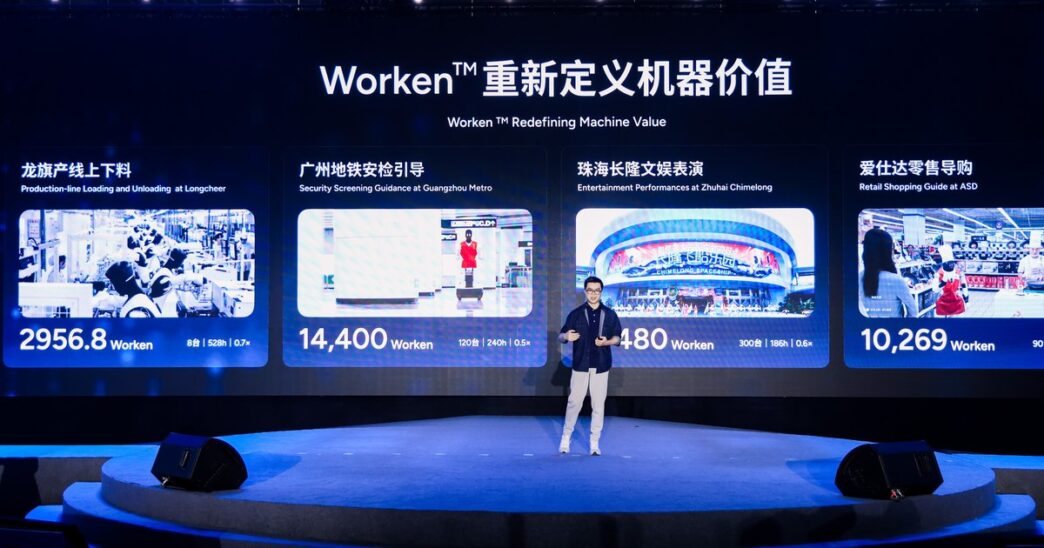
The press release doesn’t list any Worken scores. A stage photo AgiBot published with it does. The slide behind Peng shows four deployments, each with a robot count, hours and a ratio:
- Production-line loading and unloading at Longcheer: 8 robots, 528 hours, 0.7×, for 2,956.8 Worken.
- Security screening guidance at Guangzhou Metro: 120 robots, 240 hours, 0.5×, for 14,400 Worken.
- Entertainment performances at Zhuhai Chimelong: 300 robots, 186 hours, 0.6×. Peng stands in front of the total in the photo.
- Retail shopping guidance at ASD: 10,269 Worken. The rest of that panel is cut off at the edge of the frame.
The arithmetic checks out for the two legible totals: 8 × 528 × 0.7 is 2,956.8. That means the hours are per robot. What the slide doesn’t say is over what period those hours were logged, how “autonomous” was judged, or what benchmark produced a 0.7 at Longcheer. The factory example is also the smallest: eight robots. The larger counts are in guidance and entertainment work, where a robot’s output is harder to compare with a person’s.
None of this makes Worken useless. A shared unit that rewards hours of unassisted work, not shipments, would make claims easier to compare. It only works if the inputs can be checked. The release says the metric appears in the “2026 Embodied Intelligence Industry Innovation Report,” compiled by China Economic Information Service and a Shanghai innovation center of the China Academy of Information and Communications Technology (CAICT), alongside AgiBot’s deployment examples. That’s an endorsement of the idea, not an audit of the numbers.
GO-3 Preview, AHA3 and the rest of the launch
Most of the event was product news, all of it described by AgiBot without prices or release dates.
GO-3 Preview is the company’s next embodied foundation model, built on a framework it calls WRAM (World Reasoning Action Model) that is meant to help robots anticipate the results of their actions. Co-founder Yao Maoqing presented it. AgiBot showed zero-shot and few-shot demos and said that, “according to evaluation results presented at the event,” GO-3 Preview ranked first on RoboDojo for task success rate and process score, had the highest overall score on RoboTwin and ranked first overall on RoboColiseum. The release doesn’t give the scores, the competing models or a paper. Treat those rankings as company claims until the results are published. AgiBot’s Chinese-language release adds that GO-3 Preview will be open-sourced by the end of 2026, which would let outside researchers test those claims. For background on this class of model, see our guide to vision-language-action models.
AHA3, AgiBot’s third-generation humanoid hardware architecture, combines locomotion, interaction and task hardware with integrated computing, Wi-Fi 6 and 5G. AgiBot paired it with a joint liquid-cooling system for continuous operation, IP67-rated joints, a new OmniHand 3 family of dexterous hands in Lite, standard and Ultra versions, and the OmniPicker 3 tactile gripper. The company also added a “self-evolving agent” to its AGILE motion framework, which it says lets robots improve their movement through experience on site.
WITA-Omni is an interaction model that combines vision, speech, dialogue, facial expressions and gestures, runs on the robot and supports full-duplex conversation. AgiBot says it ranks first on several interaction benchmarks, including Daily-Omni.
G2 Max specs and the deployments behind them
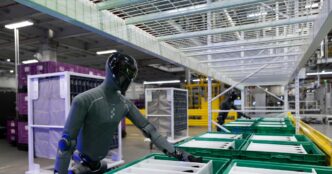
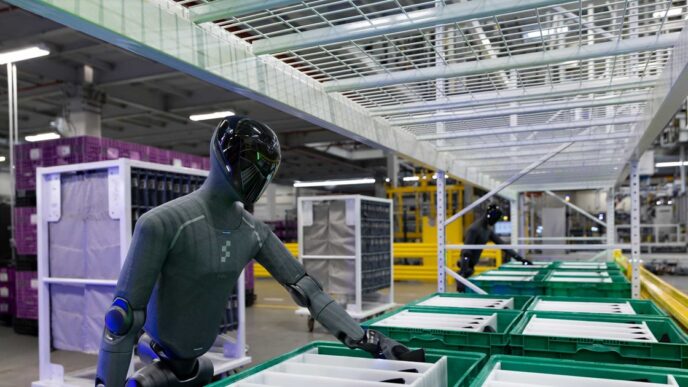
G2 Max is a wheeled, dual-arm industrial robot for factory and warehouse handling. AgiBot lists 21 degrees of freedom, a dual-arm payload of up to 40 kg, a working height adjustable from 0.1 to 2.5 meters, force-controlled manipulation and omnidirectional mobility. It didn’t give a price, battery life or delivery date. Some early coverage gave different payload figures; we’re using the company’s release.
AgiBot pointed to G2-family work in tablet production at Longcheer, semiconductor packaging and testing, CNC machine tending and logistics. It says Longcheer judges the robots on cycle time, sustained operation and task completion. On the service side it named Guangzhou Metro and Chimelong. The release calls these deployments but doesn’t say which are paid contracts and which are pilots.
Link-U OS 1.0, which AgiBot calls an operating system built for embodied intelligence, is being trialed by selected partners. The company says it will be fully open source by the end of 2026 and that it has donated the project to the OpenAtom Foundation, where it is now a Platinum sponsor. It also says its ecosystem spans 255 universities, 511 companies and more than 80,000 developers.
What to watch next
Worken becomes meaningful if AgiBot publishes the reference benchmarks and measurement periods behind each score, and if a customer or an independent tester reports one. Watch for GO-3 Preview scores on the public benchmark leaderboards, Link-U OS and GO-3 Preview code releases before the year-end deadline, and a price and delivery date for G2 Max. Until then, Worken is a useful question with AgiBot grading its own answers.
Frequently asked questions
What is AgiBot Worken?
Worken is a metric AgiBot proposed on October 29, 2026, to measure productive robot work. It multiplies the number of active robots by their autonomous working hours and by an output efficiency ratio against a reference benchmark for the task.
How is a Worken score calculated?
Multiply active robots by autonomous hours per robot and by the efficiency ratio. AgiBot’s slide showed 8 robots at Longcheer working 528 hours at a 0.7 ratio, which gives 2,956.8 Worken. The benchmark behind each ratio isn’t published.
Is AgiBot GO-3 available?
Not yet. AgiBot showed GO-3 Preview at Innovation Day and claimed top rankings on RoboDojo, RoboTwin and RoboColiseum. Its Chinese-language release says the model will be open-sourced by the end of 2026, but AgiBot hasn’t given an exact date, a license, pricing or a paper with detailed scores.
What are the AgiBot G2 Max specs?
AgiBot lists 21 degrees of freedom, a dual-arm payload of up to 40 kg, a working height of 0.1 to 2.5 meters, force-controlled manipulation and omnidirectional mobility. It hasn’t given a price or ship date.
Is Link-U OS open source?
Not yet. Link-U OS 1.0 is being trialed by selected partners, and AgiBot says it plans to make it fully open source by the end of 2026. It has donated the project to the OpenAtom Foundation.
Sources
- AgiBot, “AGIBOT Introduces Worken to Measure Productive Robot Work at AGIBOT Innovation Day 2026” (October 29, 2026; formula, quotes, AHA3, GO-3 Preview, WITA-Omni, G2 Max, Link-U OS, ecosystem figures and event photos, including the Worken slide): agibot.com
- AgiBot, “以全域务实创新 启具身部署新程|智元创新日重磅发布全栈技术成果” (Chinese-language Innovation Day release, October 30, 2026; GO-3 Preview year-end open-source plan): agibot.com.cn
- AgiBot, “What does a 300+ robot deployment actually look like?” (official YouTube channel, September 2026; Chimelong deployment): youtube.com
- AgiBot official YouTube channel, linked from the press release: youtube.com/@AGIBOTofficial
- Robotica Guide, “Humanoid Robot Production Numbers: AgiBot Says 20,000, Unitree Says 18,000” (background on AgiBot’s production claim): roboticaguide.com/
All sources accessed October 29, 2026, between about 7:20 and 7:55 AM ET.
Updated October 30, 2026: added AgiBot’s plan to open-source GO-3 Preview by the end of 2026, from its Chinese-language release.
Last updated: October 30, 2026. To report an error, see our corrections page. Articles are drafted with AI assistance and reviewed and edited by an editor; see our editorial policy.