Physical Intelligence opened a beta for the Pi API on October 13, 2026. In the company’s own words on pi.website/blog/api-beta, you upload data, fine-tune on Pi-managed compute and infrastructure, then call a hosted inference gateway. The models in play are the π0 / π0.5 family — the same line we covered in our π0 explainer. Pi does not publish a price, a hardware compatibility list or an admission timetable.
That framing is the whole story. Pi is selling iteration speed for robot teams that already have data and machines, not a public rate card. The blog names partner deployments to show breadth. What it leaves out is what a buyer usually needs first: cost, SLA and whether your arm is supported.
What the Pi API beta actually does
Pi’s post describes a three-step loop: upload demonstrations or evaluation data, launch fine-tuning on compute Pi manages, then run the fine-tuned model through a hosted gateway on your robot. The company says the latest model available through the API is more data-efficient and more capable for its partners — a company claim, not an independent benchmark.
Pi also says it can update the models behind the API quickly, so beta users would keep getting newer checkpoints without rebuilding their own training stack. Separately, Physical Intelligence still maintains an open-source path through openpi for people who want to run training and inference on their own hardware. The API beta is the hosted product track, not a replacement announcement for openpi.
If you’re still mapping the vocabulary, our guides to robot foundation models and vision-language-action models sit behind π0’s design. This post is the product news on top of that stack.
Partner examples Pi named
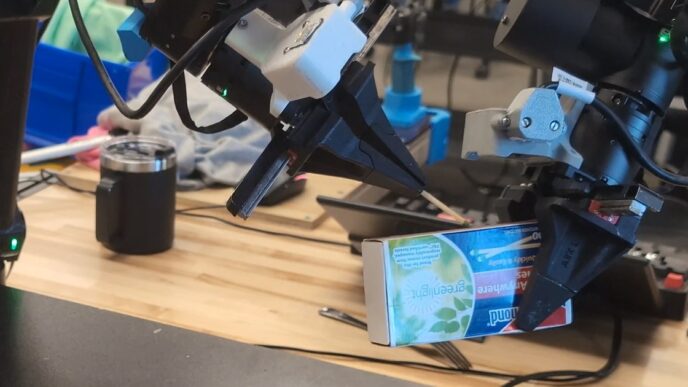
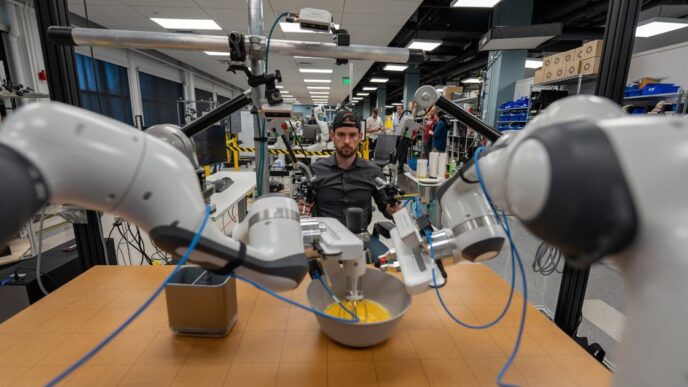
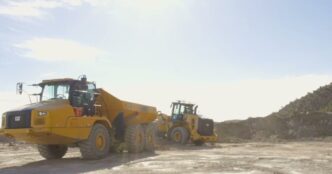
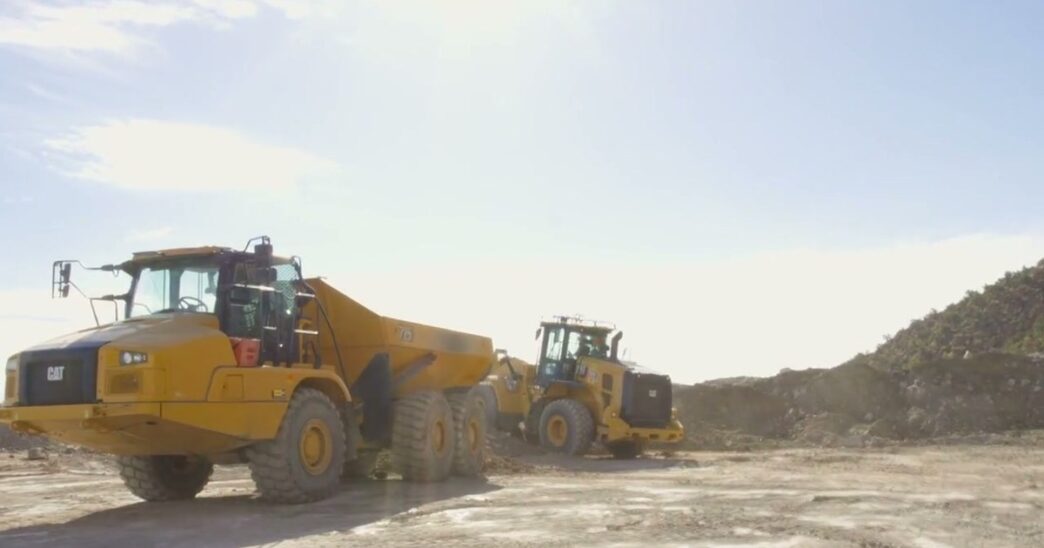
To answer “does this work on real hardware?”, Pi lists collaborations. Two get detailed callouts. Actor, in Utah, runs an autonomous wheel loader that scoops material and loads a dump truck in a commercial deployment with no operator inside the machine — Pi’s description. Almond, in San Francisco, builds Axol, a dual-arm robot; Pi says Axol deburred spacers used in its own assembly after four days of API iteration.
Other names on the page include AgRobotics, Argon Robotics, Chef Robotics, CloudChef, Deft, Dream Machines, Formic, Foundry, Frontier Machines, General Instinct, Intuition.dev, Omakase, robot.com, Ultra, Weave and Yondu, plus a dairy partner. Pi says most of the showcased applications used cloud-hosted inference through the API, across environments from Japan to Switzerland to U.S. sites, and that those deployments highlighted limits — including network connectivity challenges for some.
Those are company-selected demos. They show Pi wants the API associated with mobile heavy equipment, dual-arm manufacturing and food automation, not only lab arms. They are not a certified hardware matrix.
What the announcement leaves out
Price: none on the blog. Waitlist: Pi asks interested teams to say what they want to build; there is no public queue position or promised review date. Hardware support: no guaranteed list of robots, controllers or edge boxes. Service levels: no uptime, latency or data-retention commitments in the post we checked October 16.
Pi is hiring across research, infrastructure, hardware, people and operations, per the same page — useful signal that the API is a product bet, not a one-off research drop. But a beta without a rate card means early partners are negotiating privately. If your constraint is local compute or air-gapped plants, openpi remains the path Pi itself still points at for self-hosted work.
The honest read: Physical Intelligence is productizing fine-tune-and-serve for embodied models, and it’s using named deployments to argue the models generalize. Until pricing and support boundaries are public, treat the API beta as an application process, not a buy button.
Frequently asked questions
What is the Physical Intelligence Pi API beta?
It’s Pi’s hosted path to fine-tune and serve its robotic foundation models. Per the October 13, 2026 blog post, you upload data, train on Pi-managed compute, then call a hosted inference gateway. Access is by application, not an open self-serve checkout.
Which models does the Pi API use?
Pi says the API exposes its π0 / π0.5 family and that the latest API model is more data-efficient for partners. Exact checkpoint names and versioning beyond that family framing are not itemized as a public SKU list in the beta post.
How much does the Pi API cost?
Physical Intelligence has not published a public price on the API beta blog post we checked October 16, 2026. There is also no public SLA or admission timetable in that post.
Is the Pi API the same as openpi?
No. openpi is Pi’s open-source route for running models on your own compute. The Pi API beta is a separate hosted product: Pi manages training compute and a cloud inference gateway. Most demos Pi showcased used that hosted path.
Which robots work with the Pi API?
Pi names partner examples such as Actor’s wheel loader and Almond’s Axol dual-arm robot, plus a longer list of collaborators on the blog. It does not publish a guaranteed hardware compatibility list or certify every platform those partners use.
Sources
- Physical Intelligence, “Frontier Models for Every Robot: Announcing our API beta,” October 13, 2026: pi.website/blog/api-beta
- Physical Intelligence homepage: pi.website
- RoboticaGuide, “What Is Physical Intelligence’s π0?”: roboticaguide.com/what-is-physical-intelligence-pi0
All sources accessed October 16, 2026.
Related: What is Physical Intelligence’s π0? · What is a robot foundation model? · More Embodied AI coverage
Last updated: October 16, 2026. To report an error, see our corrections page. Articles are drafted with AI assistance and reviewed and edited by an editor; see our editorial policy.