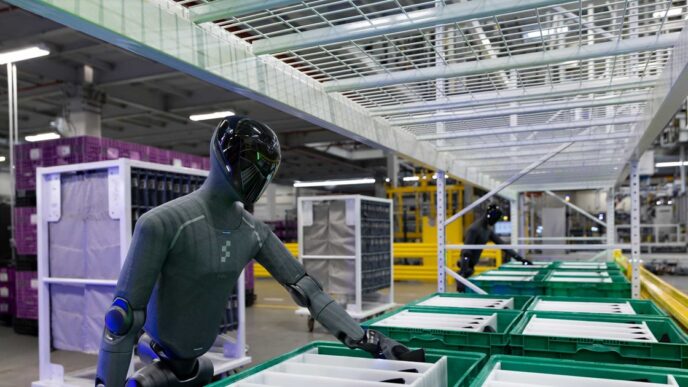
For almost every machine in a factory, the safe thing to do in an emergency is to stop. For a two-legged humanoid robot, stopping can be the hazard. Cut the power to a robot that balances by constantly adjusting its joints and it doesn’t freeze in place. It falls over, possibly onto the person who hit the stop button.
That one fact explains most of what’s different about humanoid robot safety systems, and why they’re suddenly a live issue. On October 13, South Korea’s industry ministry cleared 20 Robros IGRIS-C humanoids to work beside people at four company sites without the safety fences Korean rules normally require. Agility Robotics says its fifth-generation Digit is designed to work near people without barriers. Yet the international standard written for robots like these is still a committee draft. Here’s how fall recovery, balance control, speed and separation monitoring and the standards fit together, and where the gaps still are.
A robot that falls when the power goes
The draft standard’s own definition is the clearest place to start. ISO/CD 25785-1 covers industrial mobile robots with “actively controlled stability,” which it defines as robots that need active control “in order to remain balanced and could become unstable in the absence of power.” Its scope note lists bipedal, quadrupedal and wheeled balancing robots. A bolted-down robot arm doesn’t fit that description. A walking humanoid always does.
Agility learned this the hard way, by its own account. In a June 22, 2026 company blog post, Agility’s Pras Velagapudi and Kevin Reese wrote that an earlier Digit relied on a remote e-stop and then an external safety controller, and “if there were communication issues with the robot it would fall.” The company then added an onboard safety PLC (a dedicated industrial controller that can override the main computer) and a Category 1 stop, which brings the robot to a controlled stop before power is cut. Even that, Agility wrote, “was still not enough to guarantee the safety of people working around and with Digit,” so every Digit it had deployed worked behind physical barriers in a fenced workcell.
How humanoids stay upright, and how they get back up
Balance control is the first safety system on any legged robot, even though nobody markets it that way. A widely cited idea in the field is the “capture point,” introduced by Jerry Pratt and colleagues at the 2006 IEEE-RAS Humanoids conference: the spot on the ground where a robot would need to step to come to rest after a push. If the robot can get a foot there in time, it recovers. If it can’t, it needs another step, or it falls.
Fall recovery is the next layer, and it’s an active research area rather than a solved problem. A 2025 paper by Tao Huang and colleagues, HoST (Humanoid Standing-up Control, an RSS 2025 Best Systems Paper finalist), trained a reinforcement learning policy in simulation and ran it directly on a Unitree G1. The authors report the robot standing up from a range of postures in lab and outdoor settings, and recovering from large shoves without fully falling. They also had to add smoothness penalties and an implicit speed limit because unconstrained policies produced “oscillatory and violent motions” on real hardware. That’s a useful reminder: a robot flailing its way upright is its own hazard if a person is nearby.
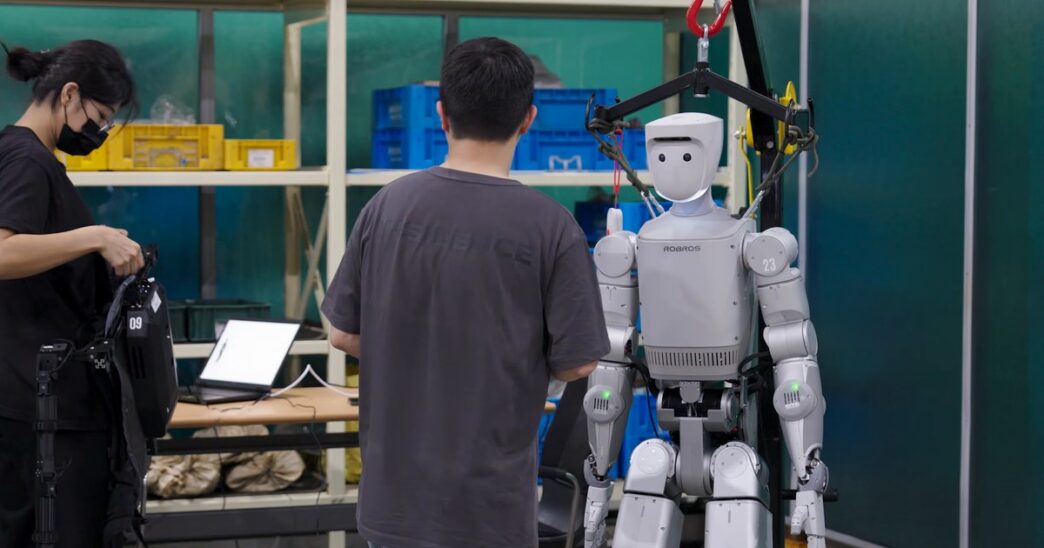
That’s why the training setups you see in company videos matter. In the Robros video our featured image comes from, an IGRIS-C hangs from an overhead gantry while engineers work around it, so a lost balance ends with the robot dangling, not on the floor.
The standards that exist, and the one that doesn’t yet
Three ISO documents do most of the work today, and none was written for walking robots. We cover the full list in our guide to ISO safety standards for humanoid robots; here’s how they apply to the safety systems themselves.
| Document | Status on ISO’s site (checked Oct 14, 2026) | What it means for humanoids |
|---|---|---|
| ISO 10218-1:2025 and ISO 10218-2:2025 | Published February 2025 (third edition of Part 1) | The core industrial robot standards. Part 1’s scope excludes robots “fixed to or part of mobile platforms” and uses where the public has access |
| ISO/TS 15066:2016 | Published; marked “to be revised” since June 2025, with ISO/AWI 15066-1 in development | The collaborative-robot specification. Most of its requirements now sit inside ISO 10218-2:2025 |
| ISO/CD 25785-1 | Committee draft; comment period closed July 8, 2026 | The first ISO project for dynamically stable industrial mobile robots, including humanoids. Nothing to certify against yet |
| ISO/FDIS 13482 | Final draft; ballot opened September 15, 2026 | Service robots in personal and commercial use. ISO 25785-1 points non-industrial robots here |
The 2025 rewrite of ISO 10218 changed the vocabulary in ways that matter for humanoid marketing. The revised standard, adopted in the US as ANSI/A3 R15.06-2025, drops the term “collaborative robot” and uses “collaborative application” instead, because only a real task, with its workpieces, tools and layout, can be validated as safe. “In actuality there is no such thing as a ‘cobot,’ rather there are robots that utilize collaborative technologies,” Todd Dickey, the Honda safety consultant who chairs the R15.06 drafting subcommittee, told A3. So when a humanoid maker calls its robot “collaborative,” the standard’s answer is: show us the application. Dickey also offered the line that sums up humanoid safety in 2026: “Historically, technology always outpaces standards.”
ISO 25785-1 is meant to fill the gap. It’s being written in ISO’s robotics committee, TC 299, where Agility says it is “contributing to and leading projects” in Working Group 12, alongside a US technical report, ANSI/A3 TR R15.108, on the same class of robots. The draft’s Part 1 covers the robot itself; a separate Part 2 will cover integrating it into a workplace. It applies only to “industrial environments,” which the draft defines as workplaces where the public is excluded or restricted. Homes, shops and sidewalks are out of scope.
Speed and separation monitoring: slow down before anyone gets close
Of the collaborative techniques ISO 10218-2:2025 now covers (hand guiding, power and force limiting, and speed and separation monitoring), the last one is the most relevant to a robot that walks around a workplace. Speed and separation monitoring, or SSM, means sensors track where people are and the robot slows down or stops before the gap between them gets too small.
How small is too small is a calculation, not a feeling. In a 2017 paper in Robotics and Computer-Integrated Manufacturing, NIST researchers Jeremy Marvel and Rick Norcross broke the ISO/TS 15066 protective-distance formula into four parts: how far a person can move while the robot is stopping, how far the robot travels before it starts braking, how far it travels while braking, and an allowance for reach and sensor error. Human approach speeds come from ISO 13855. Their test results came with a warning: even a simple SSM setup can improve safety “but will not provide safety in all circumstances,” so the sensors and models have to be validated before anyone relies on them.
For a humanoid, every term in that formula gets harder. Braking distance depends on whether the robot can stop without tipping. The robot is the thing moving, so the sensors usually ride on its body rather than on a fixed cell. And the “stop” at the end of the chain has to be a stop that keeps the robot upright. Velagapudi described Agility’s goal to Rocking Robots as reducing risk “as humans approach, rather than react when they cross a threshold.”
What humanoid robot safety systems look like in real 2026 deployments
Korea’s sandbox trial is the clearest public example of fence-free work under government supervision. Korea’s Occupational Safety and Health Standards Rules (Article 223) require a fence at least 1.8 meters high around industrial robots, or sensor-based protective devices where a fence isn’t practical. The October 13 special case lets 20 IGRIS-C robots skip that at Nepes, Sungwoo Hitech, HD Hyundai Samho and Delivery Lab, conditional on risk assessments and risk-reduction measures, according to Global Economic’s report. Robros CEO Noh Seung-jun told the Hankyoreh that IGRIS-C slows down when it senses people nearby, stops if they come closer, and sits down where it stands if a person shuts it off after a fault. Those are the company’s descriptions; no outside test data has been published. We covered the trial in detail in South Korea lets 20 Robros humanoids work beside people without safety fences.
Notice what “sits down” is doing there. It’s the humanoid version of a controlled stop: lower the center of mass first, then cut motion, so a shutdown doesn’t become a fall.
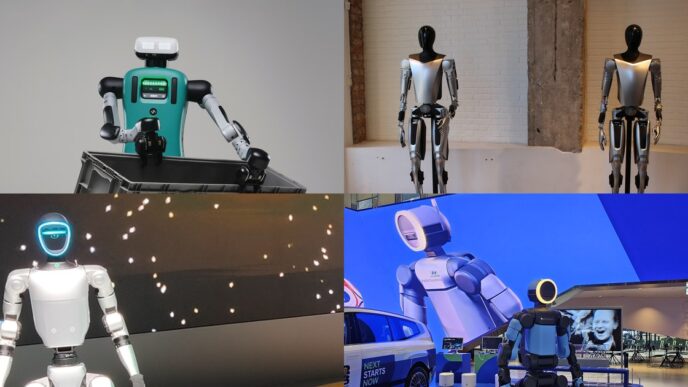
Agility’s Digit 5, unveiled September 15, 2026, is the other headline case. Agility says the robot has safe human detection, visual and audible safety cues, and an independent safety controller that responds when people get too close, and that it’s built to work near people without the barriers traditional automation needs. Agility’s June post says the safe human detection runs on NVIDIA’s IGX Thor platform, and on October 1 Agility and FORT Robotics announced a memorandum of understanding for a safety pendant and related hardware. Agility also expects Digit 5 to carry a CE mark. None of those releases publishes a third-party certificate against a finished humanoid standard, because there isn’t one. Our Digit 5 safety and specs explainer has the details.
Trust is a safety system too
People decide how close to stand to a robot, whether to step into its path and whether to override it. That makes trust part of the safety case, not just a matter of public relations. The most cited quantitative study on the topic, a 2011 meta-analysis in Human Factors by Peter Hancock and colleagues, pooled 29 human-robot interaction studies and found that the robot’s performance, things like reliability and predictability, had the strongest link to how much people trusted it. Human-related factors showed little effect.
The authors’ point was calibration. People who trust a robot too much misuse it; people who trust it too little stop using it. For humanoids that suggests something less glamorous than a friendly face: consistent, legible behavior. Lights and sounds that signal what the robot will do next, which Agility describes for Digit 5, are a way of making the machine predictable to the people next to it. Whether they work in a busy plant is a question for trial data, not marketing.
What to watch
The next concrete milestone is on ISO’s own page. ISO 25785-1 sits at stage 30.60, close of comment; the next step is either a revised committee draft or registration as a Draft International Standard. Until that text is final, every “fence-free” humanoid is running on a risk assessment, a company’s own safety architecture and, in Korea’s case, a government exception. The data from the Korean trial, especially how often a person had to step in, will say more about whether that’s enough than any spec sheet.
Frequently asked questions
Why can’t a humanoid robot just use an emergency stop?
It can, but cutting power to a robot that balances actively can make it fall. That’s why newer designs use controlled stops. Agility describes a Category 1 stop that brings Digit to a controlled stop before power is cut, and Robros says IGRIS-C sits down after a fault-related shutdown.
Is there a safety standard for humanoid robots?
Not a finished one. ISO/CD 25785-1, for dynamically stable industrial mobile robots including bipeds, is a committee draft whose comment period closed July 8, 2026. Integrators currently rely on ISO 10218-1:2025 and ISO 10218-2:2025, risk assessments and maker-specific safety functions.
What is speed and separation monitoring?
It’s a collaborative safety method in which sensors track people and the robot slows or stops before the separation distance falls below a calculated minimum. The method was specified in ISO/TS 15066 and is now covered in ISO 10218-2:2025.
Can humanoid robots recover from a fall?
Some can stand back up in lab tests. The HoST research project, for example, trained a Unitree G1 to stand up from many postures and resist large pushes. Researchers had to limit motion speed because unconstrained get-up motions were violent on real hardware.
Do humanoid robots work without safety fences anywhere?
In Korea, a government sandbox approved on October 13, 2026 lets 20 Robros IGRIS-C humanoids work beside people at four sites without the usual 1.8-meter fence, subject to risk assessments. Agility says Digit 5 is designed to work near people without barriers; its earlier Digit deployments ran inside fenced workcells.
Sources
All accessed October 14, 2026.
- ISO, “ISO/CD 25785-1 Robotics: Safety requirements for dynamically stable industrial mobile robots (legged, wheeled, or other forms of locomotion), Part 1: Robots” (stage 30.60): iso.org
- ISO, “ISO 10218-1:2025 Robotics: Safety requirements, Part 1: Industrial robots”: iso.org
- ISO, “ISO/TS 15066:2016 Robots and robotic devices: Collaborative robots”: iso.org
- ISO, “ISO/FDIS 13482 Robotics: Safety requirements for service robots”: iso.org
- A3, “Updated ISO 10218: Answers to Frequently Asked Questions”: automate.org
- A3 Industry Insights, “Industrial Robot Safety Standard Gets Major Update” (R15.06-2025): automate.org
- Jeremy A. Marvel and Rick Norcross, “Implementing Speed and Separation Monitoring in Collaborative Robot Workcells,” Robotics and Computer-Integrated Manufacturing 44 (2017): PMC full text
- Jerry Pratt, John Carff, Sergey Drakunov and Ambarish Goswami, “Capture Point: A Step toward Humanoid Push Recovery,” 6th IEEE-RAS International Conference on Humanoid Robots, 2006: pp. 200-207: doi.org/10.1109/ICHR.2006.321385
- Tao Huang et al., “Learning Humanoid Standing-up Control across Diverse Postures” (HoST), RSS 2025, arXiv:2502.08378: arxiv.org
- Peter A. Hancock et al., “A Meta-Analysis of Factors Affecting Trust in Human-Robot Interaction,” Human Factors 53(5), 2011: author PDF
- Agility Robotics, Pras Velagapudi and Kevin Reese, “Built for the Real World,” June 22, 2026: agilityrobotics.com
- Agility Robotics, “Agility unveils Digit 5 humanoid robot built for cooperatively safe work at scale,” September 15, 2026: agilityrobotics.com
- Agility Robotics and FORT Robotics, “Strategic Partnership to Advance Humanoid Robot Safety,” October 1, 2026: agilityrobotics.com
- Rocking Robots, “Humanoids Beyond the Hype” (interview with Pras Velagapudi): rockingrobots.com
- Ministry of Trade, Industry and Resources (Korea), sandbox committee results, October 13, 2026: motir.go.kr
- Hankyoreh, Kim Nam-il, October 13, 2026: hani.co.kr
- Global Economic, Lee Da-hyun, October 13, 2026: g-enews.com
- Korea Occupational Safety and Health Standards Rules, Article 223, via the National Law Information Center: law.go.kr
- Robros, “From One to Many: Deployed in the Real World” (official video; source of the featured image), August 28, 2026: youtube.com
Related: ISO safety standards for humanoid robots · Teleoperation vs autonomy in humanoid demos · More policy and safety coverage
Last updated: October 14, 2026. To report an error, see our corrections page. Articles are drafted with AI assistance and reviewed and edited by an editor; see our editorial policy.