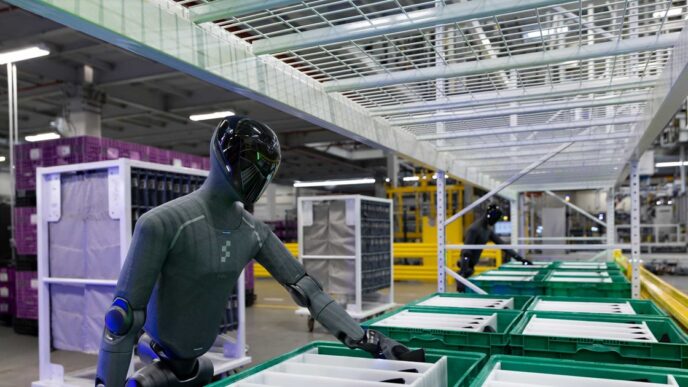
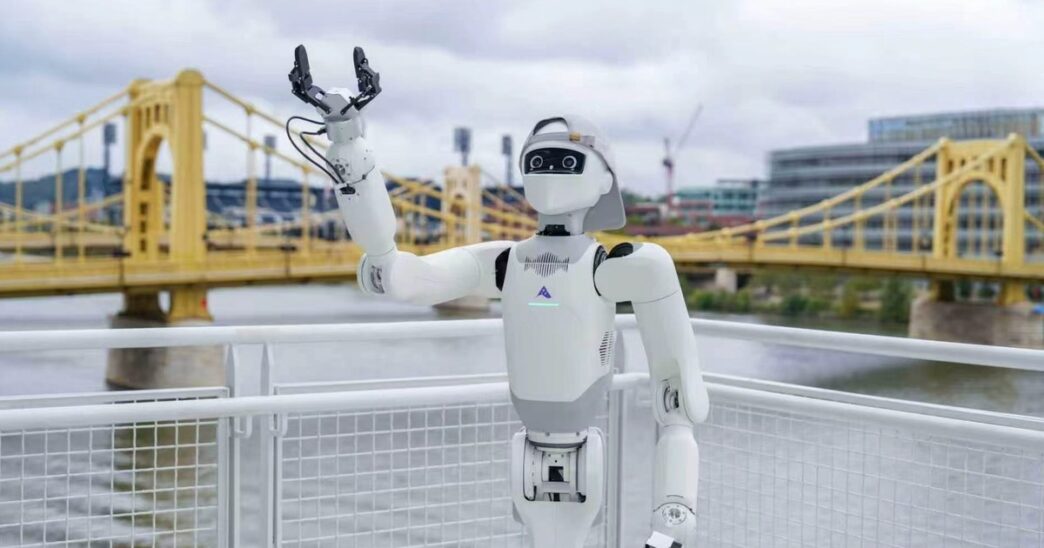
A two-armed robot that Astribot says can pack a backpack on its own is on sale in the US from $18,000, and the company says it can ship right away. That’s the Astribot T1 price Astribot announced from IROS in Pittsburgh on September 30. It’s also less than the $20,000 1X asks for its NEO home robot, and under the $29,990 Feather lists on its website for its own two-armed machine.
Before anyone reaches for a credit card, the fine print matters. “Starting at” isn’t a quote, the release doesn’t say what’s in the base configuration, and Astribot’s China launch in May carried a different price in a different currency. Here’s what the T1 is, what it costs and what Astribot hasn’t said.
What the T1 is, on paper
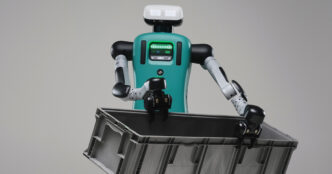
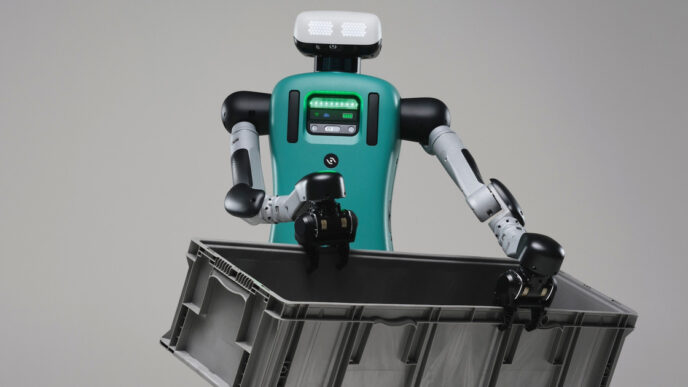
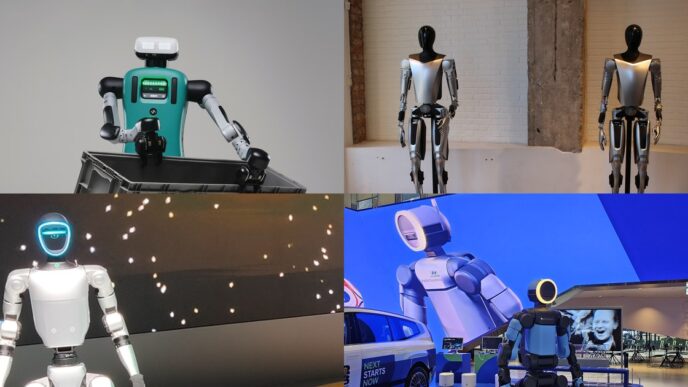
The T1 is a wheeled, cable-driven robot with a torso, a head and two arms. It isn’t a walking humanoid, which matters for what it can and can’t do (our look at bipedal versus wheeled humanoids covers the trade-off). Astribot, a Shenzhen company, says in its Chinese launch post that the cables driving its joints mean less friction and smoother motion than a conventional rigid, geared joint, and pass cleaner real-time force data to the AI.
| US release (Sept 30) | China launch post (republished May 29) | |
|---|---|---|
| Price | US pricing “starting at $18,000” | From ¥89,900 |
| Height | About 1.55 m | 1.53 m |
| Weight | About 66 kg | Not stated in the post’s text we read |
| Degrees of freedom | 23, excluding end effectors | 23, excluding end effectors |
| Payload | Up to 5 kg per arm | 5 kg per arm |
| Charging and battery | Automatic charging, quick battery replacement | Charge time under 1 hour |
| Base footprint | Not stated | 0.55 m by 0.56 m |
The hardware is modular. Astribot says the T1 takes different end effectors, compute modules and sensors, so the gripper or hand, the computer and the cameras you end up with can change the bill. The company’s English product page we checked on October 10 describes only its older S1 research robot, so there’s no spec sheet for the T1 there yet.
Two prices in two countries, and no explanation
Astribot’s own release says US customers “can order T1 now, with immediate delivery available.” It doesn’t say where to order, what ships in the box at $18,000, how long delivery takes or what shipping, import duties and support cost. The company hasn’t said whether the US and China prices buy the same configuration, so we haven’t converted the yuan figure into dollars.
The tell is in the wording. The US release calls the T1 a “developer-accessible” platform for researchers and developers. This isn’t a robot to put in a kitchen and forget. It comes with an SDK and API for joint control, Cartesian motion, whole-body coordination and sensor data, plus VR-based teleoperation, which Astribot pitches as a way to collect training data.
A robot that improves when Astribot retrains it, not while it works
The claim most buyers will care about is the backpack demo. Astribot says a T1 running its Lumo-2 base model has autonomously gathered miscellaneous items into a backpack, handling deformable objects along the way. The release gives no success rate, no number of attempts and no list of tasks beyond that one, and says additional capabilities depend on further training.
It also explains how the robot gets better, and it’s refreshingly blunt: the T1 “does not learn autonomously in real time during deployment.” Astribot collects data from robot operation and teleoperation, curates it, retrains models like Lumo-2 and ships the updated skills over the air or through on-site installation and calibration. Customers can choose whether to collect data for their own model training or during autonomous task execution. That’s the same loop the whole industry leans on, as our piece on humanoid robot training data explains, and it means a T1 is only as capable as the data behind the skill you want.
Astribot also points to its second Astribot OS hackathon, which ended September 21 in Beijing, where it says 15 teams built more than ten working T1 applications in 36 hours. That’s a company claim about a company event, but it shows who the robot is for.
How $18,000 compares with other robots under $30,000
The T1 doesn’t compete with a walking humanoid like Unitree’s G1 on locomotion, and it doesn’t compete with a home robot like NEO on being a finished product. Prices below are each maker’s published starting figure, checked October 10, and are not like-for-like.
| Robot | Published price | Form |
|---|---|---|
| Astribot T1 | “Starting at” $18,000 (US release) | Wheeled, two arms, cable-driven |
| Unitree G1 | $13,500 in Unitree’s store feed (our price guide) | Walking biped |
| 1X NEO | $20,000, or $499 a month, with a $200 deposit; deliveries “start 2026” per 1X’s order page | Home humanoid |
| Feather | $29,990 on its site, $31,990 in its store (our Feather report) | Wheeled, two arms |
The closest rival is Feather, another two-armed wheeled platform pitched at developers. The T1’s headline price is lower, but both companies sell add-ons, and neither has published a full configured price for the same set of hands, cameras and compute.
What Astribot hasn’t said
Battery runtime, top speed and ingress protection aren’t in the US release. Nor are an order page, a warranty, a support plan or a count of T1 robots delivered anywhere. Astribot calls itself the only company to have put a cable-driven AI robot into mass production, which is a company claim we haven’t been able to check.
The test is simple. If Astribot publishes a configured quote for a US buyer, or a customer shows a T1 delivered and working, $18,000 starts to mean something. Until then it’s a starting line.
Frequently asked questions
How much does the Astribot T1 cost?
Astribot says US pricing starts at $18,000. In China, the company’s Chinese-language launch post, republished May 29, listed the T1 from ¥89,900. Both are “starting at” prices, and the company hasn’t published what’s included.
Is the Astribot T1 available to buy in the US?
According to Astribot’s September 30 release, US customers can order the T1 now and immediate delivery is available. We couldn’t find a public order page or delivery terms, and Astribot hasn’t named any US customers.
Is the Astribot T1 a humanoid robot?
It has a head, torso and two arms, but it moves on wheels rather than legs. Astribot describes it as a cable-driven robot for developers and researchers, with 23 degrees of freedom excluding end effectors and up to 5 kg of payload per arm.
What can the Astribot T1 do on its own?
Astribot’s one published example is autonomously gathering items into a backpack using its Lumo-2 model. It hasn’t released a success rate, and it says the robot doesn’t learn in real time on the job. New skills arrive through retraining and updates.
Sources
All accessed October 10, 2026.
- Astribot, “Astribot Brings T1 to North America, Showcasing a Physical AI Stack Built on Design for AI” (press release, Sept 30, 2026): openpr.com
- Astribot (Stardust Intelligence), T1 launch post from its WeChat account, republished May 29, 2026 (in Chinese): gkzhan.com
- Astribot, product page (S1): astribot.com
- Humanoids Daily, “Astribot Brings Its $18,000 T1 Robot to North America at IROS” (Oct 1, 2026): humanoidsdaily.com
- Robot Price Index, “Astribot T1 Reaches the US From $18,000, With ‘Immediate Delivery’ Claimed” (Oct 4, 2026): robotpriceindex.com
- 1X, order page (price check, Oct 10, 2026): 1x.tech/order
Related: Feather’s “under $30,000” robot costs $31,990 in its own store · 1X NEO price, shipping and factory status · Teleoperation vs autonomy in humanoid robot demos
Last updated: October 10, 2026. To report an error, see our corrections page. Articles are drafted with AI assistance and reviewed and edited by an editor; see our editorial policy.