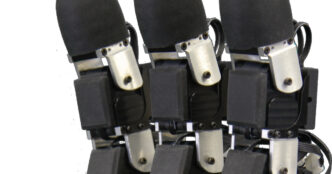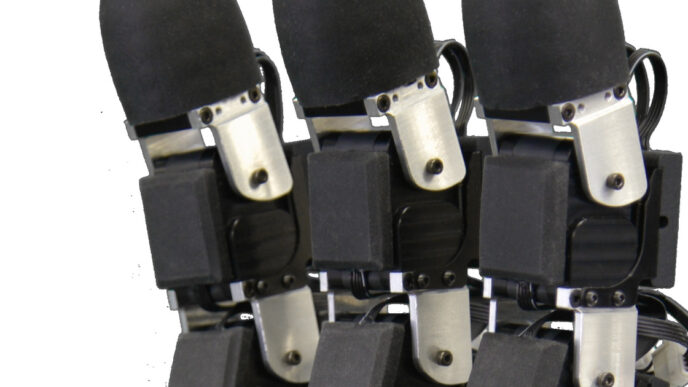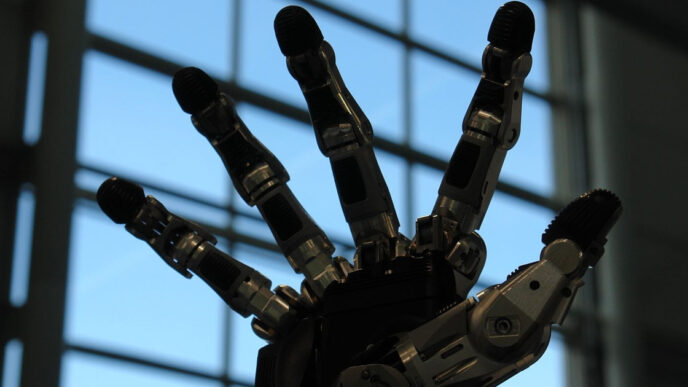
The Unitree Dex5-S robot hand is now listed “from $6,350.” For that you get 22 motorized joints and a 620-gram aluminum hand, with touch sensing on the Pro version. That’s less than half the $13,500 Unitree charges for an entire G1 humanoid, and it makes the Dex5-S the only one of this season’s new robot hands with a published price.
The timing matters because hands are where humanoid plans keep snagging. In the past three weeks Unitree launched its hand, Boston Dynamics unveiled a 13-joint hand for Atlas, Sharpa showed a 21-joint hand with full-hand touch sensing, and a Tesla patent application about robot-hand “skin” became public on October 8. Here’s how the four compare, and what each company has and hasn’t said.
What the Unitree Dex5-S gets you for $6,350
According to Unitree’s product page, checked October 9, the Dex5-S has 22 degrees of freedom: five in the thumb, four in each of the index, middle and ring fingers, and five in the pinky, which gets an extra roll axis. All 22 motors are direct-drive and backdrivable, meaning an outside push can move the joints, and each has a dual encoder. Unitree says an impact-protection structure shields the gears if a joint takes a hard knock.
The rest of the spec sheet: 620 grams, 102 by 187 by 26 millimeters, a 1-kilogram continuous payload per hand and a 2-kilogram peak, a 15 to 65 volt supply and a 1,000 Hz control loop over Ethernet or USB. Tactile sensing is listed only for the Dex5-S Pro. The page prints one price, “from $6,350,” and doesn’t say whether it covers one hand or a pair, or which version it refers to. Humanoids Daily’s report on the September 21 announcement gave a starting price of $6,500 before tax and shipping (39,900 yuan in China), so the page now reads $150 lower. We haven’t found Unitree explaining the difference.
We also couldn’t find the hand in the public product feed of Unitree’s US store, which lists the G1 at $13,500 and the R1 Air at $4,900. So a price is public. How you actually buy one, and when it ships, isn’t.
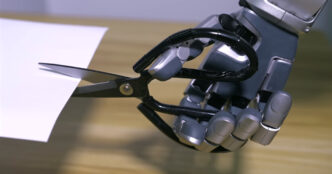
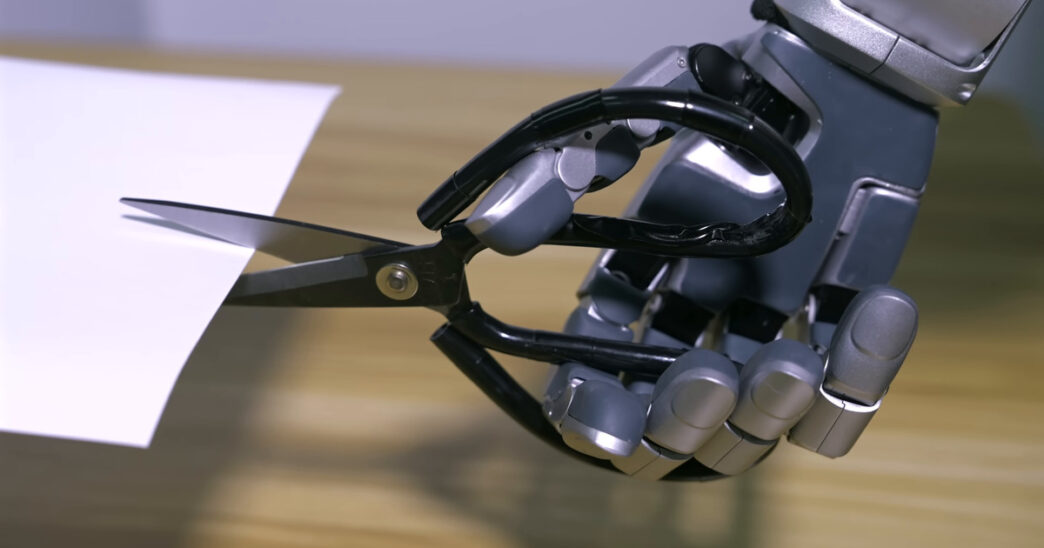
Unitree’s launch video, published on September 21, shows the hand picking up a spoon and cutting paper with scissors in a segment the company labels “captured at real speed, with no acceleration.” It doesn’t say whether the hand was teleoperated or running an autonomous policy, and that’s the first thing to ask about any hand demo. Our guide to teleoperation versus autonomy explains why.
Four hands, four different bets
| Hand | Joints | Touch sensing | Price and availability |
|---|---|---|---|
| Unitree Dex5-S (Sep 2026) | 22 (thumb 5, fingers 4 each, pinky 5) | Pro version only | “From $6,350”; purchase route not stated |
| Sharpa Wave W02 (Sep 28, 2026) | 21 active | Vision-based fingertip sensing (5 mN to 30 N) plus full-hand e-skin (0.1 to 20 N) | No price; “Request a Quote” |
| Boston Dynamics Atlas hand (Oct 1, 2026) | 13 (thumb 4, three fingers at 3 each), no pinky | Pressure sensors on fingertips and palm | No price; part of Atlas, which has no public price |
| Tesla (patent application, Oct 8, 2026) | Not described | Flexible 3D tactile “pixels” for curved fingers and palms | None; a patent filing, not a product |
Sharpa’s figures come from its W02 page and a September 28 release from the IROS conference in Pittsburgh. The company says the hand weighs under 750 grams and is rated IP54, protected against dust and splashes, or IP67 with an official glove. Atlas’s numbers are from Boston Dynamics’ blog post, which we cover in detail in our Atlas hand article. For comparison, 1X says each NEO hand has 22 degrees of freedom, and Unitree’s G1 uses a seven-joint Dex3-1 hand on its EDU option.
More joints isn’t the same as a better hand
Unitree and Boston Dynamics have made opposite choices. Unitree added joints and protection. Boston Dynamics dropped the pinky altogether, saying each extra finger needs three more actuators and adds cost and ways to break. IEEE Spectrum quotes Boston Dynamics’ Alberto Rodriguez calling hands “a ruthless design trade-off.”
Neither company has published the numbers that would settle the argument: how many grasps a hand survives, how it performs on tasks it hasn’t been tuned for, or what a replacement costs. Joint count tells you how many ways a hand can move. It doesn’t tell you how reliably it does so. Our explainer on degrees of freedom covers why vendors count them so differently.
Tesla’s patent is about touch, not fingers
Tesla’s application, US 2026/0310299 A1, was filed on September 11, 2025 and published on October 8. It describes soft tactile sensors made of two flexible sheets of printed conductive traces around a pressure-sensitive layer, shaped to fit curved fingers, thumbs and palms. Each crossing point is an individually readable “pixel,” according to Humanoids Daily, which says it reviewed the full publication from the U.S. Patent and Trademark Office, and TeslaNorth. Both note that the filing never names Optimus and gives no sensitivity, durability or cost figures.
A patent shows where an engineering team is looking, not what’s in a robot. Two other details make this one worth watching. TeslaNorth found an open Tesla job listing for an “Optimus Hand” manufacturing engineer that describes the hand as “tendon-driven” with “advanced tactile sensing” and names the same thermoforming and dispensing processes. And Humanoids Daily recalls The Information’s report that Tesla was building several hundred robots a week while struggling with hand assembly and touch-sensor durability. Tesla hasn’t confirmed that, and it hasn’t published specifications for the Optimus it is building now, as we noted in our Optimus status report.
What to watch
Three things would turn these announcements into evidence. Unitree needs to say how to buy a Dex5-S, what the Pro version costs and whether any demo shows the hand working autonomously. Tesla’s third-quarter call on October 21 is the next chance to hear whether Optimus’s hand has specifications, or a supplier. And Sharpa’s quote-only W02 will show its hand only when somebody publishes a price or names a customer. Until then, the $6,350 is the one number on the table.
Frequently asked questions
How much does the Unitree Dex5-S hand cost?
Unitree’s product page lists “Price from $6,350” and doesn’t say whether that is per hand or per pair, or which version it covers, and Humanoids Daily’s coverage of the September 21 launch gave $6,500 before tax and shipping. We didn’t find the hand in the public product feed of Unitree’s US store as of October 9, so how to order one isn’t clear.
How many degrees of freedom does the Dex5-S have?
Unitree says 22: five in the thumb, four in each of the index, middle and ring fingers, and five in the pinky. All 22 motors are direct-drive and backdrivable, and the hand weighs 620 grams.
Does the Dex5-S have tactile sensing?
Only the Pro version, according to Unitree’s spec table, which lists tactile sensing as “YES” for the Pro and blank for the standard Dex5-S. The page doesn’t give sensor specifications.
Can you buy the new Atlas hand or Sharpa’s W02?
Not at a public price. Boston Dynamics hasn’t published a price for the Atlas hand, and Sharpa sells the W02 by quote request only.
Sources
All accessed October 9, 2026.
- Unitree, Dex5-S Dexterous Hand product page and spec table: unitree.com
- Humanoids Daily, “Unitree Unveils Human-Sized Robot Hand Starting at $6,500” (Sep 21, 2026): humanoidsdaily.com
- Unitree US store, product feed and G1 listing: shop.unitree.com
- Sharpa, W02 product page: sharpa.com; “Sharpa Unveils Three Flagship Products” (Sep 28, 2026): prnewswire.com
- Boston Dynamics, Atlas hand blog post (Oct 1, 2026), via our Atlas hand coverage, which cites IEEE Spectrum and The Robot Report
- Humanoids Daily, “Tesla Patent Application Details Flexible Touch Sensors for Robot Hands” (Oct 8, 2026): humanoidsdaily.com
- TeslaNorth, “Tesla Wants to Give Optimus a Skin That Can Feel” (Oct 8, 2026): teslanorth.com
- Electrek, “Tesla ramps Optimus to hundreds a week, but the robots can’t generalize” (Sep 25, 2026): electrek.co; Tesla Form 8-K (Q3 2026 results date, Oct 2, 2026), via our Optimus status article
Related: Unitree G1, R1 and H2 prices and specs · Humanoid robot training data · Humanoid robot prices 2026
Last updated: October 9, 2026. To report an error, see our corrections page. Articles are drafted with AI assistance and reviewed and edited by an editor; see our editorial policy.