Galbot researchers and academic collaborators have published PASSAGE, a planner–tracker system that teaches a humanoid to step over, squeeze past and duck under clutter from onboard perception, without a library of obstacle-specific skills. The arXiv paper (2609.18732, September 16, 2026) reports 100 hours of scene-aligned human motion across 1,500 cluttered scenes, 70.3% contact-free success in simulation on held-out scenes, and tests on 50 unseen physical layouts with a fully onboard Jetson AGX Orin stack.
Those numbers are from the paper and project page, not from a warehouse pilot. The useful story is how the team scaled motion capture into traversal behavior, and which success rates they actually report once you read past the highlight reel.
What PASSAGE is
PASSAGE is a perception-conditioned planner paired with a whole-body tracker. A conditional flow-matching planner proposes short-horizon motion from recent history, a local destination and a robot-centric multi-layer elevation map. A perceptive tracker then executes those references at 50 Hz with geometric feedback. Real-time chunking keeps successive plan chunks consistent; planner-side reinforcement learning under a frozen tracker is used to improve closed-loop performance.
The authors argue that many prior traversal methods train specialists per obstacle type or lean on curated motion libraries. PASSAGE’s claim is that one planner–tracker pair can select and compose behaviors across geometries it has not seen, without skill annotations.
The data scale, and the number that matters
Training data starts with virtual-reality and inertial motion capture: 100 hours of human motion in 1,500 cluttered scenes. Ablations in simulation, across three seeds, show contact-free success rising from 48.1% with 6 hours of captured data to 68.9% at 100 hours on held-out scenes. With validated scene augmentation, the final model reaches 70.3% contact-free success in simulation.
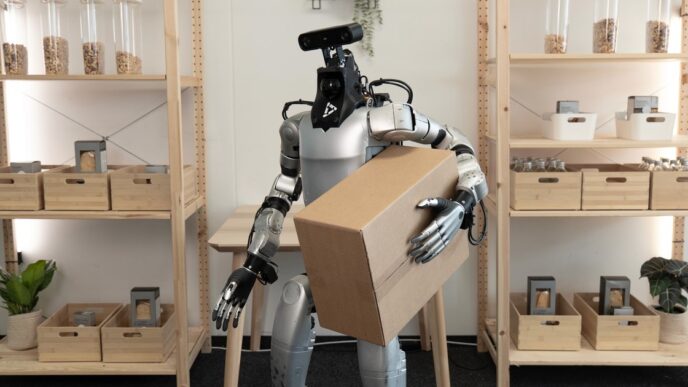
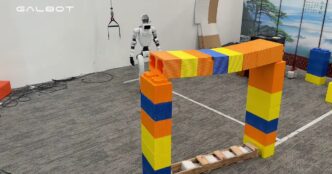
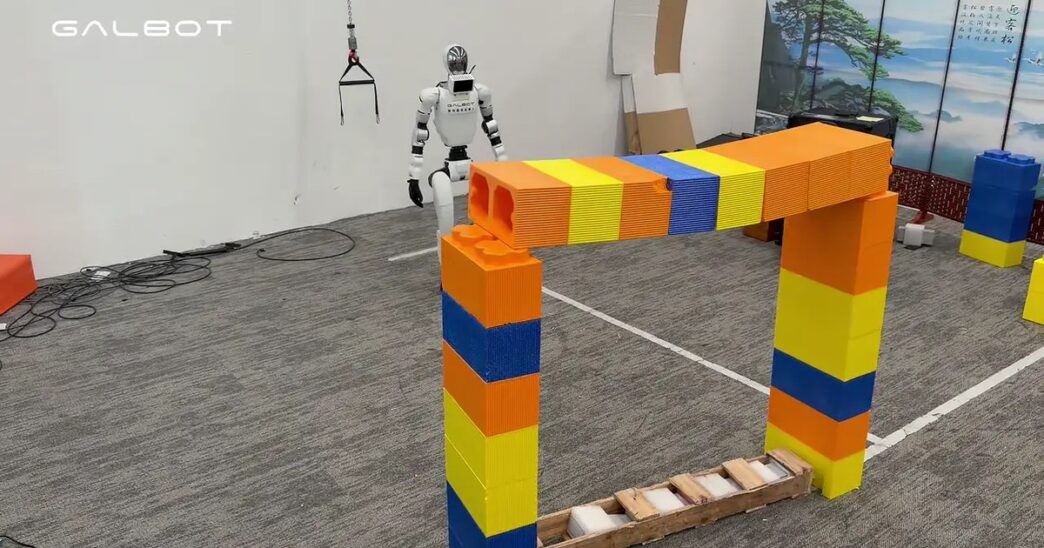
That 70.3% figure is the one to keep. Destination-arrival percentages that ignore contact are easier to inflate; the paper’s contact-free rate is the stricter read. On hardware, the team reports traversal across 50 unseen physical layouts with egocentric 3D LiDAR, online occupancy mapping, 6.25 Hz planning and 50 Hz control on a Jetson AGX Orin, without prebuilt maps or offboard compute. The project page shows a Galbot-branded humanoid (also referred to as Odin in figure labels) navigating block courses, low arches and sideways gaps in a lab.
What this is not
- Not a commercial deployment. The physical results are research layouts with constructed clutter, not a named factory or home pilot.
- Not teleop theater. The onboard stack is the point of the paper; treat failure rates and contact events as still under-reported relative to a buyer checklist.
- Not a general household robot. PASSAGE targets perceptive traversal through clutter. Manipulation, long-horizon chores and outdoor terrain are outside the claims.
For how we read demo videos versus pilots elsewhere, see readiness levels and teleop versus autonomy. For adjacent model vocabulary, see robot foundation models and world and action models.
Why the research still matters for buyers
Humanoid marketing often shows a robot crossing a clean floor. Clutter is where bipedal platforms are supposed to earn their keep versus wheeled AMRs. PASSAGE is one of the cleaner public attempts to put a contact-aware success number, a data-scaling curve and an onboard compute budget on that problem. The next useful publication would be intervention rates on the 50 physical layouts, contact severity when the 70.3% sim figure fails, and whether the same stack transfers beyond Galbot’s lab obstacles.
Frequently asked questions
What is Galbot PASSAGE?
PASSAGE is a perception-conditioned planner–tracker framework for humanoid traversal in clutter, described in arXiv paper 2609.18732 (September 16, 2026) by Galbot researchers and academic collaborators. It generates short-horizon motion from onboard geometry and tracks it at 50 Hz.
What success rate does PASSAGE report?
In simulation, the final model reaches 70.3% contact-free success on held-out scenes after scaling captured human motion from 6 to 100 hours (with scene augmentation). On hardware, the paper reports tests across 50 unseen physical layouts with a fully onboard Jetson AGX Orin system.
How much training data did PASSAGE use?
The authors collected 100 hours of scene-aligned human motion across 1,500 cluttered scenes using VR and inertial motion capture, then used simulation augmentation and RL post-training on the planner.
Is PASSAGE a shipping product?
No. It is a research system with a paper and project page. There is no public product SKU, price or named commercial site in the materials we reviewed.
Does PASSAGE need offboard computers?
The authors say the physical tests run fully onboard: egocentric LiDAR, online mapping, 6.25 Hz planning and 50 Hz control on a Jetson AGX Orin, without prebuilt maps or offboard computation.
Sources
- Ma et al., “PASSAGE: Scaling Scene-Aligned Motion Learning for Perceptive Humanoid Traversal in Cluttered Environments,” arXiv:2609.18732, September 16, 2026: arxiv.org
- PASSAGE project page (Galbot et al.): galaxygeneralrobotics.github.io/PASSAGE
Related: Readiness levels · Robot foundation models · More research coverage
Last updated: October 15, 2026. To report an error, see our corrections page. Articles are drafted with AI assistance and reviewed and edited by an editor; see our editorial policy.