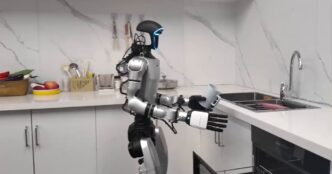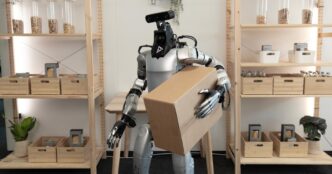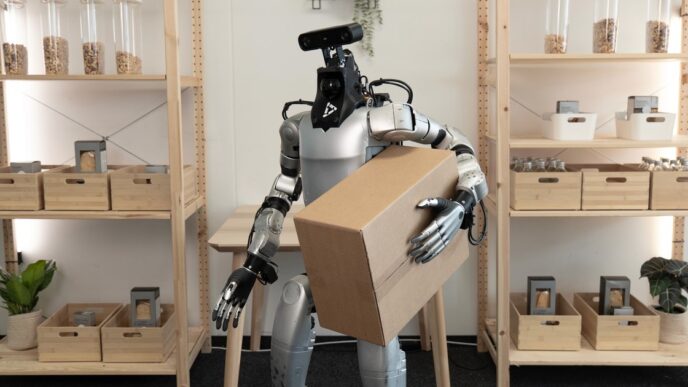
Carnegie Mellon’s Pixel wheeled humanoid just got a public cost target most labs can actually hit. In a paper posted to arXiv on November 2, 2026, Tony Tao, Jason Jingzhou Liu, Ruslan Salakhutdinov and Deepak Pathak introduce the CMU Pixel wheeled humanoid: a co-designed full learning stack for general-purpose mobile manipulation, with a hardware platform the authors say can be assembled for under $15,000.
That number lands in a crowded price map. Unitree’s store lists the R1 from $4,900 and the G1 from $13,500; most bipedal “product” humanoids, including Figure’s, still have no public list price on our 2026 price tracker. Pixel is not competing for warehouse contracts. It is a research system that argues the robot, the human data interface, the controller and the policy stack should be designed together, and a companion paper, Pixel-UMI, reports 87.0% average task progress on five mobile-manipulation tasks. The project site says the stack will be “Open Sourced Soon.”
- What: Pixel is a CMU co-designed wheeled humanoid plus teleoperation, sensorized human data collection, whole-body control and policy-learning stack for mobile manipulation (arXiv 2611.03648, November 2, 2026).
- Cost the paper states: complete hardware platform assembled for under $15,000; human-aligned 17-DoF upper body; holonomic wheeled base with vertical lift (not bipedal legs).
- Pixel-UMI result: companion paper (arXiv 2611.03647) reports 87.0% average task progress across five evaluated tasks using EAR, REAM and optional DAgger corrections.
- The catch: research demo and lab metrics, not a shipping product. Code and weights are “Open Sourced Soon” on pixel-robot.com, not released at article time. Official videos are self-hosted MP4s (no YouTube embed).
What Pixel is
Pixel’s authors start from a complaint common in robot learning: hardware, data interfaces, controllers and policies are usually built by different teams, then bolted together. Embodiment mismatches then limit what a “general” policy can do. Their answer is co-design. The same lab ships a wheeled humanoid, matched wearable grippers for human demonstrations, leader-arm and VR teleoperation, a shared whole-body controller, and a hierarchical learning stack that pairs a language-conditioned low-level policy with a vision-language high-level agent.
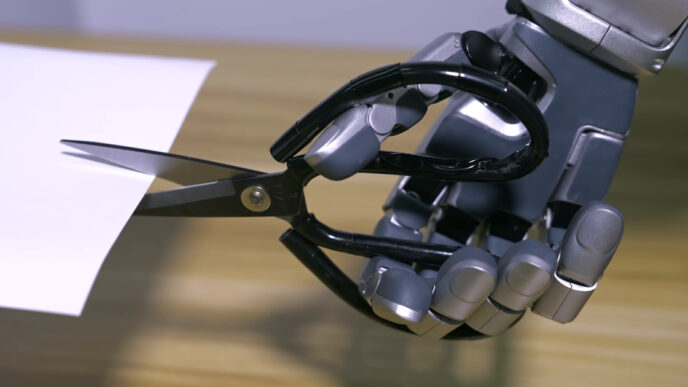
The morphology choice is deliberate. A human-proportioned upper body helps transfer human motion; legs are replaced by a holonomic mobile base and a passively stable telescopic lift to cut cost and control complexity. The paper puts the upper body at 17 degrees of freedom (torso pitch, two 7-DoF arms, 2-DoF head) and describes custom pincer grippers with compliant membranes paired to lighter human-worn grippers for in-the-wild data collection. Sensing includes wrist and head RGB cameras, a head depth camera and a base LiDAR. Compute is split between a Raspberry Pi for the drivetrain/lift and an onboard GPU laptop for whole-body control and inference.
That wheeled tradeoff matters for readers comparing Pixel to bipedal humanoids. Stairs and rough terrain are out of scope by design. Indoor floors, doorways and furniture-height work are the target. For the broader mobility debate, our guide to how robots train in simulation before real hardware is a useful companion: simulation-to-real training.
The co-design thesis, in practice
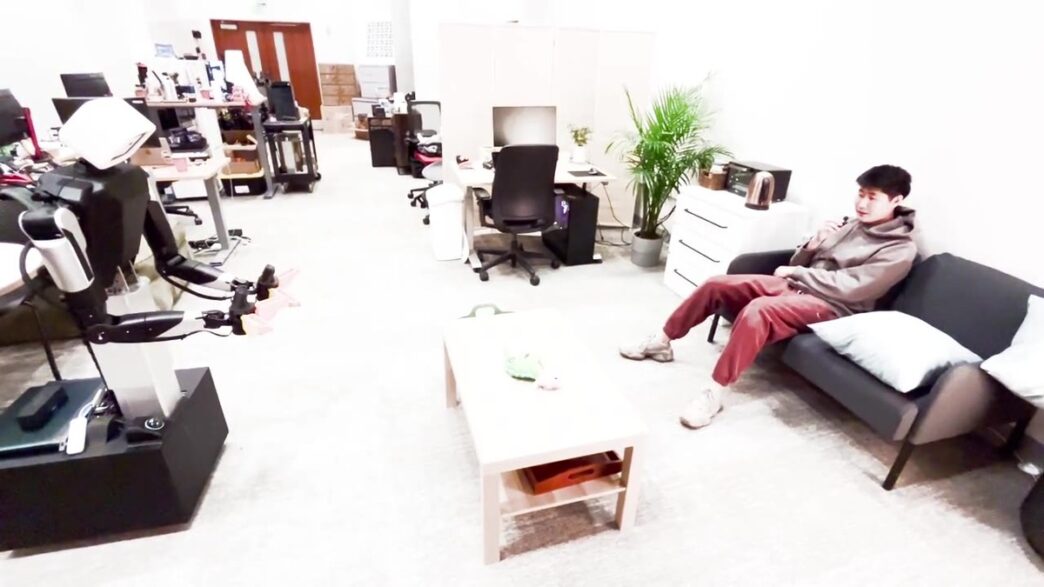
Three data paths feed the same controller. Leader-arm teleoperation gives precise bimanual tabletop control. VR teleoperation (Meta Quest) supports whole-body skills while the operator walks. Sensorized human demonstration lets people wear matched grippers and collect data without a robot in the room. All three produce task-space targets that a fabrics-based whole-body controller maps onto joints while respecting limits and self-collision.
On the learning side, Pixel uses a relative-base action space so human and robot demonstrations share a common representation, then trains a FlowDiTX diffusion-style policy on head and wrist images with language-conditioned skills. A high-level agent (the paper instantiates Gemini 3.5 Flash) decomposes open-ended requests into a skill library. In the system paper’s own ablations, policies trained from sensorized human demonstrations reached 82.0% average task progress across three mobile-manipulation tasks; robot-teleoperated demos reached 78.7% across three others. Those are the authors’ lab scores, not third-party benchmarks.
Pixel-UMI: EAR, REAM and 87.0%
The companion paper, Pixel-UMI, tackles the next problem: turning sensorized human demonstrations into whole-body robot policies when the human and robot bodies do not match. Environment-Aware Retargeting (EAR) reconstructs static scene geometry from the demonstration’s depth sequence and uses collision-aware geometric fabrics offline to choose robot postures that keep tracking the demonstrated head and gripper motion. Retargeting-Error-Aware Masking (REAM) uses residual pose errors during training to mask camera views the robot is unlikely to reproduce. For contact-rich tasks, the authors add on-policy DAgger corrections.
Headline result, from the Pixel-UMI abstract: 87.0% average task progress on five tasks spanning articulated-object manipulation, deformable-object handling, constrained-space reaching, whole-body collision avoidance and contact-rich bimanual coordination. Ablations in the paper attribute large gains to EAR (about 64 percentage points on three tasks versus retargeting without environment awareness) and additional gains to REAM. DAgger rounds lift two hard contact-rich tasks from low single-digit progress to roughly 80% average after two correction rounds, again on the authors’ rubric.
Read those scores the way we read other lab leaderboards. The metric is task progress on the authors’ stages, in their scenes, with their robot. It is useful evidence that co-designed human data can transfer. It is not a product reliability number, and it is not comparable one-for-one with LiberAI’s zero-shot percentages on Liber-0 or with Open X-Embodiment cross-embodiment benchmarks. For how large multi-robot datasets fit into this picture, see our Open X-Embodiment explainer and robot foundation model primer. LiberAI’s different approach, learning mostly from human video, is covered in our Liber-0 piece.
Price tiers: research platform vs product humanoids
Under $15,000 for a wheeled research humanoid with a full stack is the paper’s hardware claim. Put beside Unitree’s public store prices, Pixel sits near the G1’s $13,500 list and well above the R1 Air’s $4,900, while buying a very different object: open research morphology and data tooling, not a vendor-supported bipedal product. Figure 03 and many other commercial humanoids still disclose no public price on our tracker. Digit’s list price is also undisclosed.
On our readiness scale, Pixel is a research demonstration platform. The papers show teleoperation, autonomous policy rollouts and ablations inside lab tasks. There is no customer deployment claim, no safety certification story and no ship date. “Open Sourced Soon” on pixel-robot.com is a promise to release, not a GitHub tag you can clone today. Official videos live as self-hosted MP4s on the project site; there is no official YouTube upload to embed, so this article links the gallery instead of pasting a player.
What to watch next
The useful next signals are the open-source drop (code, CAD, weights, data formats), independent reproductions on a second Pixel build, and whether other labs adopt the relative-base action space or EAR/REAM ideas on different embodiments. Until the repo is public, treat Pixel as a well-documented CMU research system with a clear cost target and labeled lab scores, not as a robot you can order.
Frequently asked questions
What is the CMU Pixel robot?
Pixel is a co-designed wheeled humanoid and robot-learning stack from Carnegie Mellon researchers Tony Tao, Jason Jingzhou Liu, Ruslan Salakhutdinov and Deepak Pathak. The system paper (arXiv 2611.03648, November 2, 2026) covers hardware, teleoperation, sensorized human data collection, whole-body control and policy learning for mobile manipulation.
How much does Pixel cost?
The Pixel paper says the complete hardware platform can be assembled for under $15,000. That is the authors’ bill-of-materials claim for a research build, not a retail product price with support and warranty.
Is Pixel a bipedal humanoid?
No. Pixel uses a holonomic wheeled base and a vertical lift instead of legs, with a human-aligned 17-DoF upper body. The authors describe that as a deliberate cost and complexity tradeoff for indoor mobile manipulation.
What is Pixel-UMI’s 87.0% result?
In arXiv 2611.03647, the authors report 87.0% average task progress across five mobile-manipulation tasks after Environment-Aware Retargeting, Retargeting-Error-Aware Masking and, on two contact-rich tasks, DAgger corrections. The score uses their progress rubrics in their evaluation scenes.
Can I download Pixel’s code or buy a kit?
As of November 5, 2026, pixel-robot.com labels the project “Open Sourced Soon.” No public code release, kit SKU or commercial sales page is linked from the materials we checked. Official videos are on the project site as self-hosted files.
Sources
- Tao, Liu, Salakhutdinov, Pathak: “Pixel: A Co-Designed Full-Stack Robot System for Learning General-Purpose Mobile Manipulation,” arXiv:2611.03648, November 2, 2026
- Liu, Tao, Pathak, Salakhutdinov: “Pixel-UMI: Learning Environment-Aware Whole-Body Manipulation from Sensorized Human Demonstrations,” arXiv:2611.03647, November 2, 2026
- Pixel project site (pixel-robot.com)
- Pixel system page and video gallery
- Pixel PDF (pixel-robot.com/papers/pixel.pdf)
All sources accessed November 5, 2026.
Last updated: November 5, 2026. To report an error, see our corrections page. Articles are drafted with AI assistance and reviewed and edited by an editor; see our editorial policy.