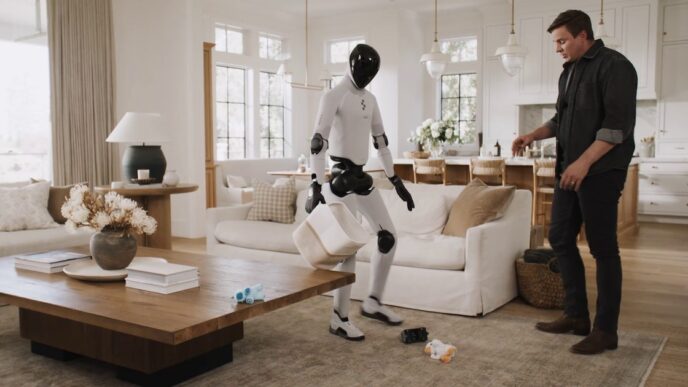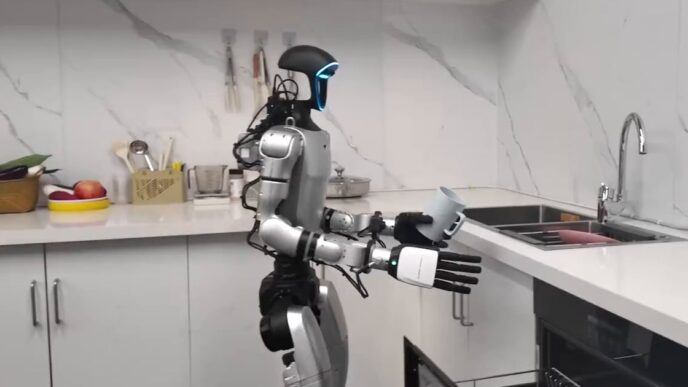
A new Alibaba humanoid model learns whole-body chores mostly by watching people do them, its creators say. Its model, λ0 (Lambda-0), was trained on 500 hours of video that people recorded from their own point of view while wearing motion trackers, and then fine-tuned on a Unitree G1. In 40 real-world trials, it succeeded 25 times, more than any of the four other robot models the team tested against.
The paper comes from the Lambda-humanoid Team at Alibaba Token Hub and Amap, Alibaba’s mapping unit. It was posted to arXiv on October 13 and revised on October 21, along with code, a project page and one model checkpoint. The headline figure that has been circulating, 62.5%, is the overall success rate on robot tasks after robot training, not the model working with no robot data at all. That number is lower and measured differently.
- What it is: an Alibaba humanoid model that learns from HumanVerse, 500 hours of first-person human video paired with body and hand motion.
- Result: 25 of 40 successes (62.5%) on four real tasks with a Unitree G1, vs. 16 of 40 for the best baseline, Physical Intelligence’s π0.5.
- Why it matters: collecting a human demo took about a quarter of the labor of a robot teleoperation demo in the team’s test.
- Open? Code (Apache-2.0) and a mid-training checkpoint, yes. The HumanVerse dataset and full training pipeline, not yet.
What HumanVerse is
Most humanoid policies today learn from teleoperation, where a person drives the robot and the robot records what it sees and does. That is slow and needs the robot on site. The Alibaba team instead had people wear a GoPro HERO13 on a neck mount plus a PICO 4 Ultra headset and body trackers, then go about everyday tasks in homes, shops and supermarkets, industrial sites, offices and outdoors. The G1 carries the same GoPro on its head, so human and robot views look alike.
The resulting dataset, HumanVerse, has 500 hours, 32,993 episodes and 87 million pose frames across 827 task types, according to the paper. Software reconstructs each person’s body and hand motion, masks out their forearms and trackers, and converts the motion into commands for NVIDIA’s SONIC whole-body controller, the controller Berkeley compared itself against in SuperMimic. Our explainer on humanoid training data covers why companies are chasing human video at all.
How λ0 is trained
λ0 pairs a Qwen3.5-2B vision-language backbone, from Alibaba’s own Qwen family, with an action expert that predicts 50 steps at a time. Training runs in three stages: pretraining on first-person hand motion, mid-training on the whole-body HumanVerse data, then post-training on robot demonstrations. On the G1, each step outputs a 64-number motion code for SONIC and two six-number commands for BrainCo Revo2 robot hands.
The ablations show where the gains come from. Without any human-data pretraining, real-world success fell to 15%. Without the HumanVerse mid-training stage it was 22.5%, and without the first-person hand stage it was 50%. The full recipe reached 62.5%. Task progress rose steadily from 59.9% to 80.4% as the team added more HumanVerse data.
The results, and how to read them
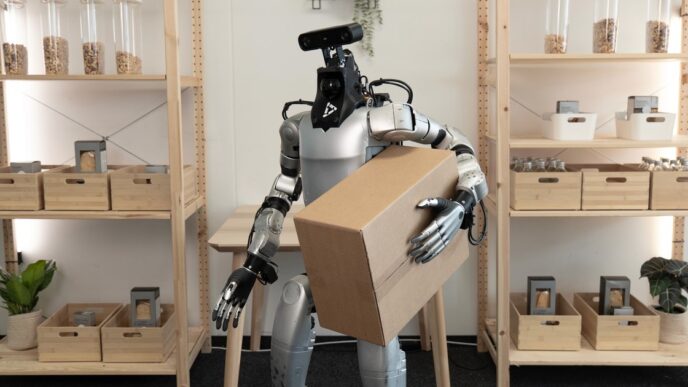
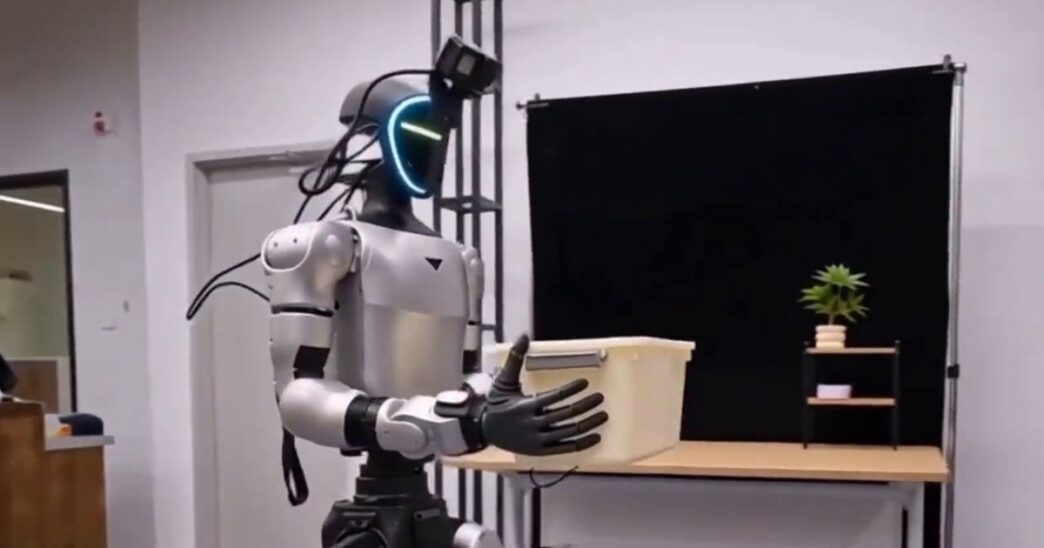
The real-world test used four tasks on a Unitree G1: throwing away a bottle, storing toys, carrying a box and placing a chair, with 10 trials each. λ0 succeeded 25 times out of 40 and averaged 80.4% task progress. The baselines, all fine-tuned on the same robot data by the authors, scored lower: π0.5 16 of 40, StarVLA 11, Ψ0 4, and NVIDIA’s GR00T N1.6 3. In the SIMPLE simulation benchmark, λ0 reached 90.0%, 3.9 points ahead of StarVLA, though the paper notes that number uses the best training configuration for each task.
The zero-shot numbers are the ones getting mixed up. When the robot learned tasks only from human demos, with no robot demos of that task, λ0 averaged 51.7% progress on four whole-body tasks and 76.2% on three long-range tasks. Those are progress scores, which credit partial completion, not success rates.
The cost argument is the most practical part. On two tasks, closing a laptop and pulling a curtain, a human demo took 33.3 person-seconds of labor vs. 140.85 for a robot demo, which needs two people. Policies trained on 200 human demos scored 53.3% on average, against 60% for 50 robot demos. So human data is cheaper per demo but not yet as good as robot data, demo for demo. These are the authors’ own lab results, with 10 to 20 trials per test, and haven’t been reproduced by others.
What’s actually open
The openlambda repository is Apache-2.0 and includes model code, human-data collection tools and motion alignment, with four example trajectories. Hugging Face hosts one checkpoint, the Stage II mid-trained model. The repo says the pretraining and HumanVerse datasets aren’t included, robot recording tools and the full post-training and deployment workflow aren’t released yet, and the published code doesn’t guarantee end-to-end reproduction. The team hasn’t announced a product, partner or commercial plan.
What to watch: a HumanVerse data release, independent reproductions on other G1s, and whether Alibaba puts the model to work in a commercial robot.
Frequently asked questions
What is Alibaba’s λ0 model?
λ0 (Lambda-0) is a humanoid robot model from the Lambda-humanoid Team at Alibaba Token Hub and Amap. It learns whole-body tasks mainly from first-person human video and motion data, then is fine-tuned on a Unitree G1 robot.
What is HumanVerse?
HumanVerse is the team’s dataset of 500 hours of first-person human video, recorded with a GoPro and PICO body trackers, with synchronized body and hand motion. It has 32,993 episodes across 827 task types. It hasn’t been publicly released.
How well does λ0 work on a real robot?
On four real-world tasks with 10 trials each, it succeeded 25 of 40 times (62.5%) after robot fine-tuning. The best baseline, π0.5, succeeded 16 times. These are the authors’ own lab results.
Can λ0 do tasks with no robot training?
Partly. Trained only on human demos of a task, it averaged 51.7% progress on four whole-body tasks and 76.2% on three long-range tasks. Progress gives partial credit, so these aren’t success rates.
Is λ0 open source?
The code is on GitHub under Apache-2.0, and a Stage II checkpoint is on Hugging Face. The HumanVerse and pretraining datasets, robot recording tools and full post-training pipeline aren’t released yet.
Sources
- Lambda-humanoid Team, “λ0: Scaling Open-World Egocentric Human Data for Humanoid Loco-Manipulation,” arXiv 2610.18950 (v1 October 13, v2 October 21, 2026): arxiv.org
- λ0 project page (Alibaba Token Hub and Amap, Alibaba Group): lambdahumanoid.github.io
- openlambda repository and release status, GitHub (Apache-2.0): github.com/LambdaHumanoid/openlambda
- Stage II checkpoint, Hugging Face: huggingface.co/lambda-humanoid
All sources accessed October 24, 2026, between about 7:00 and 8:15 AM ET.
Related: More Research coverage · More Embodied AI coverage
Last updated: October 24, 2026. To report an error, see our corrections page. Articles are drafted with AI assistance and reviewed and edited by an editor; see our editorial policy.