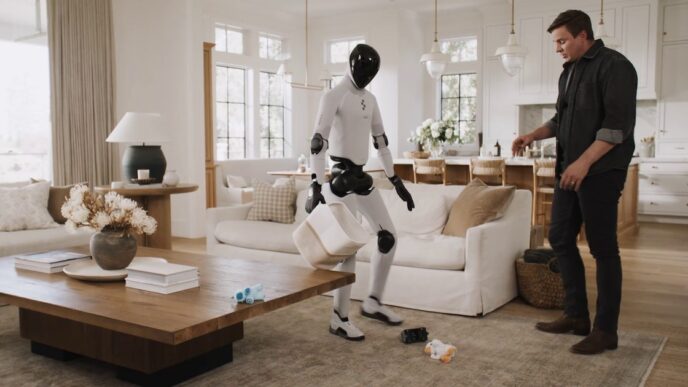
NVIDIA trained its SONIC humanoid controller on 128 GPUs for a week. A team at UC Berkeley says its new method, SuperMimic, beats that result in three hours on a single GPU, then runs the same policy on a real Unitree G1 doing flips and side rolls.
The SuperMimic paper, posted to arXiv on October 20, 2026, and accepted as an oral presentation at the Conference on Robot Learning (CoRL), claims a cut of more than 1,000 times in GPU-hours for whole-body motion tracking, the skill that lets a humanoid copy human movement from motion-capture data. If the number holds up, a capability that took a corporate GPU cluster becomes something a university lab can rerun every afternoon. That’s why lead author Qiayuan Liao’s announcement drew more than 120,000 views on X in a day.
- The claim: SuperMimic beats the normalized return of NVIDIA’s SONIC (0.90) after 3 hours on one NVIDIA H100, versus SONIC’s reported 7 days on 128 L40 GPUs, about 21,000 GPU-hours.
- Who and when: UC Berkeley researchers including Pieter Abbeel and Koushil Sreenath. Paper posted October 20, 2026; accepted at CoRL 2026.
- Real robot: one policy, trained in simulation, ran a skipping jump, a side roll and two flips on a physical Unitree G1 with no per-motion tuning, per the paper.
- The catch: the 129,514-motion benchmark uses training motions, so it measures coverage, not generalization. Flat ground only, and no SuperMimic training code is linked yet.
The SuperMimic numbers, and what they’re measured against
The baseline is serious. SONIC, published in Science Robotics in August by a 28-author NVIDIA team that includes Jim Fan and Yuke Zhu, showed that scaling up motion tracking (bigger networks, more than 100 million frames of motion capture, 21,000 GPU-hours) produces a general controller that can also take commands from VR teleoperation and vision-language-action models. NVIDIA released its code and checkpoints.
SuperMimic’s authors scored their policy against SONIC’s released checkpoint on the same 129,514 motions. On their project page, SONIC fails 179 of them, including all 44 flips and all 22 side rolls. SuperMimic fails 25 after three hours on one GPU and none after 9.8 hours on two. By the paper’s own accounting, the gap is about 7,200 times in GPU-hours and about 56 times in wall-clock time, rounded down to “more than 1000x” and “more than 50x.”
The authors are upfront about the asymmetries. SuperMimic trained on 264.56 hours of BONES-SEED, the public subset of SONIC’s data, about 2.3 times less than SONIC’s 611 hours. It ran on an H100, which the authors say has 5.5 times an L40’s tensor-core peak but only 0.74 times its fp32 throughput. Their argument is that neither difference comes close to explaining a gap of three orders of magnitude. And because every benchmark motion was also a training motion for both systems, the project page says the failure counts “measure coverage, not generalization.”
How one world model replaces 128 GPUs
Most motion trackers, SONIC included, are trained with model-free reinforcement learning, specifically PPO: the policy tries things in a physics simulator millions of times and slowly learns from noisy reward estimates. SuperMimic adds a shortcut. It fits a neural network, a learned “world model,” to transitions logged from a standard simulator (MuJoCo Warp) and then trains the policy inside that model’s imagination, on 32-step rollouts.
Because the world model is differentiable, the policy gets exact gradients by backpropagating through those imagined steps instead of estimating them from samples. The simulator itself is never differentiated, so, the authors say, simulators with non-smooth contacts “work as they are.” The world model keeps learning alongside the policy rather than being trained once and frozen, and a critic estimates the return beyond the 32-step horizon. The authors say imagined rollouts run more than 10 times faster than MuJoCo Warp at their batch sizes, and that the analytic gradients need about 64 times fewer imagined steps than PPO on the same world model to reach PPO’s best return.
One model covers every motion, and the paper says its prediction error stayed between 0.007 and 0.011 as the training data grew from one hour to 264 hours. That’s the basis for the authors’ bigger claim: measuring “the scaling laws of motion tracking is now affordable, at one GPU per run.”
We found a way to scale humanoid control that reduces GPU-hours by more than 1000×.
Across 129,514 motions, SuperMimic surpasses the state of the art (128 GPUs, 7 days) with 1 GPU in 3 hours.
Project: https://t.co/GtCWS7R1wz
Demo: https://t.co/QWx4B3ln3G pic.twitter.com/wgavuyQTc0— Qiayuan Liao (@qiayuanliao) October 21, 2026
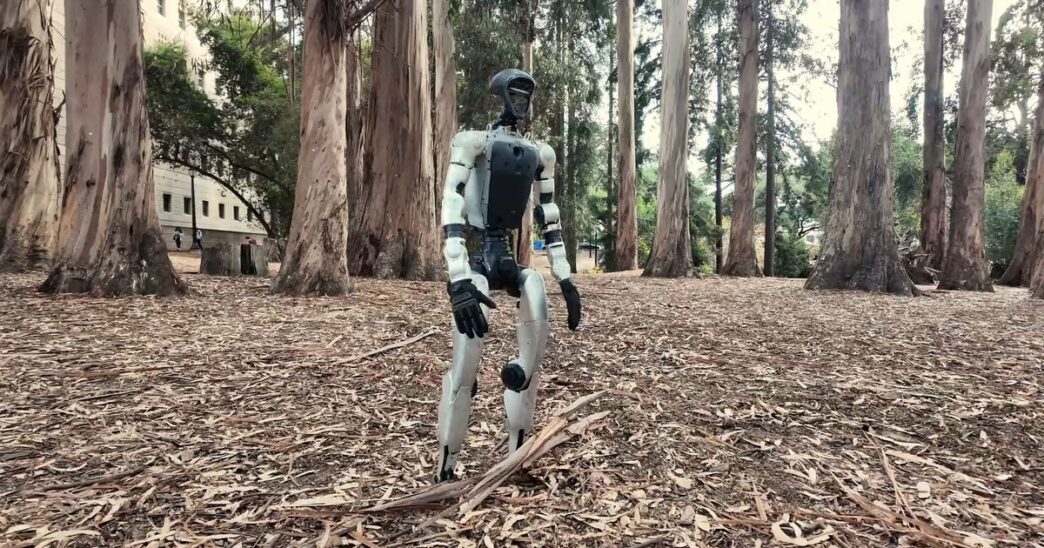
Video: Qiayuan Liao, UC Berkeley. SuperMimic overview video from lead author Qiayuan Liao’s X account, posted October 21, 2026, including simulation results and the real Unitree G1 clips (watch on X).
A flip on a real Unitree G1, with limits
The real-robot section of the paper is short. One general motion tracker, trained entirely through the world model, ran on a physical Unitree G1 without per-motion tuning, and the paper shows four motions: a skipping jump, a side roll, a 90-degree flip and an in-place 360-degree flip. The project page’s outdoor clips say the same policy runs in every one of them.
The authors list the limits themselves. The world model learns only from simulator data, not from the real robot. SuperMimic trains on flat ground only, with no terrain or object interaction, which the paper calls “ongoing work.” And its tests of downstream controls, such as steering the robot with velocity commands, are described as preliminary. In other words, this is a faster way to teach a humanoid to move like a person, not a robot that does chores.
The paper says the work was supported in part by Komatsu, the BAIR Center for Humanoid Intelligence, Apple and the RAI Institute, with compute sponsored by Lambda. Abbeel and Sreenath are also Amazon Scholars; the paper says the work isn’t associated with Amazon.
Can anyone check it yet?
Not easily. As of Thursday morning, the project page links the paper, a video and a browser demo of the policy, but no training code. An independent, unreviewed reproduction on GitHub says it reached the paper’s 0.82 tracking score on the smaller LAFAN1 dataset in 1.66 hours on a single RTX 5090, using a modified observation setup, and that runs with the paper’s exact setup are still in progress. That’s an encouraging early sign, not a confirmation.
The next test comes at CoRL, where the paper gets an oral slot, and in whether the Berkeley team releases code so other labs can run the one-GPU recipe on their own robots. If it does, the comparison worth watching is the one the paper doesn’t make yet: new motions the policy has never seen.
Frequently asked questions
What is SuperMimic?
SuperMimic is a training method for humanoid whole-body motion tracking from UC Berkeley, described in a paper accepted at CoRL 2026. It learns a differentiable world model from simulator data and trains the robot’s policy through that model, which the authors say cuts GPU-hours by more than 1,000 times compared with NVIDIA’s SONIC.
How fast does SuperMimic train?
The authors say it surpasses the return of SONIC’s released checkpoint in 3 hours on one NVIDIA H100, and reaches zero failures on their 129,514-motion benchmark after 9.8 hours on two GPUs. SONIC was reported to take 7 days on 128 NVIDIA L40 GPUs.
Does SuperMimic work on a real robot?
Yes, according to the paper. One policy trained through the world model ran on a physical Unitree G1 and performed a skipping jump, a side roll, a 90-degree flip and an in-place 360-degree flip without per-motion tuning.
Is the SuperMimic code open source?
Not yet, as far as we can see. On October 22 the project page linked the paper, a video and a browser demo but no training code. An independent reproduction exists on GitHub, but it isn’t from the authors.
What are SuperMimic’s limitations?
The authors say the world model learns only from simulation, training covers flat ground with no terrain or objects, and downstream control results are preliminary. Their benchmark also uses training motions, so it shows coverage rather than how well the policy handles new motions.
Sources
- Q. Liao, Y. Shao, J. Long, K. Zakka, R. Horowitz, P. Abbeel, K. Sreenath, “SuperMimic: Scaling Humanoid Whole-Body Control with One Differentiable World Model,” arXiv 2610.28480, submitted October 20, 2026 (accepted at CoRL 2026, oral): arxiv.org (PDF)
- SuperMimic project page (compute comparison, failure counts, FAQ, real-robot clips): supermimic.github.io
- Qiayuan Liao on X, SuperMimic announcement and video, October 21, 2026: x.com/qiayuanliao
- Z. Luo et al. (NVIDIA), “SONIC: Supersizing motion tracking for natural humanoid whole-body control,” Science Robotics 11(117), August 12, 2026: science.org; project page: nvlabs.github.io/GEAR-SONIC; code: github.com/NVlabs
- CuboiLeo, “SuperMimic-Reproduced” (independent reproduction, status as of October 21, 2026): github.com
All sources accessed October 22, 2026, at about 10:30 AM ET. View count from X as of the same time.
Related: More Research coverage · More Embodied AI coverage
Last updated: October 22, 2026. To report an error, see our corrections page. Articles are drafted with AI assistance and reviewed and edited by an editor; see our editorial policy.