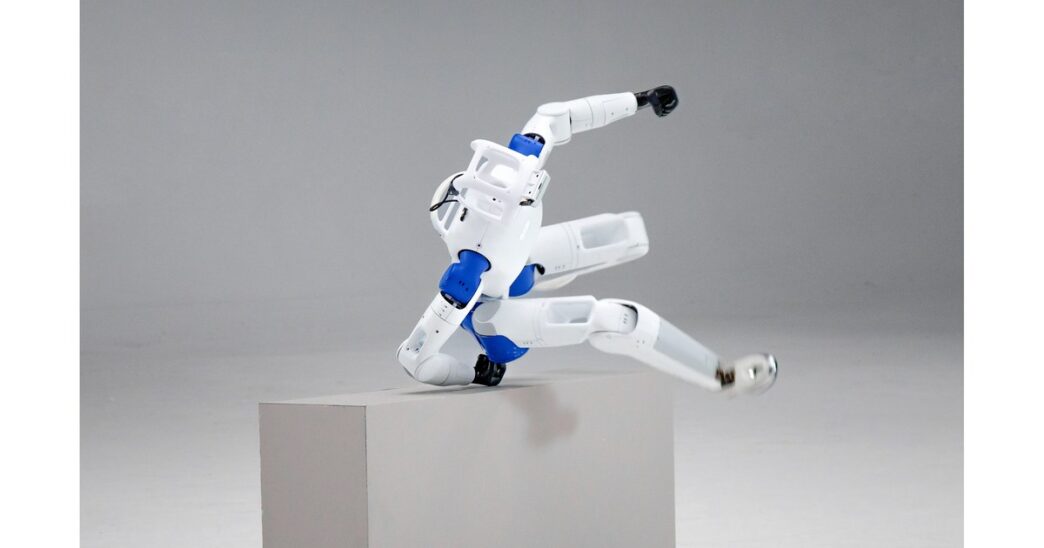
Shanghai’s RoboParty has put a full-stack open-source humanoid on GitHub. In a PR Newswire release dated October 15, 2026, the company launched RP1 (also called ROBOTO 01): mechanical CAD, electronics, ROMOMO joint modules, firmware, SDKs and training tools, under GPL-3.0 on github.com/Roboparty/RP1. The repo was created October 1 and had about 212 stars when we checked the morning of October 16. RoboParty does not publish a price.
That matters because “open source humanoid” usually means a software stack on a closed body, or a partial BOM. RoboParty is pitching the opposite: open the robot itself so labs can change actuators, firmware and policies in the same loop. Whether that’s commercially shipping hardware or a research release you build yourself is the part the PR never settles.
What RP1 is, in the company’s numbers
According to the October 15 release, the standard RP1 stands about 1.3 meters tall with 24 actuated degrees of freedom. A Pro configuration adds a 2-DoF neck and two 7-DoF arms for 30 actuated DoF. Those counts exclude dexterous hands. The RP1 GitHub README, checked October 16, lists supported configurations of 24, 28, 30 and 42 DoF variants — so the PR’s Standard/Pro pair is not the whole matrix.
RoboParty says RP1 already supports continuous walking, recovery from external disturbances, getting back up after a fall and human motion tracking. Those are company claims from the release, not independent benchmarks. The same release ties the platform to PartyOS, the UFO unsupervised reinforcement-learning framework and MimicLite motion imitation, plus VR teleoperation and motion-retargeting tools.
If you’re comparing DoF headlines across vendors, our explainer on humanoid robot degrees of freedom is the place to start: makers often count wrists, necks and fingers differently, and RoboParty is explicit that hands sit outside the 24/30 figures.
What’s actually open on GitHub
The RP1 umbrella repo points at a connected stack rather than a single dump. Linked repositories named in the README and org, as of our October 16 check, include RP1_hardware / rp1_hardware, ROMOMO, rp_dexhand / RP Hand materials, roboparty_deploy, roboparty_train, Party_OS, RP1_firmware and related description packages. The release frames that as mechanical structures, actuators, motion control, simulation, SDKs and learning frameworks in one ecosystem.
License on the main RP1 repo is GPL-3.0 via GitHub’s license metadata. Sub-repos can carry their own licenses; the README says to check each one. RoboParty’s site at roboparty.com mirrors the open-platform pitch.
This sits next to other open humanoid-model releases we’ve covered, such as Unitree’s UniFoLM-WLA 1.0 — a different problem (open model weights vs open robot body). RP1’s bet is that labs need to inspect the joints and firmware, not only the policy network.
RPO came first — and the star count checks out
RoboParty says it launched the RPO open-source project in January 2026 with mechanical and electrical design resources plus training and deployment materials, and that the project has more than 2,600 GitHub stars. We checked the org’s Roboparty/roboto_origin repository the morning of October 16: about 2,641 stars, created at the end of December 2025. So the “more than 2,600” line matches the public RPO-era repo we could find under that name.
Founder Yi Huang, quoted in the PR: “We believe the future of embodied AI should not be defined by just a handful of closed systems. With RP1, we want to open up more than code. We want to give researchers the opportunity to truly understand, modify and continuously advance robotic capabilities.”
RoboParty says it was founded in Shanghai in 2025. The release does not list a commercial SKU, a bill-of-materials dollar cost, a kit price or a shipping timeline. A second PR Newswire item dated October 16 (“No More Black Boxes…”) repeats the same open-stack framing; it likewise publishes no price.
What this announcement leaves out
Three gaps matter for anyone who might actually build one. First, price: RoboParty has not published one. Second, commercial availability: the materials read as a research and developer platform release, not a store listing — we are not calling RP1 a shipping consumer product. Third, how finished the training stack is relative to the RPO generation: we stuck to the PR and the RP1 README we fetched; we did not independently audit every training script for leftover RPO naming.
For labs comparing open stacks, the useful next step is the GitHub tree itself: clone the umbrella repo, read each linked license, and treat walking and fall-recovery demos as company-shown capabilities until someone outside RoboParty reproduces them. Until a price and a parts list land, RP1 is an open engineering drop — ambitious, documented and still incomplete as a buyer’s story.
Frequently asked questions
What is RoboParty RP1?
RP1 (ROBOTO 01) is RoboParty’s full-stack open-source humanoid platform, announced October 15, 2026. The company says it opens mechanical CAD, electronics, ROMOMO joints, firmware, SDKs and training tools. The main GitHub repo is licensed GPL-3.0.
How tall is RP1, and how many degrees of freedom does it have?
RoboParty says the standard RP1 is about 1.3 meters tall with 24 actuated DoF, and a Pro config reaches 30 DoF with a 2-DoF neck and two 7-DoF arms. Those counts exclude dexterous hands. The GitHub README also lists 24, 28, 30 and 42 DoF configuration variants.
How much does RoboParty RP1 cost?
RoboParty has not published a price in its October 15–16 PR Newswire releases or on the RP1 GitHub README we checked October 16. There is no public BOM cost in those primary sources either.
Is RP1 shipping as a commercial product?
The materials we checked frame RP1 as an open research and developer platform, not a store SKU. We are not treating it as a commercially shipping consumer humanoid based on this release alone.
What was RoboParty’s RPO project?
RoboParty says RPO launched in January 2026 as an earlier open-source humanoid release and has more than 2,600 GitHub stars. The org’s roboto_origin repo showed about 2,641 stars on October 16, which matches that claim.
Sources
- RoboParty, “Born to Be Open: RoboParty Launches RP1, a Full-Stack Open-Source Humanoid,” PR Newswire, October 15, 2026, 1:00 p.m. ET: prnewswire.com
- RoboParty, “No More Black Boxes: RoboParty Launches Full-Stack Open-Source RP1,” PR Newswire, October 16, 2026: prnewswire.com
- RoboParty, RP1 GitHub repository (README, license GPL-3.0, star count ~212 on Oct 16): github.com/Roboparty/RP1
- RoboParty, roboto_origin (RPO-era) GitHub repository (~2,641 stars on Oct 16): github.com/Roboparty/roboto_origin
- RoboParty website: roboparty.com
All sources accessed October 16, 2026. GitHub star counts checked the morning of October 16, 2026.
Related: Humanoid robot degrees of freedom · Unitree UniFoLM-WLA 1.0 · More Robot Companies coverage
Last updated: October 16, 2026. To report an error, see our corrections page. Articles are drafted with AI assistance and reviewed and edited by an editor; see our editorial policy.