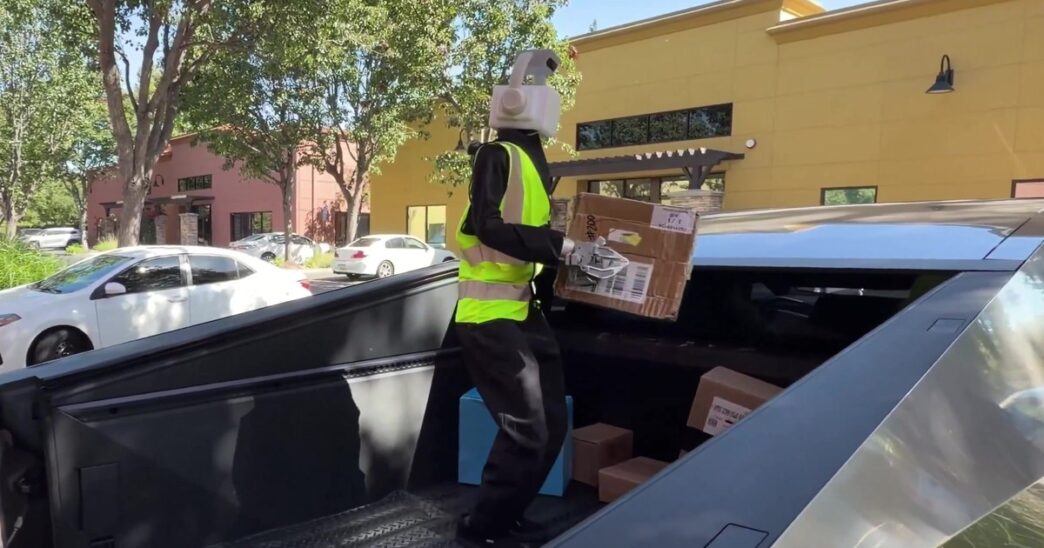
Reward AI, a young robot-AI company, posted new demos on Tuesday, October 27, of a humanoid unloading delivery boxes from the bed of a Tesla Cybertruck and picking up objects while standing on a staircase. Every clip is labeled “fully autonomous, 1x speed.” The model running the robot, Reward AI OM-1, was trained only on data from people wearing a sensor-packed hand device. The company says no teleoperation and no robot practice went into it.
That’s a striking claim, and the videos look smooth. But they’re demos the company chose to publish, the robot’s maker isn’t named, and Reward AI hasn’t shared customers, prices, funding or success rates. Here’s what the clips and the company’s technical post actually support.
- What’s new: Reward AI posted humanoid demos on October 27, 2026: last-mile package handling from a Cybertruck and grasping objects on stairs.
- The model: OM-1, which Reward AI says learns only from people wearing its Omnibody Hand, with no teleoperation and no on-robot data.
- Label: Demo and company claim. The clips are marked fully autonomous at 1x speed, but no success rates or attempt counts are published.
- Not disclosed: the humanoid’s maker, customers, pricing, funding or a commercial deployment.
What the Reward AI OM-1 demos show
Reward AI posted the clips in a short thread on X at 1:31 PM ET on October 27. “We deploy OM-1 on more humanoid tasks in both indoor and outdoor environments,” the company wrote, listing “last-mile delivery from a Cybertruck” and “manipulation on stairs.” It also claimed that OM-1 “can power humanoids to do useful things robustly that other models or form factors cannot.” That’s a comparison the company didn’t back with any side-by-side test.
In the lead video, a humanoid in a high-visibility vest stands in the bed of a Cybertruck parked outside a strip of shops, picks up cardboard boxes stacked in the truck bed. A follow-up post calls this a stress test. The company says it used packages “from Amazon, Walmart, DHL, etc in different positions and orientations,” and that the model “can reactively adjust, and let humanoids climb, navigate together with whole-body approaching, and hold packages firmly while climbing down.” That follow-up clip runs about ten minutes.
A third, 12-second clip shows the robot grasping objects on a staircase. Reward AI says it works “from different positions and orientations with feet standing on the same or different stair treads.” Reaching down while balanced on uneven footing is a real whole-body control problem, which is why the clip is worth a look.
What the videos don’t show matters as much. Reward AI hasn’t said how many attempts it ran, how often the robot dropped a box or needed a reset, or whether anyone stepped in off camera. Its About page says every clip it publishes “runs at 1x speed, clearly labeled,” which rules out sped-up footage. It doesn’t rule out picking the best takes. Skild AI made the same point about the whole industry in September: a robot that succeeds 10% of the time can produce a clip that looks just like one that succeeds 99% of the time.
How OM-1 learns without teleoperation
Most robot foundation models are trained on teleoperation: a person drives the robot through a task with a controller or a VR rig while the robot logs everything. That data is accurate but slow and expensive, and it’s tied to one robot body. Reward AI’s pitch is to skip the robot entirely during data collection.
The company’s September technical post, “OM-1: Frontier Robot Intelligence, Learned Firsthand from Humans,” describes three layers.
- Omnibody Hand. A wearable with seven degrees of freedom that captures how a person pinches, reorients and grips objects. It builds on DexCap, a portable hand-capture system some of the team published in 2024.
- One Data Interface. Tactile sensors, proximity sensors and in-hand cameras record the moments before and during contact. The company says electromagnetic tracking cut mean overshoot error by 60% at high speed compared with visual-inertial tracking, falling from 24.9 mm to 9.5 mm in its own bench test. The device also records force along the hand’s path.
- OM-1 and its control layer. The policy turns those human streams into robot actions, and a separate controller trained with reinforcement learning in simulation handles each robot’s dynamics, unexpected loads and delays.
“OM-1 learns from human data alone. No teleoperation and no on-robot experience,” the post says. It also says OM-1 “picks up a brand-new task, including challenging dynamics and long horizons, from less than 30 minutes of data,” and runs on bodies from industrial arms to humanoids. Those are the company’s own claims. Reward AI hasn’t published a paper, a benchmark against other models or open weights that would let outsiders check them.
The idea isn’t unique. Alibaba’s Lambda-0 also trains a humanoid on human video, about 500 hours of it, filmed from the wearer’s point of view. Reward AI’s twist is the sensor-heavy hand device and the claim that no robot data is needed at all, not even for fine-tuning.
Claims versus what’s confirmed
| Item | Status |
|---|---|
| Humanoid handles packages from a Cybertruck and grasps objects on stairs | Demo (company videos, October 27) |
| Clips are fully autonomous at 1x speed | Company claim (on-screen label and About page) |
| Trained only on human data, no teleoperation or robot data | Company claim (OM-1 blog) |
| New task from under 30 minutes of data | Company claim, no published benchmark |
| 60% lower tracking overshoot at high speed | Company bench test |
| Humanoid hardware maker | Not disclosed |
| Customers, pilots, pricing, funding | Not disclosed |
One word in the thread needs care: “deploy.” Reward AI uses it to mean running OM-1 on a new robot and task. Nothing in the posts describes a paying customer, a delivery company partner or a public pilot, so this is a demo, not a commercial rollout.
Who is behind Reward AI
The company’s About page is signed by co-founder Zipeng and mentions co-founder Chen. Zipeng Fu and Chen Wang both shared the demos from their own X accounts. The page lists the team’s selected past work, including ALOHA, HumanPlus and DexCap, all well-known academic robot-learning projects. It says the company’s goals are one model for any robot body, human-level speed, and eventually teams of robots working together. It doesn’t disclose investors or headcount.
What to watch next
Three things would turn this from an impressive reel into evidence. The first is success rates over many trials, especially for the stair grasps and the stress-test deliveries. The second is the name of the humanoid platform, so others can tell how much of the balance work comes from the hardware’s own controller. The third is any outside user, pilot or paper. Until then, OM-1 is one of the most polished human-data demos of the year, and still just a demo.
Frequently asked questions
What is Reward AI OM-1?
OM-1, short for Omnibody Model 1, is Reward AI’s general-purpose robot policy. The company says it learns manipulation only from people wearing its Omnibody Hand device, then runs on different robot bodies, from industrial arms to humanoids.
Was the Cybertruck delivery demo autonomous?
The clips are labeled “fully autonomous, 1x speed,” and Reward AI says every clip it publishes runs at real speed. It hasn’t published success rates, attempt counts or details on resets, so the autonomy label is a company claim.
Does OM-1 use teleoperation data?
No, according to Reward AI. Its technical post says no teleoperation and no on-robot experience go into OM-1. Instead, it learns from tactile, proximity, camera and motion-tracking data recorded on a person’s hand.
Which humanoid robot does Reward AI use?
Reward AI hasn’t named the humanoid in its October 27 posts or on its website. The robot in the delivery clip wears a black jacket and a high-visibility vest.
Is Reward AI delivering packages commercially?
There’s no sign of that. The company calls the delivery runs stress tests and hasn’t named customers, partners, pricing or a pilot. The packages are from Amazon, Walmart and DHL, but none of those companies is named as a partner.
Sources
- Reward AI on X, OM-1 humanoid thread (October 27, 2026, 1:31 PM ET): x.com/RewardAI_
- Reward AI on X, last-mile delivery stress test (October 27, 2026): x.com/RewardAI_
- Reward AI on X, manipulation on stairs (October 27, 2026): x.com/RewardAI_
- Reward AI, “OM-1: Frontier Robot Intelligence, Learned Firsthand from Humans” (September 2026): rewardai.com/blog/OM-1
- Reward AI, About us (founders, past work, 1x speed policy): rewardai.com/about
- Reward AI, “Reward AI OM-1 Model – Frontier Robot Intelligence Applied to Humanoids” (official YouTube channel): youtube.com
- Skild AI, “The Hidden Pillar of Robotics” (September 10, 2026; demos versus deployment): skild.ai
All sources accessed October 28, 2026, between about 7:10 and 7:50 AM ET.
Last updated: October 28, 2026. To report an error, see our corrections page. Articles are drafted with AI assistance and reviewed and edited by an editor; see our editorial policy.