GPT-6 is now free in ChatGPT, or at least it’s on its way to your account. OpenAI started rolling the new model out to Free and Go users on October 8, a day after paying subscribers. The catch is in the model name: free accounts get GPT-6 Luna, the cheapest model in the family, while Plus, Pro, Business and Enterprise get GPT-6 Sol.
This is the first time most ChatGPT users get OpenAI’s new generation, and OpenAI says more than 1.2 billion people use ChatGPT every week. It also lands the same week Google went the other way: starting today, October 9, free Gemini app users are limited to Flash-Lite, according to 9to5Google, which reported the change to Google’s help page. The free tier has become the place where chatbot companies decide how much intelligence they’re willing to give away.
Free GPT-6 means Luna, while subscribers get Sol
OpenAI’s October 7 announcement is short on detail about the split. It says GPT-6 in ChatGPT “is powered by GPT-6 Sol for Plus, Pro, Business, and Enterprise tiers, and GPT-6 Luna for Free and Go tiers,” and that both are “tuned for everyday conversation.” The models behind ChatGPT’s Work mode and Codex don’t change with this release.
The gap between the two shows up in OpenAI’s API price list. When the company introduced GPT-6 Sol and Luna in September, it set Sol at $2 per million input tokens and $10 per million output tokens, and Luna at $0.10 and $0.50. That’s a 20-to-1 difference on every token. OpenAI’s developer docs call Luna its “most efficient model for focused, high-volume tasks.” It isn’t a toy, though. In the same September post OpenAI said Luna at maximum effort scored 66.6% on the DeepSWE v1.1 coding benchmark, which OpenAI called comparable to Anthropic’s Claude Opus 5 at medium effort. That’s OpenAI’s own measurement, run in its research environment.
Free users have actually had Luna for a few weeks, just not in the place most of them chat. OpenAI’s September post said Free and Go users could use GPT-6 Luna in the desktop app, but that the new models weren’t yet available in Chat. This week’s change brings GPT-6 to the Chat tab, where most people actually talk to ChatGPT.
At the top end, the ChatGPT help center says GPT-6 Pro, which runs on OpenAI’s flagship GPT-6 Astra, is limited to the Pro ($100 and $200), Business and Enterprise plans. Plus subscribers get GPT-6 at the Medium and High thinking levels, but not Extra High.
Intelligent UI turns answers into small apps
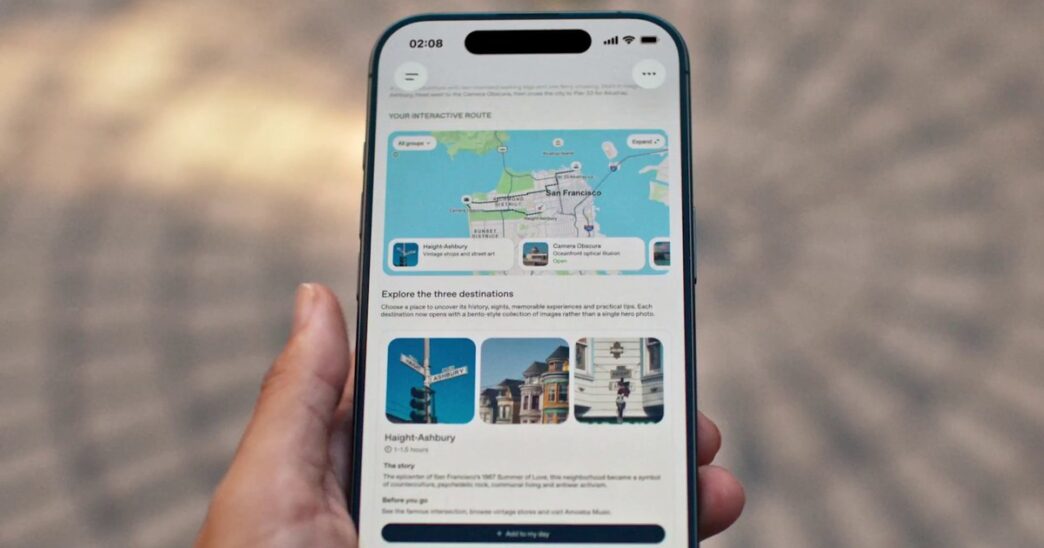
The feature OpenAI is leading with isn’t the model. It’s Intelligent UI, which lets GPT-6 answer with charts, tappable buttons, forms, maps and small interactive tools instead of only text. OpenAI’s examples include a dinner plan whose shopping list updates when you change the number of guests, a clickable breakdown of a seven-speed bicycle, a savings calculator and a bill splitter. When a plain answer is best, OpenAI says, ChatGPT still writes one.
Under the hood, OpenAI says it built a library of “native, streamable components” and a compiler that renders the interface while the model is still generating it, so the layout appears piece by piece. GPT-6 can also start answering before it has finished thinking. OpenAI says GPT-6 Instant begins answering questions that need a web search 44% sooner, on average, than GPT-5.6 Instant. As Tom’s Guide’s Amanda Caswell points out, that measures when the response starts, not when the full answer is done.
If you’d rather keep your answers plain, the help center says you can switch off Layout and visuals in Settings on the web, though some visual elements may still appear. The older ChatGPT desktop apps for macOS and Windows don’t support Intelligent UI at all; OpenAI tells those users to use the web version and to update their phone apps.
OpenAI’s help page still says GPT-5.6 Luna
If you’re on a free account and don’t see anything new, you’re not imagining it. The rollout is staged, and OpenAI says GPT-6 “may not be available for your account yet” if it’s missing from the model menu. Its own documentation hasn’t caught up, either. When we checked on the morning of October 9, the help center article on GPT-6 still said Free and Go users get GPT-5.6 Luna, including for the Think option, and that GPT-5.6 Luna “is becoming the default.” Notebookcheck flagged the same contradiction on October 8.
That matters for limits too. The help page says Free and Go accounts have unlimited everyday text chats, subject to abuse-prevention safeguards, with separate caps on file uploads, image generation, voice and data analysis. Those lines were written around GPT-5.6 Luna. We couldn’t find any GPT-6-specific limits for free accounts from OpenAI.
What OpenAI hasn’t shown yet
The October 7 post doesn’t include a single published benchmark comparing the free-tier GPT-6 Luna in ChatGPT with the GPT-5.6 Luna it replaces. Its performance claims come from internal evaluations, such as a test of “high-value, everyday agentic tasks” in which OpenAI says GPT-6 at Extra High beat GPT-5.6 at Extra High while starting to answer as quickly as GPT-5.6 at Medium. OpenAI also says GPT-6 resists jailbreak attempts better, particularly ones that build over several turns, and points to its system card for the results.
The next things to watch are concrete. OpenAI needs to update its help page and say what free accounts can actually do with GPT-6 each day. Google, meanwhile, still hasn’t dated a public release for Gemini 4 Argon, its new frontier model, which is limited for now to trusted cyber defenders and testers in its Fairwind program. Until then, the contrast is stark: OpenAI is moving free users onto its newest model family, and Google is moving its free users onto its lightest one.
Frequently asked questions
Is GPT-6 free to use in ChatGPT?
Yes, but not the full version. Free and Go accounts get GPT-6 Luna in the Chat tab, rolling out from October 8, while paid plans get GPT-6 Sol. The rollout is gradual, so some free accounts may not see GPT-6 yet.
What’s the difference between GPT-6 Sol and GPT-6 Luna?
Sol is the more capable model OpenAI gives to Plus, Pro, Business and Enterprise users. Luna is OpenAI’s most efficient GPT-6 model, and in the API it costs $0.10 per million input tokens against Sol’s $2. OpenAI says both are tuned for everyday conversation in ChatGPT.
How do I turn off Intelligent UI?
On ChatGPT on the web, open Settings and turn off Layout and visuals. OpenAI says this reduces visual elements but doesn’t switch ChatGPT to a text-only mode, so some visuals may still appear.
Why don’t I see GPT-6 in ChatGPT?
OpenAI is rolling it out in stages and says it may not be available for your account yet. Intelligent UI also needs ChatGPT on the web or an updated mobile app; the older macOS and Windows desktop apps don’t support it.
Sources
All accessed October 9, 2026.
- OpenAI, “GPT-6 and Intelligent UI for everyone” (Oct 7, 2026): openai.com
- OpenAI, “Introducing GPT-6 Sol and Luna” (September 2026; API prices and benchmark figures): openai.com
- OpenAI Help Center, “GPT-6 and other models in ChatGPT” (checked Oct 9, 2026): help.openai.com
- OpenAI API docs, GPT-6 Luna model page and pricing: developers.openai.com
- OpenAI on X, rollout announcement (Oct 7, 2026): x.com
- Notebookcheck, “ChatGPT Free and Go users start getting GPT-6 Luna in Chat” (Oct 8, 2026): notebookcheck.net
- Tom’s Guide, Amanda Caswell, “ChatGPT-6 just got a huge ‘interactive answers’ upgrade” (Oct 8, 2026): tomsguide.com
- 9to5Google, “Gemini limiting what models free & AI Plus users can access” (Oct 3, 2026): 9to5google.com
- Google, “Gemini 4 Argon: our next era of frontier intelligence” (Sep 30, 2026): blog.google
Related: What is a robot foundation model? · What is a vision-language-action model? · More LLM news
Last updated: October 9, 2026. To report an error, see our corrections page. Articles are drafted with AI assistance and reviewed and edited by an editor; see our editorial policy.