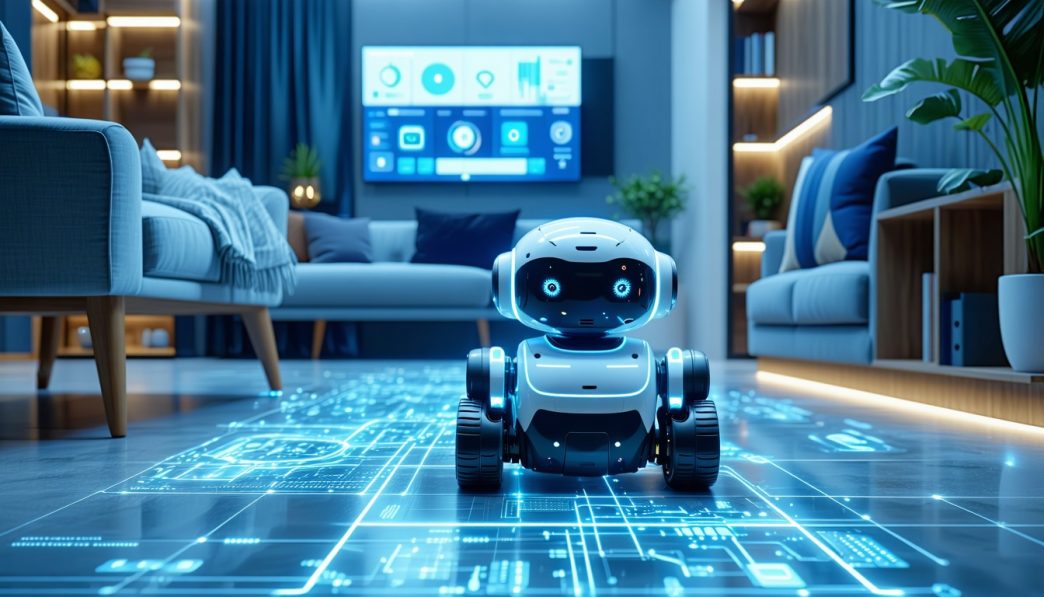
Understanding Indoor Navigation for Robots
Importance of Indoor Navigation
Indoor navigation is vital for the effective operation of robots within homes and buildings. Unlike outdoor environments, indoor spaces often present unique challenges, including variable layouts, furniture arrangements, and obstacles. A robot’s ability to navigate successfully can enhance tasks such as cleaning, delivering items, and providing assistance.
Ensuring efficient navigation not only improves a robot’s functionality but also contributes to user satisfaction. Robots employing sophisticated navigation systems are more likely to perform reliably and safely, making them valuable assets in everyday life. The integration of advanced sensors and algorithms is crucial for achieving proficient indoor navigation. For a comprehensive overview of how various technologies contribute to this purpose, refer to our article on robot sensors and navigation.
How Robots “See” and Navigate
Robots utilize a combination of sensing technologies to “see” their environment and navigate effectively. This involves interpreting data from various sensors to understand their surroundings. Common methods include: 
-
Lidar Sensors – Lidar (Light Detection and Ranging) sensors generate precise 3D maps of the area by emitting laser beams and measuring the time taken for them to return after hitting an obstacle. This technology provides detailed spatial data, allowing robots to navigate accurately.
-
Camera Systems – Cameras help robots perceive color, texture, and shapes. They can recognize various objects and assess the environment visually. When combined with image processing algorithms, camera systems can significantly enhance a robot’s ability to navigate.
-
Ultrasonic Sensors – These sensors emit sound waves and measure their reflection time to detect nearby objects. They are commonly used for short-range obstacle detection and can help robots avoid collisions.
-
Infrared Sensors – Infrared sensors work similarly to ultrasonic sensors but use infrared light to detect obstacles. They can be effective in low-light conditions, allowing robots to navigate safely even in the dark.
Below is a table summarizing the key features and applications of these sensor types:
| Sensor Type | Functionality | Common Uses |
|---|---|---|
| Lidar | 3D mapping | Autonomous navigation |
| Camera | Image recognition | Object detection and classification |
| Ultrasonic | Distance measurement | Obstacle avoidance |
| Infrared | Low-light detection | Navigation in dim environments |
By employing these sensing technologies, robots can effectively create maps, detect obstacles, and plan their movements within indoor settings. The integration of these capabilities leads to improved efficiency, safety, and functionality in a variety of robotic applications. For more information on how robots map their environments, visit the article on slam mapping for robots.
Sensor Technologies for Robotics
Indoor navigation for robots relies heavily on various sensor technologies. These sensors enable robots to perceive their surroundings, map spaces, and navigate safely within homes and buildings. Here, we will delve into four common sensor types used in robotics: Lidar sensors, camera systems, ultrasonic sensors, and infrared sensors.
Lidar Sensors
Lidar (Light Detection and Ranging) sensors use laser light to measure distances. By emitting laser beams and analyzing how long it takes for the light to bounce back, Lidar creates precise 3D maps of the environment. This is essential for robots to identify obstacles and navigate accurately.
| Feature | Details |
|---|---|
| Range | Up to 100 meters |
| Accuracy | ±2 cm |
| Update Rate | Up to 60 Hz |
Lidar sensors are particularly useful in environments where depth perception is critical. They create highly detailed maps, ideal for applications like warehouse logistics. For more comparisons between sensor types, take a look at our article on lidar vs camera based navigation.
Camera Systems
Camera systems use standard imaging technology to capture visual data. Robots equipped with cameras process images to recognize objects, detect colors, and follow visual cues. This sensor type is essential for tasks requiring visual identification.
| Feature | Details |
|---|---|
| Resolution | Up to 4K |
| Field of View | Typically 120° – 180° |
| Processing | Real-time image processing required |
Camera systems are versatile and can be used in various applications, from autonomous delivery robots to surveillance systems. They complement other sensors by providing image data that assists in navigation. For a deeper understanding of depth implications, refer to our article on depth perception in robots.
Ultrasonic Sensors
Ultrasonic sensors utilize sound waves to detect nearby objects. These sensors emit ultrasonic pulses and measure the time taken for the echo to return. Ultrasonic sensors are commonly used for obstacle detection due to their low cost and simplicity.
| Feature | Details |
|---|---|
| Range | Up to 4-5 meters |
| Frequency | 40 kHz |
| Accuracy | ±1 cm |
These sensors are effective for short-range detection, making them suitable for applications like robot vacuums, where navigating tight spaces is essential. For more information on how robots avoid obstacles, check out our article on robot obstacle detection and avoidance.
Infrared Sensors
Infrared sensors detect objects using infrared light. They can either be passive, measuring the heat emitted from objects, or active, emitting infrared light and detecting reflections. Infrared sensors are useful for close-range navigation and detecting temperature variations.
| Feature | Details |
|---|---|
| Range | Up to 1 meter |
| Types | Passive or active |
| Application | Proximity sensing and edge detection |
Infrared sensors are often employed for basic object detection and are found in many consumer robotics applications. They aid robots in avoiding obstacles in confined spaces or near dangerous edges.
Each sensor type plays a unique role in enabling robots to navigate indoor environments effectively. By leveraging these technologies, robots can enhance their capabilities and improve their safety when moving within buildings. For further insights into how multiple sensors can work together, explore our article on multi sensor fusion in robots.
Development of Robot Mapping Systems
In the realm of indoor navigation for robots, effective mapping systems play a critical role. These systems allow robots to understand their environment and navigate safely within it. Two pivotal components in this development are Simultaneous Localization and Mapping (SLAM) and the processes involved in building and updating maps.
Simultaneous Localization and Mapping (SLAM)
SLAM is a sophisticated technique that enables robots to create maps of unknown environments while simultaneously keeping track of their own locations within that environment. This process is essential for ensuring accurate navigation and obstacle avoidance.
Robots equipped with SLAM technology use various sensors to collect data about their surroundings, such as distances to obstacles and spatial information. The information gathered is processed to update the robot’s position and refine the map in real-time.
The benefits of using SLAM include:
- Increased Autonomy: Robots can navigate complex indoor environments without pre-existing maps.
- Adaptability: The map continuously updates as the robot moves, allowing for changes in the environment to be accounted for.
- Efficiency: SLAM minimizes the amount of data needed for navigation, streamlining the mapping process.
For a deeper dive into SLAM technology and its intricacies, check out our article on slam mapping for robots.
Building and Updating Maps
Creating and maintaining accurate maps is crucial for robot navigation. Various algorithms and techniques are employed to build these maps and ensure they are kept up to date.
| Mapping Process | Description |
|---|---|
| Initial Mapping | Robots gather data to construct a map of their surroundings using various sensors. This involves creating a spatial representation of obstacles, walls, and pathways. |
| Real-Time Updates | As robots navigate, they continuously update the map to reflect changes, such as newly introduced obstacles or changes in the layout. This allows for dynamic adaptation within the environment. |
| Data Correction | Algorithms are utilized to refine maps, correcting any discrepancies that may arise as the robot moves, such as correcting drift in localization. |
The ability to build and update maps efficiently is vital for the effective operation of various robotics applications, including robot vacuums and delivery robots. Ensuring that a robot has an accurate representation of its surroundings directly impacts its ability to accomplish tasks effectively.
For more on navigation technologies, visit our article on robot sensors and navigation.
Path Planning Algorithms
Path planning is a critical component of indoor navigation for robots. It enables robots to determine the most efficient route to their destination while avoiding obstacles. Various algorithms are employed for path planning, each with unique characteristics and applications. This section discusses three commonly used algorithms: A* Algorithm, Dijkstra’s Algorithm, and Potential Fields Algorithm.
A* Algorithm
The A* Algorithm is a popular choice for many robotics applications because it efficiently finds the shortest path from a starting point to a target location. This algorithm combines the benefits of both Dijkstra’s Algorithm and a heuristic approach, which estimates the cost to reach the goal.
The A* Algorithm evaluates paths based on two factors: the cost to reach the current node and the estimated cost to get to the end. This combination allows the algorithm to prioritize paths that are promising while avoiding less efficient routes.
| Feature | A* Algorithm |
|---|---|
| Type | Graph-based |
| Cost Evaluation | Combines actual distance and heuristic |
| Performance | Efficient for large maps |
| Common Use | Robot navigation, games |
Dijkstra’s Algorithm
Dijkstra’s Algorithm is another widely used method for finding the shortest path in a graph. This algorithm examines all possible paths and selects the one with the lowest cost. Unlike the A* Algorithm, Dijkstra’s does not utilize heuristics. It systematically explores all paths, which can lead to longer computation times for complex environments.
While Dijkstra’s Algorithm guarantees the shortest path, its performance can be hindered by larger or more complicated maps. However, its straightforward approach makes it suitable for simpler navigation tasks.
| Feature | Dijkstra’s Algorithm |
|---|---|
| Type | Graph-based |
| Cost Evaluation | Actual distance only |
| Performance | Slower for complex maps |
| Common Use | Simple pathfinding |
Potential Fields Algorithm
The Potential Fields Algorithm employs a different approach by creating a virtual “field” around the robot. Obstacles generate repulsive forces, while the target location generates an attractive force. The robot navigates by moving in response to these forces, creating a natural and fluid movement toward the target.
This algorithm is particularly effective in dynamic environments, as it allows the robot to adjust its path in real-time based on the presence of obstacles. However, creating local minima—situations where the robot gets stuck—can be a challenge, requiring additional mechanisms for resolving these issues.
| Feature | Potential Fields Algorithm |
|---|---|
| Type | Force-based |
| Cost Evaluation | Based on attractive/repulsive forces |
| Performance | Adapts well to dynamic environments |
| Common Use | Robot navigation and obstacle avoidance |
Understanding these path planning algorithms is essential for users interested in how robots navigate safely indoors. For a broader perspective on the technologies involved, refer to our article on robot sensors and navigation.
Challenges and Solutions in Robot Navigation
Navigating the complexities of indoor environments presents various challenges for robots. Understanding these obstacles and implementing effective solutions is essential for ensuring safe and efficient movement. This section discusses three primary challenges: obstacle avoidance, dynamic environment adaptation, and localization accuracy.
Obstacle Avoidance
Obstacle avoidance is a crucial aspect of indoor navigation for robots. Robots must detect and navigate around objects in their surroundings to prevent collisions. They utilize various sensor technologies to identify obstacles, including lidar and camera systems.
Different sensors provide varying levels of accuracy and responsiveness. For effective obstacle avoidance, robots may employ a combination of these sensors to create a comprehensive understanding of their environment.
| Sensor Type | Range (meters) | Accuracy | Advantages |
|---|---|---|---|
| Lidar | Up to 100 | ±2 cm | High precision, 360-degree coverage |
| Camera | Varies | Varies | Visual perception, can recognize objects |
| Ultrasonic | Up to 4 | ±3 cm | Cost-effective, simple implementation |
| Infrared | Up to 10 | ±5 cm | Effective in close-range detection |
For further exploration of how robots detect barriers, consult our article on robot obstacle detection and avoidance.
Dynamic Environment Adaptation
Indoor environments are often dynamic, with changing layouts due to varying furniture arrangements or moving people. Robots need to adapt their navigation strategies in real time to accommodate these changes. They often incorporate algorithms that allow them to continually assess their surroundings.
Robots use methods such as SLAM, which combines sensor data to both map environments and track their position within them. This capability enables robots to create and update maps as they encounter new obstacles or changes in their environment.
| Feature | Description |
|---|---|
| Real-time Mapping | Continuously updates surroundings |
| Environmental Awareness | Adapts to moving objects and people |
| Sensor Fusion | Combines data from multiple sensors |
For a deeper understanding of this mapping technique, refer to our article on slam mapping for robots.
Localization Accuracy
Localization is essential for robots to determine their precise location within an indoor space. Accurate localization ensures smooth navigation, allowing robots to conduct tasks without getting lost or straying from their intended paths. Various factors can impact localization accuracy, including signal interference and sensor limitations.
Robots typically integrate multiple sensors to enhance localization. This approach, known as multi-sensor fusion, enables better precision. Combining data from lidar, cameras, and other sensors provides a clearer picture of the robot’s position in relation to its surroundings.
| Localization Method | Accuracy | Suitable Environments |
|---|---|---|
| GPS | High (outdoors) | Outdoor navigation for robots |
| Visual-Inertial | Moderate to High | Indoor navigation with lighting |
| Lidar-based Localization | High | Structured environments |
For information on how different sensors work together for navigation, see our article on multi sensor fusion in robots.
Addressing the challenges of obstacle avoidance, dynamic adaptation, and localization accuracy is vital for improving indoor navigation capabilities in robots. As technology advances, these solutions will continue to evolve, providing smarter and more capable robotic systems.
Application of Indoor Navigation in Various Robots
Indoor navigation is a crucial aspect of how various robots operate within homes and buildings. Different robots utilize unique navigation systems and sensor technologies to move efficiently and safely in their environments. This section explores the applications of indoor navigation in robot vacuums, humanoid robots, and delivery robots.
Robot Vacuums
Robot vacuums are among the most widely recognized smart home devices. They rely on advanced indoor navigation systems to effectively clean floors without human intervention. Equipped with sensors such as Lidar, cameras, and ultrasonic sensors, these robots can create detailed maps of their cleaning areas.
| Feature | Description |
|---|---|
| Mapping Technology | Uses SLAM for real-time mapping |
| Navigation Type | Autonomous with obstacle detection |
| Maintenance | Returns to charging station when needed |
Robot vacuums typically utilize techniques such as SLAM mapping for robots to navigate and update their maps as they clean. This allows them to adapt to changes in the environment, such as moving furniture.
Humanoid Robots
Humanoid robots are designed to mimic human behavior and movement, making them suited for various domestic tasks. These robots use sophisticated sensor systems for indoor navigation, which enables them to interact with their surroundings safely and effectively.
| Feature | Description |
|---|---|
| Interaction | Uses cameras for face and gesture recognition |
| Mobility | Advanced path planning algorithms for movement |
| Sensors | Combination of Lidar and infrared for depth perception |
Humanoid robots often leverage depth perception in robots to understand their environment, allowing them to navigate complex indoor spaces. This capability enables them to avoid obstacles and engage with humans more naturally.
Delivery Robots
With the rise of e-commerce and food delivery services, delivery robots are becoming increasingly commonplace. These robots require efficient indoor navigation systems to move from one destination to another within buildings.
| Feature | Description |
|---|---|
| Loading Capacity | Varies by design, tailored for specific tasks |
| Navigation Approach | Uses multi-sensor fusion for accuracy |
| Deployment | Capable of navigating crowded areas |
Delivery robots utilize a combination of sensors and navigation strategies to traverse indoor environments seamlessly. They often face challenges related to dynamic environments, requiring advanced solutions for robot obstacle detection and avoidance.
Robots employed for various indoor tasks depend heavily on robust navigation systems to perform their functions efficiently. As technology advances, the capabilities of indoor navigation for robots will continue to evolve, enabling more complex interactions and operations within human spaces. For further insights into the future of robotics in navigation, explore our article on future of robotic navigation.
Future Innovations in Indoor Navigation
As robotic technology continues to evolve, there are several innovations on the horizon that will significantly enhance indoor navigation for robots. Two of the most noteworthy developments include the integration of artificial intelligence (AI) for smarter navigation and the implementation of multi-robot collaboration systems.
Integration of AI for Smart Navigation
Artificial intelligence plays a crucial role in transforming how robots navigate indoor environments. By incorporating AI algorithms, robots can analyze data from various sources—such as sensor inputs and environmental maps—to make informed decisions in real-time. This enables them to better understand their surroundings, predict obstacles, and improve their overall navigation efficiency.
There are several benefits to integrating AI into robotic navigation systems:
| Advantage | Description |
|---|---|
| Enhanced Decision-Making | AI algorithms enable robots to process complex data, making smarter navigation choices. |
| Real-Time Adaptation | Robots can learn from previous experiences, adapting to dynamic environments as they operate. |
| Improved Localization | AI enhances the accuracy of localization techniques, leading to better navigation performance. |
Various AI techniques, such as machine learning and deep learning, can be utilized to refine the way robots “see” and interpret their environment. For instance, a robot using lidar vs camera-based navigation can improve its depth perception through AI, leading to better spatial awareness and obstacle detection.
Multi-Robot Collaboration Systems
The future of indoor navigation will also see a rise in multi-robot collaboration systems. In these setups, multiple robots work together to complete tasks more efficiently and safely. By sharing information and coordinating their movements, these robots can navigate complex indoor spaces with a higher degree of accuracy than a single robot operating alone.
Key features of multi-robot systems include:
| Feature | Description |
|---|---|
| Cooperative Mapping | Robots can collectively create and update maps using SLAM mapping for robots. |
| Distributed Task Management | Tasks can be allocated among robots, improving efficiency and reducing operational time. |
| Enhanced Obstacle Detection | Collaborative sensors improve obstacle detection and allow for better navigation in crowded environments. |
The integration of AI in multi-robot systems supports their ability to communicate effectively and coordinate actions, ensuring seamless indoor navigation. This approach can significantly enhance applications in sectors like smart homes, logistics, and healthcare, where multiple robots may be needed to operate within the same environment.
Advancements in indoor navigation for robots, including AI integration and multi-robot systems, are set to reshape how they move safely and effectively within buildings. These innovations promise to enhance user experiences and expand the capabilities of robotic applications, paving the way for smarter living spaces. For more on this topic, refer to our article on the future of robotic navigation.