Odyssey says its new Odyssey-3 world model sets a record score of 66.1 on Physics-IQ Verified, a test of whether an AI can predict what happens next in real physics experiments. That number comes from picking the best of eight tries for every question. Run the way the benchmark’s rules ask, four separate times, the same model scores 63.37.
The gap matters because Odyssey-3 isn’t being pitched as a video toy. The company says the same model can steer robot arms and a humanoid after tens of hours of demonstrations, which would make world models a cheaper route to robot skills than piling up task-specific data. The free public preview that opened this week can’t do any of that yet. Here’s what the claims rest on.
The Odyssey-3 world model demo builds worlds, not robot controllers
Odyssey, founded in 2023 by Oliver Cameron and Jeff Hawke, first showed Odyssey-3 on September 15 and opened a research preview on October 8, according to its launch post. The preview runs Odyssey-3 Flash, which turns a text prompt into an interactive environment you can walk through in first or third person, and The Decoder says it’s free to try. Odyssey calls the model an autoregressive diffusion transformer: it keeps generating the next video frames from what came before and the actions taken.
A “world model” in this sense predicts how a scene changes when something acts in it. For robotics, the hope is to use that learned physics either as a simulator or as a starting point for training a controller. Odyssey says developers do the second by training an action decoder, a small output layer, on paired observations and actions. Robot control isn’t part of the public preview. Odyssey asks robotics developers to get in touch.
The 66.1 is a best-of-eight run
Odyssey’s post says Odyssey-3 Pro “sets a new state of the art” on the video-to-video track of Physics-IQ Verified, “achieving 66.1, the highest reported score.” The footnote under its chart says: “Scores average 4 runs; best-of-8 uses 1 run with the same prompts.”
The leaderboard, run by Anates Labs with DeepMind, shows both Odyssey entries. The best-of-eight entry, picked by a rank-sum selector, scores 66.10 and lists no standard deviation. The four-run entry scores 63.37 with a spread of 0.63. According to The Decoder, the benchmark’s rules require four runs with a standard deviation for any record claim, so the 66.1 doesn’t meet that bar. Both entries were submitted by Odyssey.
The lead still holds like for like, just by less. Black Forest Labs’ FLUX 3 [large], the next-best entry from another company, scores 61.11 over four runs and 64.35 with its own best-of-eight selection. That puts Odyssey 2.26 points ahead on single runs and 1.75 ahead on best-of-eight. Black Forest Labs is also pitching its video model at robots; see our explainer on FLUX 3 Action and world action models. We read these figures from the leaderboard page’s embedded data on October 11, and they may move.
FLUX 3 holds its own on image-to-video
Odyssey’s post also says Pro “scores 54.7 in image-to-video.” On the leaderboard, FLUX 3 [large] has 54.70 at best-of-eight, to Odyssey Pro’s 54.69. On four-run averages FLUX is ahead, 51.11 to 49.99. In short, the record claim is for one track and one selection method.
Physics-IQ also measures video, not robots. Odyssey’s own post says its separate WorldMark results “measure specific properties of generated worlds; applying the model to a physical system also requires evaluating the behaviors that matter for that machine and its tasks.” A model that continues a video of a rolling ball well can still drop a mug.
The robot claims come without success rates
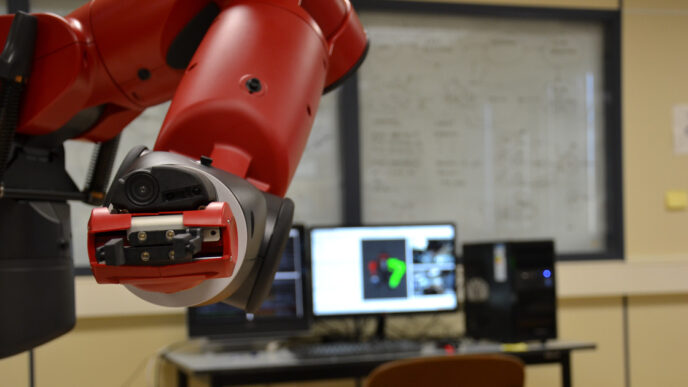
This is where the robotics promise sits, and where the evidence is thinnest. Odyssey says that with “only tens of hours of robot demonstrations” the model completed manipulation tasks, including tasks titled “Pour the cereal into the bowl” and “Close the screwbox,” and recovered from a missed grasp by reorienting the gripper. The post shows clips. It doesn’t give trial counts, success rates, the robot models used or baseline comparisons.
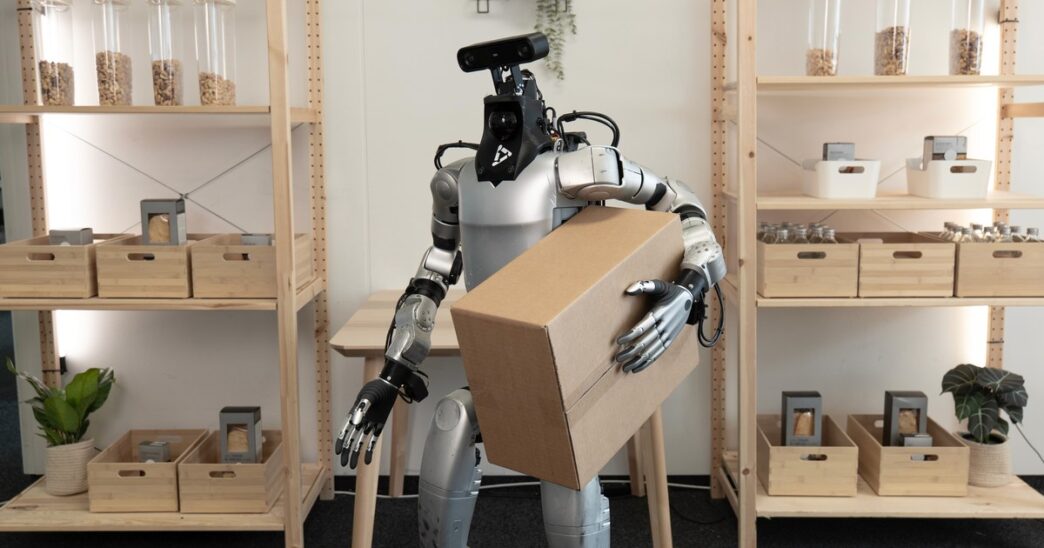
The humanoid claim comes through Flexion, a Swiss robotics company. Odyssey’s September 15 post says Flexion built humanoid control policies on Odyssey-3 with tens of hours of teleoperation data, and that they “generalize better to environmental changes than the VLA baselines tested,” continuing under lighting changes that made the baselines fail. It doesn’t name the baselines or give numbers. Flexion co-founder and CEO Nikita Rudin is quoted in that post saying what excites the company is “the opportunity to build on physical knowledge acquired far beyond a robot’s own demonstrations.”
Compare that with how Flexion reports its own system. In its June 29 Reflect v1.0 post, Flexion says a mission controller reached 90% end-to-end completion on a 16-step evaluation after reinforcement learning, up from 38% with supervised fine-tuning. Those are Flexion’s claims about a different system, but they show what a number looks like. Odyssey’s drone policy was trained on simulated flight data, and the launch pages we read link a paper for a sibling project, PROWL-2, and a technical report for Starchild-1, but no paper or report for Odyssey-3 itself. For background on how robot policies are usually built, see our guides to vision-language-action models, robot foundation models and humanoid training data.
What to watch: whether Odyssey publishes trial counts and baselines for the arm and humanoid results, and whether anyone besides Odyssey and Flexion tests it on a robot. Until then, “world models can train robots” is a promising idea with a record score on a video test behind it, not a proven result.
Frequently asked questions
What is a world model?
A world model is an AI system that predicts how a scene changes over time, including in response to actions. Odyssey-3 does this by generating video frames, and developers can attach an action decoder so the same model’s learned physics drives a robot, car or game character.
Can I try Odyssey-3?
Yes, in part. Odyssey opened a research preview on October 8 that runs Odyssey-3 Flash, and The Decoder says it’s free. It generates interactive environments from text. The Pro model and robot control aren’t in the preview; developers can apply for API access or contact Odyssey.
What does Odyssey-3’s 66.1 Physics-IQ score mean?
Physics-IQ Verified asks models to continue videos of real physics experiments and compares the result with what actually happened. 66.1 is the highest figure on the video-to-video leaderboard, but it’s a single run that picks the best of eight generations per prompt. Odyssey-3 Pro’s four-run average is 63.37.
Has Odyssey-3 been tested on real robots?
Odyssey says so for robot arms and for a Flexion humanoid, using tens of hours of demonstrations. It shows video clips but has not published success rates, trial counts or the baseline models. Its drone policy was trained on simulated flight data.
How is Odyssey-3 different from a vision-language-action model?
A VLA model maps camera images and an instruction straight to robot actions. Odyssey-3 is trained first as a world model that predicts video, and a smaller action decoder is trained on robot data afterward. Odyssey says Flexion’s policies built this way held up better than the VLA baselines it tested.
Sources
All accessed October 11, 2026.
- Oliver Cameron and Jeff Hawke, “Meet Odyssey-3: Our Most Powerful Foundation World Model,” Odyssey (October 8, 2026): odyssey.systems
- Oliver Cameron and Jeff Hawke, “Introducing Odyssey-3: A General-Purpose Physical Intelligence,” Odyssey (September 15, 2026): odyssey.systems
- Physics-IQ Verified leaderboard, Anates Labs with DeepMind (V2V and I2V entries for Odyssey-3 Pro and FLUX 3 [large]): physics-iq-verified.anates.ai
- Tomislav Bezmalinović, “Odyssey-3 is a new generative world model that you can try for free,” The Decoder (October 11, 2026): the-decoder.com
- Flexion, “Flexion Reflect v1.0 – The Path Towards Long-Horizon Autonomous Humanoid Work” (June 29, 2026): flexion.ai
Related: What is a robot foundation model? · What is a vision-language-action model? · More embodied AI
Last updated: October 11, 2026. To report an error, see our corrections page. Articles are drafted with AI assistance and reviewed and edited by an editor; see our editorial policy.